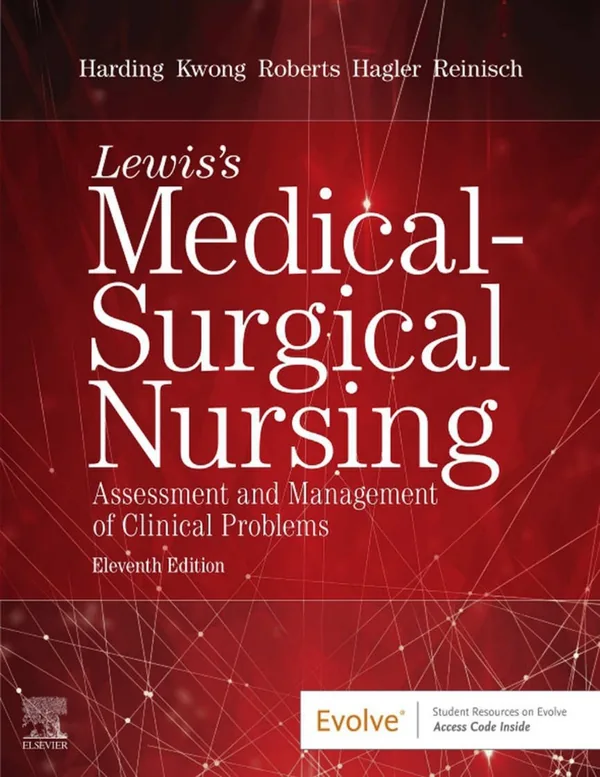
Lewis's Medical-Surgical Nursing examines adult health assessment and nursing management across major body systems. The eleventh edition brings pathophysiology, treatment, clinical reasoning, and collaborative care together for prelicensure students, with coverage extending from health promotion and acute illness to chronic disease, community care, and end-of-life concerns.
Inside this title
Connects adult disorders with assessment and nursing management
Current listed price $36.99Regular price $118.00Digital ebook
Adult health problems are considered through the nursing process: assessment, diagnosis, planning, implementation, and evaluation. The text connects body-system disorders with underlying pathophysiology, diagnostic information, and pharmacological or nonpharmacological treatment, giving students a framework for studying the care of adults with varied clinical needs.
Clinical scenarios relate concepts such as comfort, mobility, oxygenation, and perfusion to patient situations. Coverage includes perioperative and critical care, prevention and screening, chronic illness, and transitions from hospital to ambulatory or home settings. Cultural considerations, advocacy, and interprofessional collaboration run through the nursing perspective. The eleventh edition supports medical-surgical coursework and review of the relationships among assessment findings, treatment, and nursing priorities.
Study guide included
Inside Lewis's Medical-Surgical Nursing: Assessment and Management of Clinical Problems, 11th Edition.
This guide follows the nursing process through adult health, pairing pathophysiology with assessment, priority setting and evaluation. Each section is read as a chain: establish a baseline, notice change, choose a response, then verify whether the plan still suits what the patient wants and the circumstances at hand.
Early chapters set out professional practice, fairness, assessment and instruction. Later sections address comfort and protection, care around surgery, then systems behind breathing, circulation, digestion, waste removal, hormonal control and movement. Closing chapters carry that logic into critical care and emergencies. Each disorder chapter follows a similar rhythm: normal function, then altered function, then the assessment findings, tests and treatments a nurse must anticipate. Collaborative care and patient teaching receive attention throughout, and the final chapters tighten the pace for unstable patients, where priorities and handoffs matter most. A repeating structure connects signs, tests, treatments and nursing duties, so readers build reasoning rather than memorizing isolated disorder summaries.
Building baselines and clinical judgment
A history gathers symptoms, goals, earlier experience and social circumstances; examination adds measured and observed data through inspection, auscultation and related techniques. What the patient reports and what the clinician measures answer separate questions yet reinforce one another, and trends emerge only if the baseline and the observing conditions are written down. The opening chapters also describe four roles: clinician, advocate, teacher and coordinator.
Log the report and the reading apart
Document the conditions behind a baseline
Let standards and preference shape the plan
Section One
Symptom relief, coping and defense
Distress, rest, discomfort, drug use and questions near the end of life all influence how someone functions and engages with care. Assessment covers suffering, earlier attempts, what caregivers need and personal preference, while palliative principles make relief and everyday comfort part of the plan. Inflammation, healing, infection, immunity and cancer tie host defense to risk, and one treatment can solve a problem while creating another to watch.
Ask what a pain score actually means
Include caregiver capacity in the plan
Interpret fluid shifts as regulation
Sections Two–Three
Surgical phases and handoff safety
Preoperative work assembles history, risk, preparation and teaching, confirming identity, procedure, records and what the patient understands. Baseline findings, weaknesses and any communication requirements should travel along with the patient. Intraoperative care stresses safety and monitoring, while postoperative assessment reads breathing, circulation, comfort, alertness and wound recovery against that baseline. An unexpected change demands prompt reporting, written follow-up and a scheduled recheck.
Carry baseline findings into every phase
Judge healing against the usual trajectory
Name who reassesses after transfer
Section Four
Breathing, oxygen carriage, tissue flow
Pulmonary assessment ties symptoms, lung sounds, breathing effort and diagnostics to ventilation and exchange. Hematology adds the cellular side of oxygen carriage, and cardiac assessment shows how blood reaches tissue. Viewed as a set, these chapters clarify why comparable complaints can arise from unlike mechanisms. Management chapters then connect disease to tests, drugs, procedures and the surveillance nurses perform, with trends mattering more than single readings.
Identify which step an observation measures
Link therapy to the response being watched
Use trends to catch instability early
Sections Six–Eight
Organ control, elimination, daily function
The text moves from usual findings and system review into disorders of digestion, urine output, hormonal and reproductive control, and movement, with chapters on the senses and skin adding observation and protection. Long-term management depends on routines, family help, follow-up and service access. Functional review examines how symptoms or treatment alter mobility, self-care, eating, communication and safety, and teaching is judged by what someone can actually manage at home.
Match normal mechanism to illness effects
Check barriers behind a stated plan
Evaluate by what happens at home
Sections Five, Nine–Twelve
Critical care and rapid escalation
Acute and emergency chapters run the same assessment routine under sharper time limits. Teams sort urgent dangers from matters that can be deferred and revisit priorities as evidence arrives, since monitoring helps only when a finding is tied to this patient and the direction of change. Nurses spot decline, brief coworkers, record reactions and support patients and caregivers, all through clear handoffs.
Rank threats, then revisit the ranking
Give a concise, reasoned escalation
Assign the next assessment explicitly
Section Thirteen
Chapter and section map
Concepts in Nursing PracticeSection One
Comfort, Coping, Homeostasis and ProtectionSections Two–Three
Perioperative CareSection Four
Ventilation, Transport and PerfusionSections Six–Eight
Ingestion, Digestion and EliminationSection Nine
Urinary, Regulatory and Reproductive FunctionSections Ten–Eleven
Movement and CoordinationSection Twelve
Care in Specialized SettingsSection Thirteen
Key takeaways
Begin from the usual state and its direction, then read each finding through physiology, therapy and what the patient reports.
Let every transfer state what must be watched next, who owns it and how to escalate.
Judge teaching by what someone can really carry out and by the obstacles that remain.
Prelicensure nursing students in medical-surgical courses, and new nurses who want a structured way to connect pathophysiology, assessment priorities and coordinated bedside care across acute, chronic and critical settings.
Topics covered
medical-surgical nursing
clinical judgment
patient assessment
perioperative care
care transitions
chronic disease management
critical care
patient teaching
Other editions of this title.
Compare editions, prices, and book details before you choose.
Edition, audience, and study-guide details at a glance.
What is Lewis's Medical-Surgical Nursing: Assessment and Management of Clinical Problems, 11th Edition about?
Lewis's Medical-Surgical Nursing examines adult health assessment and nursing management across major body systems. The eleventh edition brings pathophysiology, treatment, clinical reasoning, and collaborative care together for prelicensure students, with coverage extending from health promotion and acute illness to chronic disease, community care, and end-of-life concerns.
Which edition of Lewis's Medical-Surgical Nursing: Assessment and Management of Clinical Problems, 11th Edition is this?
This listing is for the 11th edition. Check the title, ISBN, and book details above before ordering, especially if your course or reading list names a specific edition.
Who is Lewis's Medical-Surgical Nursing: Assessment and Management of Clinical Problems, 11th Edition for?
Prelicensure nursing students in medical-surgical courses, and new nurses who want a structured way to connect pathophysiology, assessment priorities and coordinated bedside care across acute, chronic and critical settings.
Does this page include a study guide?
Yes. This page includes an original study guide with six thematic sections, key takeaways, and a chapter and section map for structured reading.