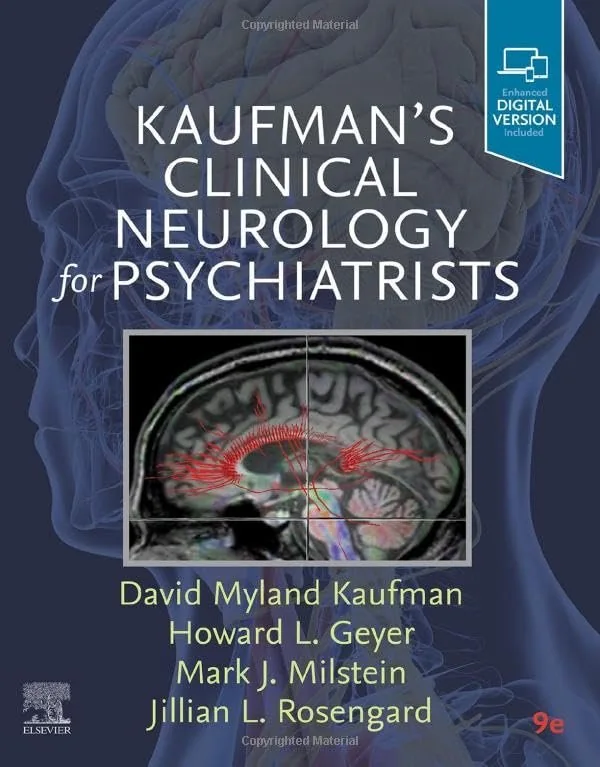
Kaufman's Clinical Neurology for Psychiatrists, 9th Edition
By David Myland Kaufman, Howard L. Geyer, Mark J. Milstein, Jillian L. Rosengard
About this ebook
Kaufman's Clinical Neurology for Psychiatrists, Ninth Edition, examines neurological conditions relevant to psychiatric assessment and board study. Written for psychiatry residents and mental health clinicians, it combines neuroanatomy and examination methods with coverage of seizures, cognitive impairment, movement disorders, stroke, and other disorders that can overlap with psychiatric presentations.
Inside this title
Neurological examination and neuroanatomy linked to psychiatric presentations
Current listed price $38.99Regular price $103.00Digital ebook
The text approaches neurology through the questions psychiatrists encounter when evaluating changes in cognition, mood, behavior, and movement. It links brain and spinal cord anatomy with the neurological examination, then examines disease categories and their psychiatric implications. Illustrations and multiple-choice questions support review alongside the explanatory chapters.
Topics include epilepsy and nonepileptic events, headache syndromes, dementia, Parkinsonian disorders, drug-induced movements, and cerebrovascular disease. Inflammatory conditions such as multiple sclerosis and autoimmune encephalitis extend the discussion of neurological differential diagnosis. The ninth edition offers a focused course of study for psychiatry trainees, with material that can also interest psychiatric nurse practitioners and clinicians revisiting neurological foundations.
Study guide included
Inside Kaufman's Clinical Neurology for Psychiatrists, 9th Edition.
Psychiatrists meet neurological disease through changes in thinking, mood, movement and behavior. Kaufman's text starts from that clinical vantage point, pairing neuroanatomy and examination technique with the disorders most likely to complicate a psychiatric assessment, and closes each area with review questions built for board preparation.
The book is organized around the questions a psychiatrist asks when a presentation does not fit a purely psychiatric explanation. Anatomy and the neurological examination come first, establishing the vocabulary for localizing a problem. Disease categories follow: seizures and nonepileptic events, headache, dementia, parkinsonian and drug-induced movement disorders, stroke, and inflammatory conditions such as multiple sclerosis and autoimmune encephalitis. Illustrations carry the spatial and diagnostic content, while multiple-choice items convert each section into review material. The ninth edition keeps the focus on practical differential reasoning for trainees and clinicians returning to neurological foundations.
Neuroanatomy tied to clinical signs
Anatomy is presented for use at the bedside, not as a separate memorization exercise. Tracts, nuclei and cortical regions are introduced in relation to the deficits their damage produces, so a finding on examination can be traced back to a plausible site. This linking of structure to sign is the book's organizing habit and recurs in later disease chapters.
Structure is taught through the deficits it causes
Tracts and nuclei are linked to signs
Localization organizes the differential
Topic 1
The examination as a localizing tool
The neurological examination is treated as a sequence of questions rather than a ritual. Each component is explained for what it can and cannot establish, and the text notes where psychiatric symptoms may mimic or obscure a neurological finding. Mental status, cranial nerves, motor and sensory testing, and coordination connect back to the opening anatomy.
Each test answers a specific question
Psychiatric symptoms can obscure findings
Examination narrows the anatomical site
Topic 2
Seizures and nonepileptic events
Epilepsy is considered together with the events that resemble it, because the distinction is a common source of misdiagnosis. The book discusses seizure types, the role of history and description, EEG and imaging, and the psychiatric conditions that accompany epilepsy. Nonepileptic attacks receive their own attention, reflecting how often they reach psychiatric services first.
History and witnessed description carry diagnostic weight
EEG and imaging support but do not replace description
Nonepileptic events are a genuine differential
Topic 3
Cognitive decline and dementia
Dementia coverage moves from recognition of cognitive change to the differentiation of causes. The text separates major degenerative patterns from reversible or secondary contributors, and it addresses behavioral and psychiatric features that bring patients to mental health care. Assessment tools and cognitive testing are placed alongside the clinical description, so decline can be documented rather than merely suspected.
Recognize change before assigning a cause
Separate degenerative from secondary contributors
Document decline with testing rather than impression
Topic 4
Movement disorders and drug effects
Parkinsonian syndromes, tremor, chorea and dystonia are described with attention to the medications that can produce or worsen them. Because antipsychotics and other psychotropics may cause movement abnormalities, the chapter is directly relevant to prescribing. The book distinguishes underlying disease from drug-induced syndromes and considers adjusting treatment when the two overlap.
Distinguish disease from medication effect
Psychotropics can produce movement syndromes
Treatment adjustment depends on the distinction
Topic 5
Headache, stroke and inflammation
Headache syndromes, cerebrovascular disease and inflammatory conditions broaden the differential. The text covers warning features that separate primary headache from secondary causes, the neurological consequences of stroke, and disorders such as multiple sclerosis and autoimmune encephalitis where psychiatric and neurological symptoms interlace. Imaging and laboratory findings are presented as part of the reasoning rather than as isolated results.
Warning features separate primary from secondary headache
Stroke can present through behavior and cognition
Autoimmune disease blurs neurological and psychiatric categories
Topics 6–8
Topic map
Neuroanatomy for Clinical PracticeTopic 1
The Neurological ExaminationTopic 2
Seizures and Nonepileptic EventsTopic 3
Cognitive Impairment and DementiaTopic 4
Movement Disorders and Medication EffectsTopic 5
Headache SyndromesTopic 6
Stroke and Cerebrovascular DiseaseTopic 7
Inflammatory and Autoimmune NeurologyTopic 8
Key takeaways
Localize before labeling; the examination exists to narrow the site of the problem.
Nonepileptic events and drug-induced movement problems belong to psychiatric practice, not outside it.
Use the review questions to test whether anatomy and disease categories stay connected.
Psychiatry residents preparing for board examinations, psychiatric nurse practitioners, and practicing clinicians who want a structured refresher on neurological assessment and differential diagnosis in daily practice.
Topics covered
clinical neurology
psychiatric assessment
neurological examination
seizures and epilepsy
movement disorders
neuroanatomy for psychiatrists
neurology board review
autoimmune encephalitis
Questions about this ebook.
Edition, audience, and study-guide details at a glance.
What is Kaufman's Clinical Neurology for Psychiatrists, 9th Edition about?
Kaufman's Clinical Neurology for Psychiatrists, Ninth Edition, examines neurological conditions relevant to psychiatric assessment and board study. Written for psychiatry residents and mental health clinicians, it combines neuroanatomy and examination methods with coverage of seizures, cognitive impairment, movement disorders, stroke, and other disorders that can overlap with psychiatric presentations.
Which edition of Kaufman's Clinical Neurology for Psychiatrists, 9th Edition is this?
This listing is for the 9th edition. Check the title, ISBN, and book details above before ordering, especially if your course or reading list names a specific edition.
Who is Kaufman's Clinical Neurology for Psychiatrists, 9th Edition for?
Psychiatry residents preparing for board examinations, psychiatric nurse practitioners, and practicing clinicians who want a structured refresher on neurological assessment and differential diagnosis in daily practice.
Does this page include a study guide?
Yes. This page includes an original study guide with six thematic sections, key takeaways, and a topic map for structured reading.