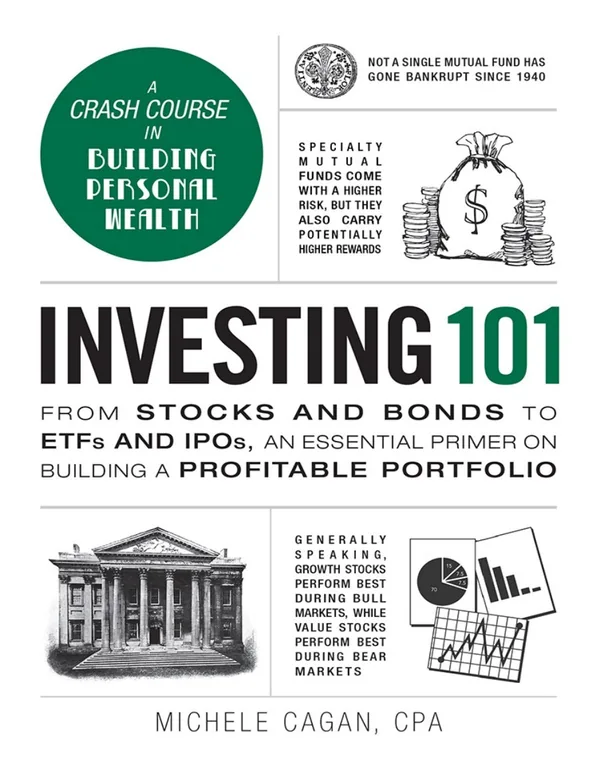
Investing 101 introduces common investments and the decisions involved in assembling a portfolio. Michele Cagan explains stocks, bonds, mutual funds, ETFs, and initial public offerings for beginners, connecting the characteristics of each with risk tolerance, diversification, financial goals, and the monitoring of a long-term investment plan.
Inside this title
Stock ownership, dividends, bonds, and fixed-income investment concepts
Current listed price $7.00Regular price $11.00Digital ebook
Michele Cagan presents investment terminology through the main types of assets and pooled funds available to individual investors. Stocks introduce ownership and dividends, bonds illustrate fixed-income investing, and mutual funds and ETFs provide examples of portfolio-based products. Initial public offerings receive separate attention as another way companies enter public markets.
The discussion connects these instruments with risk tolerance, diversification, and the formulation of financial goals. It also considers following performance and adjusting a plan over time. Beginners, students developing financial literacy, and self-directed readers can use the book to compare investment categories and understand portfolio concepts as a basis for understanding the language and choices discussed in personal finance.
Study guide included
Inside Investing 101: From Stocks and Bonds to ETFs and IPOs, An Essential Primer on Building a Profitable Portfolio.
Michele Cagan introduces the instruments a new investor meets first and the decisions that hold a portfolio together. Stocks, bonds, ETFs, mutual funds and initial public offerings are described in plain terms, then linked to risk tolerance, diversification and financial goals. It is a vocabulary-building primer rather than a stock-picking manual.
The book works through asset categories one at a time. Stocks are presented through ownership and dividends, bonds through fixed-income payments, and pooled products through the logic of holding many securities at once. Initial public offerings are treated as a separate event in how companies reach public markets. Cagan then connects these instruments to the investor's own situation: how much risk a portfolio can carry, why diversification is discussed alongside return, and how goals and monitoring shape a long-term plan. Beginners and independent readers get a map of the choices rather than a single recommended path through them.
Stocks, ownership and dividends
Stocks are introduced through the idea of ownership and the dividends that can accompany it. The book treats a share as a claim on a business rather than a ticker symbol to be traded. That framing sets up later discussion of why equity investments behave differently from lending.
A share represents ownership in a company
Dividends are part of how stock returns can be described
Equity investing differs from lending to an organisation
Topic 1
Bonds and fixed-income investing
Bonds illustrate the lending side of investing, where an investor provides capital in exchange for scheduled payments. The book uses this to contrast fixed-income products with ownership-based ones. The distinction matters because the two categories expose an investor to different kinds of uncertainty.
Bonds represent a lending relationship
Fixed-income investments are described through scheduled payments
Lending and owning carry different kinds of uncertainty
Topic 2
Mutual funds and exchange-traded funds
Pooled investments are presented as a way to hold many securities through a single product. Mutual funds and ETFs give the book its clearest example of portfolio-based investing. The discussion explains why such products are described in terms of the collection they hold rather than one company.
Pooled products hold many securities at once
Mutual funds and ETFs are portfolio-based instruments
The collection matters more than any single holding
Topic 3
Initial public offerings
An initial public offering is treated as an event in how a company enters public markets. The book gives IPOs separate attention rather than folding them into the general stock discussion. Readers see that the process of becoming publicly traded has its own vocabulary and sequence.
An IPO marks a company's entry into public markets
Offering events have their own vocabulary and sequence
IPOs are distinct from ordinary share trading
Topic 4
Risk tolerance and diversification
Risk tolerance is framed as a property of the investor that sets limits on what a portfolio should attempt. Diversification is the response that spreads holdings rather than concentrating them. Together they explain why two investors with the same goal might still assemble different portfolios.
Risk tolerance describes how much uncertainty an investor can accept
Diversification spreads exposure instead of concentrating it
Portfolio choices follow from both goals and tolerance for risk
Topic 5
Goals, monitoring and the long-term plan
Financial goals give the portfolio a purpose, and monitoring checks whether it is still serving that purpose. The book treats investing as an ongoing plan rather than a one-time purchase. Performance is reviewed in relation to the plan, not in isolation from it.
Goals define what the portfolio is meant to achieve
Monitoring compares performance against the stated plan
Long-term investing involves review and adjustment over time
Topic 7
Topic map
Stock Ownership and DividendsTopic 1
Bonds and Fixed-Income InvestingTopic 2
Mutual Funds and Exchange-Traded FundsTopic 3
Initial Public Offerings and Public MarketsTopic 4
Risk ToleranceTopic 5
Diversification and Portfolio ConstructionTopic 6
Goal Setting and Performance ReviewTopic 7
Key takeaways
Each asset class carries a different source of return and a different kind of risk.
Risk tolerance sets the boundary within which a portfolio is planned.
A portfolio is reviewed against goals over time rather than assembled once and forgotten.
New investors, students building financial literacy, and independent readers who want the language of stocks, bonds, pooled funds and portfolio planning before making decisions.
Topics covered
Investing 101 Michele Cagan
beginner investing guide
stocks bonds ETFs IPOs
portfolio diversification
risk tolerance investing
mutual funds explained
long-term investing basics
initial public offerings
Questions about this ebook.
Edition, audience, and study-guide details at a glance.
What is Investing 101: From Stocks and Bonds to ETFs and IPOs, An Essential Primer on Building a Profitable Portfolio about?
Investing 101 introduces common investments and the decisions involved in assembling a portfolio. Michele Cagan explains stocks, bonds, mutual funds, ETFs, and initial public offerings for beginners, connecting the characteristics of each with risk tolerance, diversification, financial goals, and the monitoring of a long-term investment plan.
Who is Investing 101: From Stocks and Bonds to ETFs and IPOs, An Essential Primer on Building a Profitable Portfolio for?
New investors, students building financial literacy, and independent readers who want the language of stocks, bonds, pooled funds and portfolio planning before making decisions.
Does this page include a study guide?
Yes. This page includes an original study guide with six thematic sections, key takeaways, and a topic map for structured reading.