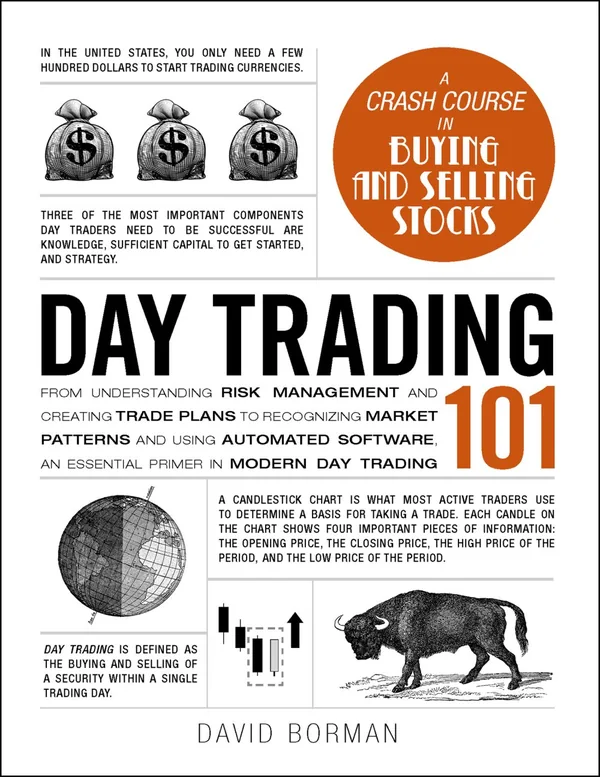
Day Trading 101 introduces the mechanics and planning involved in short-term trading. David Borman writes for beginners, finance students, and self-directed investors, covering market participants, trading products, chart patterns, risk management, psychology, and automated software in a primer that emphasizes how these elements fit into a trading process.
Inside this title
Market participants, trading venues, and commonly traded products
Current listed price $7.99Regular price $15.00Digital ebook
Borman starts with market structure, common trading products, and the participants involved in daily price movements. He then examines the construction and testing of a trading plan, including the role of capital, position sizing, and stop placement within that plan. Candlestick charts and recurring market patterns introduce the analytical side of short-term trading.
The book also discusses trading psychology and the capabilities and limitations of automated or algorithmic software. These subjects connect decisions about tools with decisions about behavior and process. Written as an introductory volume, it suits readers building financial vocabulary or comparing day trading with longer-term investing, as well as business students looking at trading activity in practical terms.
Study guide included
Inside Day Trading 101: From Understanding Risk Management and Creating Trade Plans to Recognizing Market Patterns and Using Automated Software.
Short-term trading looks like prediction but is mostly process. Borman introduces market participants, products, chart patterns, and automated tools, then keeps returning to the parts that decide survival: a written plan, position sizing, stop placement, and control of behaviour under pressure.
The primer opens with market structure and the participants whose activity moves prices intraday, then describes the products commonly traded. From there it turns to planning: how capital, position size, and stop placement fit into a written trade plan, and why a plan needs testing before it is trusted. Candlestick charts and recurring patterns supply the analytical vocabulary. Psychology and automated software are treated as parts of the same system, since tools and temperament both affect whether a process is followed. Written for newcomers, the book builds vocabulary rather than promising an edge.
Market structure and participants
Daily price movement is produced by different kinds of participants with different horizons and constraints. The book introduces these roles and the venues where trading occurs, giving a beginner a map of who is on the other side of a trade. Understanding the setting precedes choosing a method.
Name the participants involved
Distinguish trading horizons and constraints
Map venues and products
Topic 1-2
Traded products and instruments
Commonly traded instruments carry different liquidity, volatility, and cost profiles. The text surveys them so a reader can see why instrument choice affects both risk and execution in practice. The aim is careful comparison and working vocabulary, not a recommendation of one market over another.
Compare liquidity and volatility
Account for trading costs
Match instrument to plan
Topic 3
Writing the trade plan
A plan states what will be traded, under what conditions, with what risk, and when the trader will stand aside. Borman treats it as a document to be tested rather than a resolution to be admired. The plan is what makes decisions reviewable after the fact.
Define entry conditions in advance
State risk before the trade
Make decisions reviewable afterward
Topic 4
Position sizing and stops
Sizing converts an idea into a controlled exposure, and stop placement defines where that exposure ends. Together they determine what a single loss can do to the account, which is why the book treats them as central rather than incidental. Risk per trade is framed as a planning decision, not an afterthought.
Set risk per trade first
Size positions from that risk
Place stops before entering
Topic 5
Reading candlestick chart patterns
Candlestick charts compress open, high, low, and close into a visual form, and recurring shapes give traders a shared vocabulary. The book introduces these patterns while keeping them within a broader process. A pattern is treated as information to test, not a signal that removes the need for risk control.
Learn the chart's components
Recognise recurring chart shapes
Test patterns within a plan
Topic 6
Trading psychology and automation
Behaviour under uncertainty decides whether a plan is followed, and the book examines the impulses that break discipline. Automated software is discussed with its capabilities and limits, since a tool can enforce rules but cannot supply judgment the trader has not defined. The two subjects meet in the question of who is really making the decision.
Identify impulses that break plans
Know what software can enforce
Keep judgment explicit in rules
Topic 7-8
Topic map
Market Participants and StructureTopic 1
Trading Venues and ProductsTopic 2
Constructing a Trade PlanTopic 3
Position Sizing and CapitalTopic 4
Stop Placement and Risk LimitsTopic 5
Candlestick Charts and PatternsTopic 6
Trading PsychologyTopic 7
Automated Trading SoftwareTopic 8
Key takeaways
Treat a trade plan as something to test and review, since an untested set of rules is only a preference.
Position size and stop placement together set the worst case for a trade, which makes them planning decisions rather than details.
Automation can enforce rules you have defined, but it cannot supply the judgment you left undefined.
Beginners, finance students, and self-directed investors who want a careful, structured introduction to short-term trading mechanics, trade planning, risk control, and the real limits of trading tools.
Topics covered
day trading basics
trade planning
risk management
position sizing
candlestick patterns
trading psychology
automated trading
short-term trading
Questions about this ebook.
Edition, audience, and study-guide details at a glance.
What is Day Trading 101: From Understanding Risk Management and Creating Trade Plans to Recognizing Market Patterns and Using Automated Software about?
Day Trading 101 introduces the mechanics and planning involved in short-term trading. David Borman writes for beginners, finance students, and self-directed investors, covering market participants, trading products, chart patterns, risk management, psychology, and automated software in a primer that emphasizes how these elements fit into a trading process.
Who is Day Trading 101: From Understanding Risk Management and Creating Trade Plans to Recognizing Market Patterns and Using Automated Software for?
Beginners, finance students, and self-directed investors who want a careful, structured introduction to short-term trading mechanics, trade planning, risk control, and the real limits of trading tools.
Does this page include a study guide?
Yes. This page includes an original study guide with six thematic sections, key takeaways, and a topic map for structured reading.