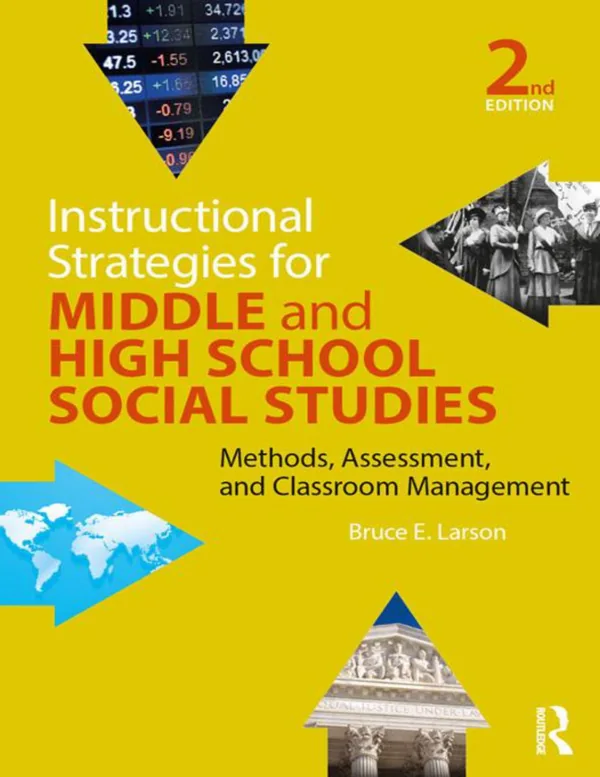
Instructional Strategies for Middle and High School Social Studies: Methods, Assessment, and Classroom Management, 2nd Edition
By Bruce E. Larson
About this ebook
Instructional Strategies for Middle and High School Social Studies, Second Edition presents seven teaching strategies with their associated assessment and classroom management considerations. Bruce E. Larson writes for prospective secondary teachers, connecting decisions about methods with lesson design, learner differences, reflection, and the practical conditions of social studies classrooms.
Inside this title
Seven instructional strategies for secondary social studies teaching
Current listed price $20.99Regular price $39.00Digital ebook
Larson treats an instructional strategy as part of a teaching sequence that includes planning, managing the classroom, and assessing what students learn. Detailed explanations of seven approaches are accompanied by guidance on deciding when and how each fits a social studies lesson.
The integration of methods, management, and assessment encourages readers to consider these decisions together. Differentiation and the needs of varied learners shape the discussion, while reflective practice helps prospective teachers examine and adjust their choices. The second edition is designed for teacher preparation in middle and high school social studies, giving readers a framework for relating methods coursework to lesson planning and the realities of classroom teaching.
Study guide included
Inside Instructional Strategies for Middle and High School Social Studies: Methods, Assessment, and Classroom Management, 2nd Edition.
Larson presents seven instructional strategies for secondary social studies and refuses to treat them in isolation. Each is tied to classroom management, assessment and lesson design, so prospective teachers learn to choose a method for a purpose and to consider differentiation and reflection while planning.
The second edition treats an instructional strategy as one element in a teaching sequence. Planning, managing the classroom and assessing learning are discussed together, because a method that ignores the other two rarely works. Seven approaches receive detailed treatment, with guidance on when each suits a social studies lesson and how it fits the content being taught. Differentiation and the needs of varied learners shape those choices, and reflective practice asks prospective teachers to examine and adjust what they do. Written for teacher preparation in middle and high school social studies, the book links methods coursework to the practical conditions of planning lessons and running a classroom.
Teaching as a Sequence
A strategy is presented as part of a sequence that includes planning, management and assessment. Seeing the parts together helps readers avoid treating a method as a standalone trick.
Plan methods within a sequence
Connect strategy to purpose
Keep management and assessment in view
Topic 1
The Seven Strategies
Seven approaches are explained in detail, each with its own logic and best uses. The point is not to rank them but to understand what each is good for in a social studies classroom.
Learn what each strategy does
Identify appropriate uses
Compare approaches for a lesson
Topic 2
Classroom Management
Management is treated as a condition for instruction rather than a separate concern. The discussion connects how a room is organised and directed with whether a chosen strategy can succeed.
Plan management alongside methods
Anticipate classroom conditions
Support instruction through structure
Topic 3
Assessment
Assessment is tied to the method it accompanies, so that what students learn can be examined in a way suited to how it was taught. The book links assessment choices to instructional purpose.
Match assessment to method
Clarify what is being measured
Use results to inform teaching
Topic 4
Differentiation
Varied learners require adjustments in how a strategy is implemented. Differentiation is woven through the methods discussion rather than confined to a single chapter, reflecting its role in everyday planning.
Adapt methods to learners
Plan for varied needs
Keep access central
Topic 5
Planning and Reflection
Lesson planning and reflective practice turn methods into professional judgement. Teachers are encouraged to examine their choices and revise them in light of what happens in the classroom.
Design coherent lessons
Reflect on what occurred
Adjust future planning
Topics 6-7
Topic map
Teaching as a SequenceTopic 1
The Seven StrategiesTopic 2
Classroom ManagementTopic 3
AssessmentTopic 4
DifferentiationTopic 5
Lesson PlanningTopic 6
Reflective PracticeTopic 7
Key takeaways
An instructional strategy only works when it is planned together with management and assessment.
Choosing a method means matching it to purpose and to the learners in the room.
Reflection turns teaching methods into professional judgement over time.
Prospective middle and high school social studies teachers in preparation programmes, plus early-career teachers who want a structured way to relate methods, management and assessment.
Topics covered
Instructional Strategies for Middle and High School Social Studies 2nd Edition
Bruce E. Larson
secondary social studies teaching methods
classroom management and assessment
differentiated instruction
lesson planning
reflective teaching practice
Questions about this ebook.
Edition, audience, and study-guide details at a glance.
What is Instructional Strategies for Middle and High School Social Studies: Methods, Assessment, and Classroom Management, 2nd Edition about?
Instructional Strategies for Middle and High School Social Studies, Second Edition presents seven teaching strategies with their associated assessment and classroom management considerations. Bruce E. Larson writes for prospective secondary teachers, connecting decisions about methods with lesson design, learner differences, reflection, and the practical conditions of social studies classrooms.
Which edition of Instructional Strategies for Middle and High School Social Studies: Methods, Assessment, and Classroom Management, 2nd Edition is this?
This listing is for the 2nd edition. Check the title, ISBN, and book details above before ordering, especially if your course or reading list names a specific edition.
Who is Instructional Strategies for Middle and High School Social Studies: Methods, Assessment, and Classroom Management, 2nd Edition for?
Prospective middle and high school social studies teachers in preparation programmes, plus early-career teachers who want a structured way to relate methods, management and assessment.
Does this page include a study guide?
Yes. This page includes an original study guide with six thematic sections, key takeaways, and a topic map for structured reading.