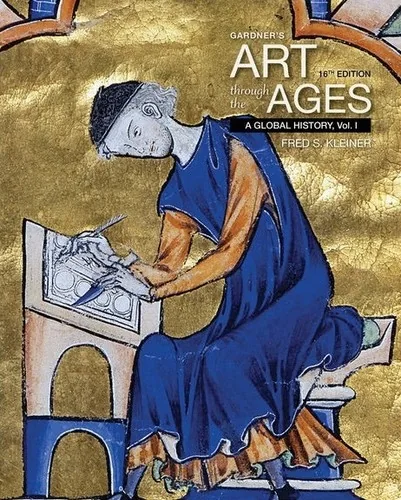
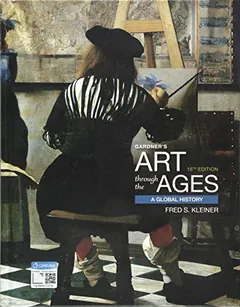
Gardner's Art Through the Ages: A Global History, 16th Edition, Volume I surveys art and architecture from prehistory through the Renaissance. Fred S. Kleiner places objects, buildings, techniques, and imagery within cultural, religious, and political settings for introductory art history students studying visual analysis and historical relationships.
Inside this title
Volume I surveys prehistory, ancient traditions, and Renaissance developments
Current listed price $31.99Regular price $79.00Digital ebook
Painting, sculpture, and architecture are examined as products of particular societies and systems of belief. This first volume follows a historical path from prehistoric monuments and ancient civilizations through medieval traditions and Renaissance developments. Cross-cultural comparisons connect examples from Egyptian, Greek, Roman, Byzantine, and Islamic art.
Maps, timelines, architectural plans, and illustrations support the reading of individual works and larger historical patterns. Discussions of iconography, materials, techniques, and patronage offer ways to interpret both images and buildings. Introductory students can use the text to relate formal choices to religious practices, political power, social structures, and the changing position of artists within their communities.
Study guide included
Inside Gardner's Art Through the Ages: A Global History, 16th Edition, Volume I.
Volume I of Kleiner's survey carries readers from the first cave images to late medieval Italy, with regional chapters on Asia, the Americas, and Africa. It teaches a method: inspect materials and settings, then weigh what written and archaeological evidence can support.
This half of the survey concentrates on prehistory through roughly 1400, pairing a chronological spine with sections that let non-European traditions stand apart. The introduction explains how art historians reason from physical evidence; later chapters cover Mesopotamian, Egyptian, Greek, Aegean, Etruscan, and Roman material, then late antique, Islamic, Byzantine, and medieval European work. Separate units address South and Southeast Asia, China, Korea, Japan, the Americas, and Africa. Because the volume stops before the Renaissance expands, readers get a sustained look at how belief, burial, and court life shaped images over millennia. Study questions and comparison exercises close each chapter.
Objects as historical evidence
The opening pages distinguish what a surviving artifact can prove from what an interpreter merely suspects. Medium, size, and technique anchor the discussion, while findspot and display context supply the next layer. The book repeatedly returns to this order because ancient objects often arrive without the documents that would explain them.
Start with material and technique
Locate the findspot and setting
Mark where evidence runs out
Introduction, p. 1
Early states and durable authority
Cave images, Sumerian temple vessels, and Egyptian pyramid complexes show visual order doing different jobs. Registers sequence an offering ritual, while royal scale and stone make a ruler's claim to permanence visible. The authors keep speculation about prehistoric belief in check by pointing to what placement and comparison can actually establish.
Read narrative order in registers
Notice how stone signals permanence
Test function against find context
Chs. 1–3, pp. 14, 30, 54
Borrowed forms, local purposes
Makers across the Aegean, Greece, Etruria, and Rome shared motifs without sharing institutions. The text contrasts settings across the Cyclades, Crete, and Mycenae, then shows Greek temple reliefs and painted pottery pursuing separate visual problems. Etruscan tombs adapt Greek figures for funerary display, and Roman concrete, vaults, and arches enlarge what civic architecture could do.
Ask what a borrowed motif now serves
Compare a vase with a tomb image
Connect building technique to public life
Chs. 4–7, pp. 82, 102, 162, 176
Worship shapes building design
Chapters on late antiquity, Byzantium, Islam, and medieval Europe tie artistic choice to ritual use. Sarcophagi keep familiar Roman formats while carrying Christian subjects; mosaics at San Vitale place the emperor inside a church. Manuscripts are handled at arm's length, while pilgrimage churches organize crowds in motion. Gothic vaulting redistributes height, light, and structural load.
Trace how a rite uses the space
Compare handheld and architectural images
Read structure as an aesthetic decision
Chs. 8–14
Asian monuments and movement
Stupas, gateways, and temples are presented as routes rather than facades. A pilgrim circling Sanchi experiences sculpture in sequence, so a single photograph captures only part of the design. Korean and Japanese connections show Buddhist imagery traveling while courts and local communities reshape materials, plans, and subject matter for their own purposes.
Diagram the path a pilgrim takes
Compare transmission with local adaptation
Look beyond Buddhist patronage
Chs. 15–17, pp. 434, 460, 490
Survival, gaps, and attribution
American and African chapters widen the map while admitting how uneven the record is. Teotihuacan and Maya construction demonstrate organized labor and ceremonial space; Benin works reconstruct a specific court setting. Climate, burial, and collecting histories favor some materials over others, so a museum collection reflects accident as much as past practice.
Separate survival from past prevalence
Name the site before generalizing
Present dating as provisional
Chs. 18–19, pp. 508, 538
Chapter and section map
What Is Art History?p. 1
Art in the Stone Agep. 14
Ancient Greecep. 102
The Roman Empirep. 176
Byzantiump. 256
Late Medieval Italyp. 410
South and Southeast Asia before 1200p. 434
Native American Cultures before 1300p. 508
Key takeaways
Describe material, scale, and setting before deciding what an ancient object was for.
Follow one region's chapters together so concurrent traditions are not flattened into a single timeline.
Treat museum collections as evidence of survival and collecting, not a census of past art.
Students in the first half of an introductory art history sequence, plus general readers who want a careful, method-focused account of ancient and medieval art.
Topics covered
art history volume one
prehistoric art
ancient Mediterranean art
medieval art
Asian art history
Gardner 15th edition
Kleiner survey
visual analysis
Other editions of this title.
Compare editions, prices, and book details before you choose.
Edition, audience, and study-guide details at a glance.
What is Gardner's Art Through the Ages: A Global History, 16th Edition, Volume I about?
Gardner's Art Through the Ages: A Global History, 16th Edition, Volume I surveys art and architecture from prehistory through the Renaissance. Fred S. Kleiner places objects, buildings, techniques, and imagery within cultural, religious, and political settings for introductory art history students studying visual analysis and historical relationships.
Which edition of Gardner's Art Through the Ages: A Global History, 16th Edition, Volume I is this?
This listing is for the 16th edition. Check the title, ISBN, and book details above before ordering, especially if your course or reading list names a specific edition.
Who is Gardner's Art Through the Ages: A Global History, 16th Edition, Volume I for?
Students in the first half of an introductory art history sequence, plus general readers who want a careful, method-focused account of ancient and medieval art.
Does this page include a study guide?
Yes. This page includes an original study guide with six thematic sections, key takeaways, and a chapter and section map for structured reading.