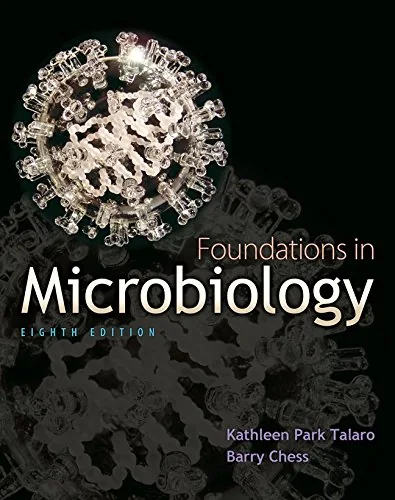
Foundations in Microbiology, eighth edition, introduces microorganisms and infectious disease for allied health and non-science majors. Kathleen Park Talaro and Barry Chess build from cell structure, metabolism, and genetics to microbial control, immunity, and pathogens. Its taxonomic organization of disease chapters helps students connect microbial groups with their characteristics and clinical significance.
Inside this title
Microbial cell structure, metabolism, growth, and genetic processes
Current listed price $6.99Regular price $11.00Digital ebook
Microbial structure and function establish the differences among organisms before the text develops metabolism, nutrition, growth, and genetics. Physical and chemical control methods explain how microbial activity can be limited, while host-pathogen relationships and immune responses introduce the biological setting in which infection occurs. Epidemiology connects individual infections with patterns of disease.
Disease chapters are organized by taxonomy, bringing bacterial, viral, fungal, and parasitic agents into related groups. Clinical applications discuss diagnosis, treatment, and prevention within that framework. The eighth edition is designed for a one-semester course, giving allied health and other introductory students a progression from basic microbial biology to the study of organisms associated with human disease.
Study guide included
Inside Foundations in Microbiology, 8th Edition.
Structures, genes, and growth conditions explain how microbes are detected, controlled, and put to work. The book builds those mechanisms first, then applies them to infection, immunity, environmental processes, and industrial microbiology for allied health and non-science majors with clear explanations.
Early chapters teach seeing and classifying organisms with microscopy, stains, and culture. Later ones connect environment with growth, metabolism, gene expression, and control. Medical chapters combine host defenses, transmission, and laboratory evidence to explain particular diseases. The closing chapters return to microbial activity as an ecological and industrial resource, where many of the same variables become design choices. The book rewards readers who can move between mechanism and application. Diagrams and case material keep the two sides linked. It is written to be approachable for beginners.
Observe carefully before identifying
Microscopy and staining reveal structure and arrangement; cultivation tests which organisms reproduce under chosen conditions; isolation separates organisms that would otherwise be examined together. A culture that looks pure supports a focused reading only if selection conditions and contamination risk are recorded. Some microbes and viruses need specialized methods entirely.
Match the tool to the material
Record selection conditions and contamination risk
Link structure to classification
Chs. 3–6 · pp. 58, 89, 123, 158
Growth, metabolism, and habitat
Growth depends on usable nutrients, temperature, pH, oxygen, and water. Organisms differ in tolerance and in whether a condition permits growth or merely survival, and a change that suppresses one population may select for another. Metabolic pathways move energy and build materials, and oxygen availability can shift which routes are open.
Separate reproduction from survival
Tie pathways to energy and products
Remember that mixed communities share chemical changes
Chs. 7–8 · pp. 185, 217
Genetic change and control
Microbes inherit and express genetic information, and variation arrives through mutation or transfer of material; conjugation can move plasmid DNA between suitable partners. Control has several aims, and sterilization, disinfection, antisepsis, and sanitization are not interchangeable. Antimicrobial chemotherapy exploits differences between host and microbe for selective toxicity.
Distinguish mutation from gene exchange
Choose the control objective and setting
Expect selection to change survivors
Chs. 9–12 · pp. 254, 291, 319, 351
From exposure to disease
Normal microbiota occupy niches and interact with the host. Infection can follow when organisms reach susceptible tissue, cross barriers, or meet altered defenses, and reservoirs, carriers, and vectors describe different exposure routes. Innate defenses act quickly and broadly; adaptive immunity adds specific recognition and memory. Laboratory tests look for the organism, its parts, or the host response.
Explain how the encounter became possible
Read immunity and tests together
Match specimen site to the organism's role there
Chs. 13–17 · pp. 386, 424, 452, 486, 517
Comparing major pathogen groups
Bacterial chapters sort organisms partly by staining reaction and shape, then refine with physiology, habitat, and disease association. A positive stain narrows the field, but precise identification needs further tests. Fungal, parasite, and viral chapters show why a label needs a biological explanation, following infectious stage and entry route.
Start with a discriminating property
Follow life stage and transmission route
Build comparison tables of stage, route, and evidence
Chs. 18–25 · pp. 539–783
Environmental and industrial microbiology
Environmental microbiology asks how communities shape water quality, nutrient cycles, and pollutant transformation, with oxygen and substrate availability deciding which organisms act. Industrial microbiology uses selected organisms under controlled conditions to make or convert materials. A biochemical possibility becomes a process only when yield, separation, stability, and cost are addressed.
Link organisms to ecosystem processes
Prove the reaction happens in the mixed community
Define the goal of the managed process
Chs. 26–27 · pp. 784, 807
Chapter and section map
Tools of the LaboratoryCh. 3 · p. 58
An Introduction to VirusesCh. 6 · p. 158
Microbial Nutrition, Ecology, and GrowthCh. 7 · p. 185
Microbial GeneticsCh. 9 · p. 254
Physical and Chemical Agents for Microbial ControlCh. 11 · p. 319
Microbe-Human InteractionsCh. 13 · p. 386
Identifying Pathogens and Diagnosing InfectionsCh. 17 · p. 517
Applied and Industrial MicrobiologyCh. 27 · p. 807
Key takeaways
Keep sample handling, growth conditions, and test targets visible when interpreting an identification.
Explain how one organism can survive, reproduce, and spread across different environments.
Connect infection evidence with transmission and host response before naming a source.
Allied health and non-major undergraduates in introductory microbiology, plus students preparing for clinical or laboratory coursework. Accessible explanations suit readers without a deep science background.
Topics covered
introductory microbiology
microscopy and staining
microbial growth
microbial genetics
infection and immunity
pathogen groups
industrial microbiology
laboratory diagnosis
Questions about this ebook.
Edition, audience, and study-guide details at a glance.
What is Foundations in Microbiology, 8th Edition about?
Foundations in Microbiology, eighth edition, introduces microorganisms and infectious disease for allied health and non-science majors. Kathleen Park Talaro and Barry Chess build from cell structure, metabolism, and genetics to microbial control, immunity, and pathogens. Its taxonomic organization of disease chapters helps students connect microbial groups with their characteristics and clinical significance.
Which edition of Foundations in Microbiology, 8th Edition is this?
This listing is for the 8th edition. Check the title, ISBN, and book details above before ordering, especially if your course or reading list names a specific edition.
Who is Foundations in Microbiology, 8th Edition for?
Allied health and non-major undergraduates in introductory microbiology, plus students preparing for clinical or laboratory coursework. Accessible explanations suit readers without a deep science background.
Does this page include a study guide?
Yes. This page includes an original study guide with six thematic sections, key takeaways, and a chapter and section map for structured reading.