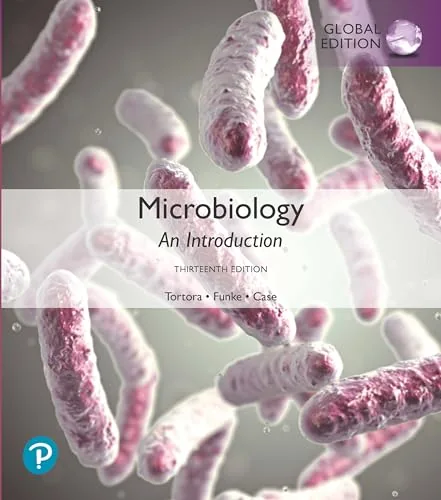
Microbiology: An Introduction, Thirteenth Global Edition, surveys microorganisms and their relationships with human health, disease, and the environment. Tortora, Funke, and Case introduce cell structure, metabolism, genetics, immunity, and epidemiology for beginning microbiology students, with microbiome features and visual overviews connecting microbial processes to broader biological and applied questions.
Inside this title
Microbial cell structure, metabolism, growth, and genetic processes
Current listed price $32.99Regular price $87.00Digital ebook
Bacteria, archaea, viruses, fungi, protozoa, and helminths form the biological range of this introductory text. Cell organization, growth, metabolism, and microbial genetics establish the foundation for understanding how microorganisms function. Host defenses and host-microbe interactions then connect that foundation with immunity, vaccination, antimicrobial treatment, and infectious disease.
The thirteenth Global Edition also examines epidemiology and applications in food, industry, biotechnology, and environmental work. Exploring the Microbiome features and Big Picture spreads connect individual topics with larger relationships in microbial biology. Students beginning microbiology in life science, nursing, and related health programs can use the book to relate cellular mechanisms to disease processes and the varied roles microorganisms play beyond infection.
Study guide included
Inside Microbiology: An Introduction, 13th Edition, Global Edition.
What separates a useful microbiological claim from a guess? This edition keeps returning to that question, pairing each topic with the evidence behind it. From cell structure through metabolism, genetics, immunity, and applied work, students practice tracing an observation back to the organism, the conditions, and the method that produced it.
The opening units handle chemistry, microscopy, cell anatomy, metabolism, how populations grow, and how to control them, then move into genes, mutation, transfer, and recombinant tools. Diversity follows: bacteria, archaea, fungi, protists, helminths, viruses, and the stranger agents. The disease block is the longest, covering epidemiology, virulence, innate and adaptive defense, vaccines, antimicrobial therapy, and infections organized by organ system. A closing pair of chapters examines environmental roles and industrial uses. Microbiome features recur as a thread, linking diversity, gene exchange, and host defense so that students see one microbial community informing several chapters instead of isolated facts.
Reading a specimen correctly
A microscope image is an argument about preparation as much as about biology. Resolution, not magnification, determines whether fine detail is genuinely resolved; stains reveal or distinguish structures according to chemical behavior. Two pictures that look unlike each other may simply differ in staining, focus, or scale. Students are trained to state the conditions behind a micrograph before drawing conclusions, and to connect visible features — capsule, pilus, endospore — with the functions those features might serve.
Name the conditions behind an image
Resolve detail, not just size
Link features to possible functions
Chs. 1–4
Where microbial energy comes from
A microscope image is an argument about preparation as much as about biology. Resolution, not magnification, determines whether fine detail is genuinely resolved; stains reveal or distinguish structures according to chemical behavior. Two dissimilar pictures may simply differ in staining, focus, or scale. Students are trained to state the conditions behind a micrograph before drawing conclusions, and to connect visible features — capsule, pilus, endospore — with the functions those features might serve.
Balance energy and material
Read the growth phases
Choose control by mechanism
Chs. 5–7
Information, inheritance, and exchange
This unit separates two things students often blur: how a gene is used and whether its sequence has changed. Regulation adjusts expression in response to conditions; mutation rewrites the code. Either can move a measured trait, so a shift seen under one set of circumstances may not be heritable. Traits also travel sideways through transformation, conjugation, and transduction. The DNA-technology chapter then shows how enzymes, vectors, and amplification are matched to an objective.
Distinguish use from change
Trace transfer between lineages
Match tools to objective
Chs. 8–9
Placing organisms in context
Classification supplies evolutionary context and tells you which evidence suits which group. Bacteria, archaea, and eukaryotes differ in history and cell chemistry; fungi, protists, algae, and parasitic animals add medically relevant stages; viruses, viroids, and prions stretch the definition of infectious. Appearance can mislead because unrelated organisms converge on similar shapes. Differential stains, metabolic profiles, serology, and sequence comparison each answer a narrower question, and a group-level match does not identify a species.
Match evidence to the group
Expect shape to mislead
Stop short of species claims
Chs. 10–13
From exposure to immune defense
Disease chapters follow an agent from reservoir through transmission and entry to tissue damage and exit, while epidemiology looks for patterns across people, place, and time. Virulence factors — adhesion, invasion, toxins, evasion — explain how harm occurs. Host defense runs from barriers and inflammation to the specific, memory-forming adaptive system that vaccines exploit. Antimicrobial drugs work because microbes and human cells differ, and a susceptibility result is meaningful only within the assay that generated it.
Build timelines from exposure to exit
Separate virulence from defense
Keep results inside their assay
Chs. 14–26
Communities at work in the world
The last chapters move from the clinic to soil, water, waste, and industry. Microbes cycle carbon and nitrogen, and communities succeed or fail according to substrate and local conditions. Wastewater treatment is presented as managed microbial activity: inputs, outputs, and the conditions keeping the community functioning matter more than a roster of species. Industrial microbiology asks how organism and substrate choices determine products, with contamination control built into any process that must be repeated.
Follow material through a system
Judge a community by function
Pair organism with product
Chs. 27–28
Chapter and section map
The Microbial World and Youp. 1
Microbial Metabolismp. 107
Microbial Geneticsp. 204
Classification of Microorganismsp. 269
Principles of Disease and Epidemiologyp. 393
Antimicrobial Drugsp. 558
Environmental Microbiologyp. 786
Applied and Industrial Microbiologyp. 809
Key takeaways
State what a technique detects and which rival explanations survive the result.
Connect anatomy, chemistry, and heredity to a feature before letting the feature name the organism.
Trace infection or production across the entire system, noting where evidence can settle a question.
Undergraduates taking a first microbiology course, instructors who build case-based assignments, and health-science readers who need a rigorous but accessible bridge from cell biology to infection and immunity.
Topics covered
microbiology textbook
human microbiome
microbial genetics
host immunity
antimicrobial resistance
disease epidemiology
microbial diversity
applied microbiology
Questions about this ebook.
Edition, audience, and study-guide details at a glance.
What is Microbiology: An Introduction, 13th Edition, Global Edition about?
Microbiology: An Introduction, Thirteenth Global Edition, surveys microorganisms and their relationships with human health, disease, and the environment. Tortora, Funke, and Case introduce cell structure, metabolism, genetics, immunity, and epidemiology for beginning microbiology students, with microbiome features and visual overviews connecting microbial processes to broader biological and applied questions.
Which edition of Microbiology: An Introduction, 13th Edition, Global Edition is this?
This listing is for the 13th edition. Check the title, ISBN, and book details above before ordering, especially if your course or reading list names a specific edition.
Who is Microbiology: An Introduction, 13th Edition, Global Edition for?
Undergraduates taking a first microbiology course, instructors who build case-based assignments, and health-science readers who need a rigorous but accessible bridge from cell biology to infection and immunity.
Does this page include a study guide?
Yes. This page includes an original study guide with six thematic sections, key takeaways, and a chapter and section map for structured reading.