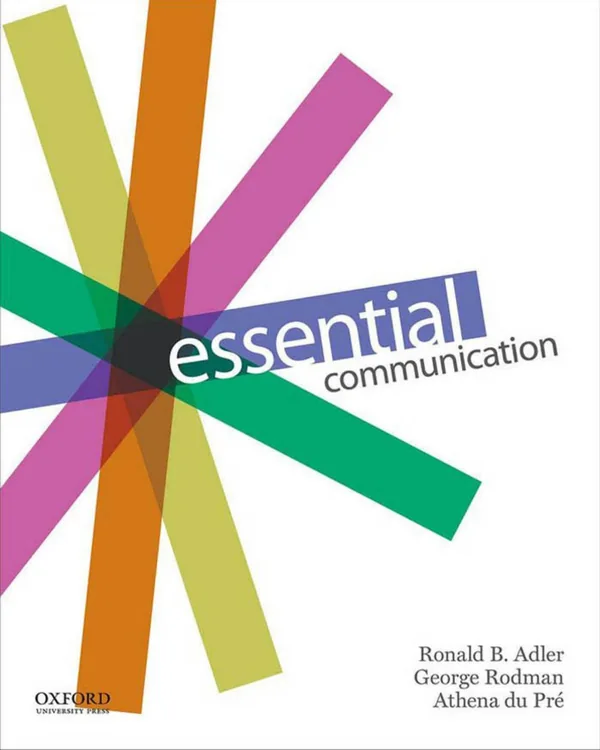
Essential Communication, 1st Edition introduces interpersonal, professional, and public communication for college students and independent learners. Adler, Rodman, and du Pré connect listening, verbal and nonverbal messages, teamwork, and speech preparation with cultural context and social media, using practical exercises and examples to apply communication theory.
Inside this title
Interpersonal listening, verbal messages, nonverbal behavior, and conflict
Current listed price $9.99Regular price $17.00Digital ebook
Communication principles are developed across the conversations, workplace exchanges, and presentations readers encounter. Perception, listening, verbal and nonverbal messages, and conflict form the interpersonal foundation. Professional applications include teams, interviews, and feedback, while public speaking coverage follows the process of researching, organizing, rehearsing, and delivering a speech.
Culture and social media are woven through these subjects as influences on identity, relationships, and communication choices. Practical exercises and self-assessment activities ask readers to connect theory with their own interactions. The first edition supports introductory college courses and also gives working readers a structured way to examine communication in personal and organizational settings.
Study guide included
Inside Essential Communication, 1st Edition.
This concise text introduces interpersonal, professional and public communication to college students and independent learners. Adler, Rodman and du Pré connect listening, verbal and nonverbal messages, teamwork and speech preparation with cultural context and social media, using exercises that turn theory into observable practice.
Communication models, the self and cultural context open the book. Language, listening and nonverbal behavior are then treated separately so their interaction becomes visible. Friendships, families, romance, job hunting, teams and speeches show how principles shift with setting. Throughout, readers observe consequences, check interpretations and select responses suited to task and relationship. Activities are built for immediate use in class, at work or online. Examples are drawn from ordinary exchanges that readers can recognize and discuss with peers, instructors and others in everyday settings.
Meaning is made together
Some models list sender, message, channel and interference, but the transactional account has both parties signaling and interpreting continuously. A confused expression can redirect an explanation before anyone speaks. Interference may be environmental or internal: fatigue, worry, expectations. Self-concept and past encounters shape attention, so perception checking distinguishes what happened from the story told about it.
Both parties interpret signals continuously
Noise includes internal as well as external distractors
Separate observation from interpretation
Chapters 1–3 · pp. 2, 28, 50
Language use and listening
Words are symbols, and their sense depends on shared usage and situation. Vague phrasing can hide disagreement about deadlines, duties or seriousness, whereas concrete description makes a request answerable. Listening involves attention, interpretation, evaluation and response; a task, relational, analytical or critical purpose each calls for a different move, and one conversation may need several in turn.
Concrete wording makes requests answerable
Listening style should fit the purpose
A conversation may need several styles
Chapters 4–5 · pp. 74, 100
Reading nonverbal signals in context
Nonverbal signals may reinforce, replace, regulate or contradict words. Voice, face, gesture, posture, distance and timing can all operate at once, and a pause might mean thought, doubt, a turn-taking norm or trouble entering the conversation. A cluster of cues may warrant a question, but any reading must account for setting, relationship and how many cues the medium provides.
Nonverbal cues can contradict spoken words
A pause has several plausible readings
Digital media provide fewer emotional cues
Chapter 6 · p. 124
Relationships, conflict and negotiation
A request conveys both a task and a view of the other person, so a correction can feel like care, annoyance or control depending on delivery and history. Confirming responses acknowledge experience even amid disagreement, and disclosure builds trust when depth, timing and audience fit. Tension between closeness and independence recurs, and collaborative solving names the issue, hears interests and compares options.
Tone and history color a correction
Confirming messages preserve the relationship
Name interests before proposing options
Chapters 7–9 · pp. 150, 174, 194
Careers and team decisions
Career communication starts before an interview: an informational chat can clarify a role, and a well-targeted application links experience to employer needs. Messages to colleagues, managers and direct reports serve different functions, so audience, authority and desired next step should be explicit. Groups hold varied knowledge, yet status and early consensus can silence it; goals, roles and a comparison method must be set.
Clarify audience, authority and next action
Status differences can suppress input
Set roles before comparing alternatives
Chapters 10–11 · pp. 224, 260
Speaking to an audience
Audience, occasion, purpose and thesis frame a speech, and support is chosen to help listeners understand or judge the main points. Openings orient, transitions reveal relationships, and closings reinforce memory or action. Planned structure plus flexible wording defines extemporaneous delivery, and rehearsal manages time and visuals. Information, persuasion and entertainment each demand different evidence and style.
Audience and thesis guide the main points
Rehearsal controls timing and visual aids
Purpose determines evidence and style
Chapters 12–14 · pp. 288, 316, 340
Chapter and section map
Communication: What and WhyCh. 1 · p. 2
The Self, Perception, and CommunicationCh. 2 · p. 28
LanguageCh. 4 · p. 74
ListeningCh. 5 · p. 100
Nonverbal CommunicationCh. 6 · p. 124
Communicating in Interpersonal RelationshipsCh. 7 · p. 150
Communicating in Groups and TeamsCh. 11 · p. 260
Preparing SpeechesCh. 12 · p. 288
Key takeaways
Describe observable behavior before asking a person to confirm or correct your interpretation.
Choose a listening purpose before offering advice, evaluating evidence or summarizing a decision.
Write down the need, the chosen action, its owner and a review time when a group disagrees.
College students and independent learners seeking a short, practical communication text, along with instructors who want applied exercises across interpersonal, team and public speaking contexts.
Topics covered
communication theory
transactional model
perception checking
nonverbal signals
conflict styles
team decision making
public speaking
professional communication
Other editions of this title.
Compare editions, prices, and book details before you choose.
Edition, audience, and study-guide details at a glance.
What is Essential Communication, 1st Edition about?
Essential Communication, 1st Edition introduces interpersonal, professional, and public communication for college students and independent learners. Adler, Rodman, and du Pré connect listening, verbal and nonverbal messages, teamwork, and speech preparation with cultural context and social media, using practical exercises and examples to apply communication theory.
Which edition of Essential Communication, 1st Edition is this?
This listing is for the 1st edition. Check the title, ISBN, and book details above before ordering, especially if your course or reading list names a specific edition.
Who is Essential Communication, 1st Edition for?
College students and independent learners seeking a short, practical communication text, along with instructors who want applied exercises across interpersonal, team and public speaking contexts.
Does this page include a study guide?
Yes. This page includes an original study guide with six thematic sections, key takeaways, and a chapter and section map for structured reading.