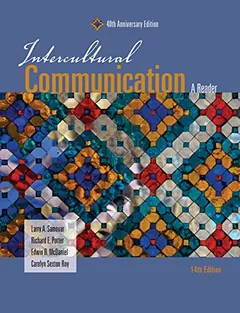
Cover of Communication Between Cultures, 9th Edition

Communication Between Cultures, 9th Edition

By Larry A. Samovar, Richard E. Porter, Edwin R. McDaniel, Carolyn S. Roy

About this ebook

Communication Between Cultures, Ninth Edition examines how cultural values, identity, language, and context shape interaction. Written for communication students and readers working across cultural boundaries, it connects intercultural theory with examples of verbal and nonverbal behavior, barriers to understanding, and approaches to listening, adaptation, and conflict.

Inside this title
  • Cultural value frameworks connected to everyday communication patterns
Current listed price $27.99Regular price $74.00Digital ebook
Buy now

Digital ebook. Checkout sends an order request.

Format
Digital ebook
ISBN
9781305995079
Last updated
2026-11-03
Build a fuller reading list

What this book covers.

Culture influences what people notice, how they interpret a message, and what they expect from an encounter. This textbook examines those connections through concepts of perception, worldview, and identity, alongside cultural value frameworks associated with Hofstede, Hall, and Kluckhohn and Strodtbeck. Cross-cultural examples give the theoretical discussion a concrete setting.

Coverage extends to language, silence, gestures, eye contact, and personal space, showing how familiar behavior can carry different meanings. The authors also consider ethnocentrism, stereotyping, prejudice, and anxiety as communication barriers. Students, educators, and professionals can use the text to study empathy, active listening, adaptability, and conflict resolution within culturally varied relationships.
Study guide included

Inside Communication Between Cultures, 9th Edition.

Samovar, Porter, McDaniel and Roy start from a plain observation: culture conditions what a person registers, the sense they make of a message, and the behavior they anticipate in an exchange. The text then builds an account of values, identity, language and nonverbal conduct, along with the barriers that derail understanding between cultural groups.

Intercultural communication is approached through perception, worldview and identity, then tied to value frameworks drawn from Hofstede, Hall, and Kluckhohn and Strodtbeck. Verbal and nonverbal conduct receive close attention, including silence, gesture, eye contact and personal space; examples show how an ordinary behavior can mean different things in different settings. Ethnocentrism, stereotyping, prejudice and anxiety are analyzed as obstacles rather than personal failings, which leaves room for change. Later material turns to empathy, listening, adaptability and conflict resolution in cross-cultural relationships. Illustrations drawn from several cultures keep the theory grounded, and the ninth edition addresses communication students and readers whose work crosses cultural lines.

Culture as a filter on perception

The opening argument is that culture influences perception before a message is even interpreted. What a person notices, how a cue is read and what counts as relevant are all shaped by cultural learning. This establishes the book's premise: intercultural misunderstanding is often a difference in perception rather than a failure of goodwill.

  • Culture filters what gets attention
  • Cues carry learned meaning
  • Relevance is culturally shaped
  • Misunderstanding is not malice
Topic 1

Value frameworks made concrete

Cultural value frameworks are introduced to give perception a structure. The text draws on Hofstede, Hall, and Kluckhohn and Strodtbeck and connects their dimensions with everyday communication patterns. The frameworks are treated as tools for asking better questions, not as labels that predict what any individual will do.

  • Frameworks help organize cultural comparison
  • Values shape what people expect
  • Dimensions describe broad tendencies
  • Individuals still vary within cultures
Topic 2

Language, silence and verbal style

Language is examined as more than vocabulary. Style, directness, silence and the social meaning of speech vary across cultures and affect how a message lands. The discussion shows why a fluent speaker can still miscommunicate, since competence includes knowing when to speak, pause or leave something unsaid.

  • Style varies across cultures
  • Silence carries social meaning
  • Directness is culturally read
  • Fluency is not competence
Topics 3–4

Nonverbal meanings in context

Gestures, eye contact, facial expression and personal space are treated as culturally learned rather than universal. The same behavior can signal respect in one setting and discomfort in another. Because nonverbal cues are often read automatically, the text argues that making them explicit is part of intercultural skill.

  • Nonverbal behavior is learned
  • Gestures vary in meaning
  • Personal space signals relationship
  • Automatic readings need checking
Topic 5

Barriers: ethnocentrism and stereotype

Ethnocentrism, stereotyping, prejudice and anxiety are presented as barriers to understanding rather than as moral verdicts. The treatment explains how each distorts perception and narrows interpretation. Naming them as barriers keeps open the possibility of change, which matters for readers who expect to work across cultural boundaries.

  • Ethnocentrism centers one's own norms
  • Stereotypes simplify and distort
  • Prejudice hardens and narrows perception
  • Anxiety narrows attention and confidence
Topic 6

Adaptation, empathy and conflict

The later chapters turn toward response: empathy, active listening, adaptability and conflict resolution. These are framed as practices that can be developed, not as attitudes one either has or lacks. The book closes by asking how culturally varied relationships can be sustained when interpretation is uncertain.

  • Empathy is a practice
  • Active listening supports adaptation
  • Conflict needs cultural reading
  • Relationships require ongoing adjustment
Topics 7–8

Topic map

  • Culture, Perception and WorldviewTopic 1
  • Cultural Value FrameworksTopic 2
  • Identity and CommunicationTopic 3
  • Language and Verbal StyleTopic 4
  • Silence, Gesture and Personal SpaceTopic 5
  • Ethnocentrism, Stereotyping and PrejudiceTopic 6
  • Listening, Empathy and AdaptationTopic 7
  • Conflict Across CulturesTopic 8

Key takeaways

  • Treat cultural difference as a difference in perception before assuming bad intent.
  • Use value frameworks to ask better questions rather than to predict individuals.
  • Check your nonverbal readings, because automatic interpretation is where miscommunication often hides.

Communication students, educators and professionals who work across cultural boundaries and who want a practical, theory-grounded account of values, language, nonverbal behavior, barriers and adaptation.

Topics covered

  • intercultural communication
  • cultural values
  • identity and perception
  • language and silence
  • nonverbal behavior
  • Ethnocentrism and prejudice
  • Stereotyping and bias
  • cross-cultural conflict

Questions about this ebook.

Edition, audience, and study-guide details at a glance.

What is Communication Between Cultures, 9th Edition about?

Communication Between Cultures, Ninth Edition examines how cultural values, identity, language, and context shape interaction. Written for communication students and readers working across cultural boundaries, it connects intercultural theory with examples of verbal and nonverbal behavior, barriers to understanding, and approaches to listening, adaptation, and conflict.

Which edition of Communication Between Cultures, 9th Edition is this?

This listing is for the 9th edition. Check the title, ISBN, and book details above before ordering, especially if your course or reading list names a specific edition.

Who is Communication Between Cultures, 9th Edition for?

Communication students, educators and professionals who work across cultural boundaries and who want a practical, theory-grounded account of values, language, nonverbal behavior, barriers and adaptation.

Does this page include a study guide?

Yes. This page includes an original study guide with six thematic sections, key takeaways, and a topic map for structured reading.

Keep your curiosity going.

More books from this carefully grouped reading set.

See the whole set

Enter your name and email to open a WhatsApp message with your details.