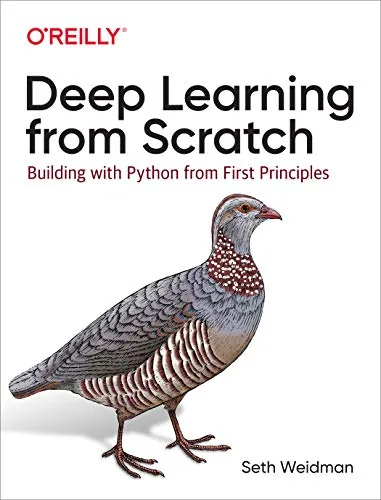
Deep Learning from Scratch: Building with Python from the Ground Up
By Seth Weidman
About this ebook
Deep Learning from Scratch explains neural networks by constructing their components in Python and NumPy. Seth Weidman connects mathematical reasoning with forward passes, backpropagation, optimization, and multilayer models, building toward a neural network library. The book suits software engineers and data scientists who already know basic machine learning.
Inside this title
Python and NumPy implementations make neural network calculations explicit
Current listed price $23.99Regular price $46.00Digital ebook
Building the machinery of a neural network is the main route into the subject here. Weidman develops the calculations behind layers, loss functions, and gradient descent, then connects them through forward and backward passes. The chain rule and computational graphs help explain how changes in parameters influence a model's output.
Successive implementations lead toward a working neural network library and multilayer perceptrons for classification and regression. Discussion of training methods and regularization adds context to the basic components. Python and NumPy keep the calculations visible, making the book useful for readers with machine learning experience who want to examine the mechanisms beneath higher-level frameworks.
Study guide included
Inside Deep Learning from Scratch: Building with Python from the Ground Up.
A hands-on route into neural networks by building them in Python and NumPy. Weidman develops layers, losses, forward passes, backpropagation, and gradient descent before assembling the pieces into a working library, aiming at software engineers and data scientists who already know basic machine learning.
The book treats implementation as the way to understand deep learning. Beginning with Python and NumPy, it shows how mathematical reasoning connects to forward passes, loss functions, and parameter updates. Computational graphs and the chain rule carry the explanation into backpropagation, while gradient descent supplies the optimization routine. Successive builds move toward multilayer perceptrons for classification and regression, then toward a small neural network library assembled from the components already developed. Training methods and regularization round out the picture. Readers with prior machine learning experience are the intended audience, since the text assumes familiarity with basic models and wants them to see the mechanisms beneath higher-level frameworks.
Building from First Principles
The text starts from the operations a network actually performs, using Python and NumPy so nothing is hidden behind a framework. Implementing calculations directly is presented as a way to test understanding, because each result can be traced back to the code that produced it.
Work with Python and NumPy directly
Implement calculations instead of importing them
Trace results back to code
Topic 1
Layers, Losses, and Forward Passes
Layers and loss functions turn raw inputs into predictions and a measurable error. The forward pass is followed step by step so readers see how data moves through the model and where the loss comes from. These pieces set up the learning problem the rest of the book solves.
Construct layers and loss functions
Follow data through a forward pass
Locate the source of the loss
Topic 2
Backpropagation and Computational Graphs
Backpropagation explains how a model learns which parameters to adjust. Computational graphs and the chain rule make the gradient calculation visible, connecting each layer's contribution to the final loss. The treatment emphasizes reasoning about change rather than memorizing formulas.
Read computational graphs
Apply the chain rule
Trace gradients through layers
Topic 3
Gradient Descent and Optimization
Optimization uses the gradients from backpropagation to update parameters. The book connects the descent procedure with the loss it navigates, showing how changes in parameters influence output. This is where the calculated derivatives become actual learning steps.
Use gradients to update parameters
Connect updates to the loss
Understand the optimization routine
Topic 4
From Components to a Neural Network Library
Separate pieces are combined into working models and, eventually, a small library. Multilayer perceptrons for classification and regression demonstrate the assembly, while the library shows how reusable components fit together. The progression mirrors how frameworks are structured internally.
Combine components into models
Build classifiers and regressors
Assemble reusable library pieces
Topics 5–6
Training Methods and Regularization
Beyond the basic loop, training choices affect how well a model generalizes. The book discusses training methods and regularization as ways to control learning. Readers see that a working network is not automatically a reliable one.
Examine training methods
Apply regularization
Consider generalization
Topic 7
Topic map
Foundations of neural computation in Python and NumPyTopic 1
Layers, loss functions, and forward passesTopic 2
Backpropagation, the chain rule, and computational graphsTopic 3
Gradient descent and optimizationTopic 4
Multilayer perceptrons for classification and regressionTopic 5
Building a neural network libraryTopic 6
Training methods and regularizationTopic 7
Key takeaways
Building each component in Python and NumPy makes the mathematics of neural networks inspectable rather than abstract.
Backpropagation and gradient descent form the loop that turns a loss into parameter updates.
Assembling a small library clarifies how the pieces of a deep learning framework relate.
Software engineers and data scientists who already know basic machine learning and want to understand neural networks by implementing their components in Python and NumPy.
Topics covered
deep learning
neural networks
backpropagation
gradient descent
Python and NumPy
computational graphs
multilayer perceptrons
Seth Weidman
Questions about this ebook.
Edition, audience, and study-guide details at a glance.
What is Deep Learning from Scratch: Building with Python from the Ground Up about?
Deep Learning from Scratch explains neural networks by constructing their components in Python and NumPy. Seth Weidman connects mathematical reasoning with forward passes, backpropagation, optimization, and multilayer models, building toward a neural network library. The book suits software engineers and data scientists who already know basic machine learning.
Who is Deep Learning from Scratch: Building with Python from the Ground Up for?
Software engineers and data scientists who already know basic machine learning and want to understand neural networks by implementing their components in Python and NumPy.
Does this page include a study guide?
Yes. This page includes an original study guide with six thematic sections, key takeaways, and a topic map for structured reading.