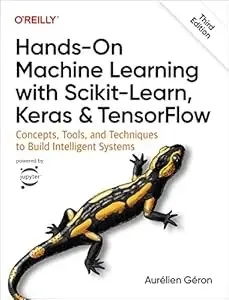
Hands-On Machine Learning with Scikit-Learn, Keras, and TensorFlow, 3rd Edition
By Aurélien Géron
About this ebook
Aurélien Géron's Hands-On Machine Learning with Scikit-Learn, Keras, and TensorFlow, 3rd Edition, teaches machine learning through Python examples. It develops classical prediction methods before moving into neural networks, transformers, generative models, and reinforcement learning, connecting data preparation, training, evaluation, and deployment for developers and data science learners.
Inside this title
End-to-end projects connect data preparation with evaluation
Current listed price $19.00Regular price $45.00Digital ebook
An applied project workflow introduces the choices involved in preparing data, selecting models, measuring performance, and improving results. Scikit-Learn provides the setting for regression, classification, clustering, dimensionality reduction, and ensemble methods. Examples connect algorithmic ideas with the code needed to investigate them.
The deep learning portion uses Keras and TensorFlow to develop neural networks for tasks involving images, sequences, and language. Convolutional and recurrent architectures lead into transformers, generative models, and reinforcement learning. Regularization, tuning, deployment, and monitoring bring model development into a wider engineering context. The third edition suits readers comfortable with Python who want to study both classical machine learning and neural methods through practical implementation.
Study guide included
Inside Hands-On Machine Learning with Scikit-Learn, Keras, and TensorFlow, 3rd Edition.
Géron frames machine learning as engineering work: settle the decision, establish a trustworthy evaluation, then strengthen the system by studying its data, mistakes and operating limits. Python examples carry the reader from classical models and ensembles to neural networks, generative methods and reinforcement learning, ending with deployment.
The second edition, released by O'Reilly Media in 2019, keeps the practical pairing of explanation and runnable code. A complete project introduces splitting, metrics and leakage; later chapters cover classification, training, trees, ensembles and unsupervised methods. The neural half builds models in Keras and TensorFlow, moving through images, sequences, attention and representation learning. A closing chapter on serving and monitoring returns attention to production constraints. Throughout, equations and APIs are tied to decisions such as what to measure and whether a simpler reference model will do.
Framing the problem and its metric
Before choosing an algorithm, the project chapter fixes what the system should predict and what information will exist at prediction time. The metric should reflect the cost of mistakes, because one costly miss can outweigh many minor ones, and users may rank outcomes differently. A test set is reserved early, and preprocessing is fitted inside each training split to avoid leakage.
State the decision before the model
Set aside a holdout set before exploring
Fit transformations inside the training split
Chapter 2 · End-to-End Machine Learning Project
Reading errors and generalisation
Digit classification illustrates recall, precision, confusion matrices and the consequences of moving a threshold: precision measures how often a positive flag is correct, while recall measures the share of true positives caught. Model capacity is then explored with linear and polynomial fits, where learning curves separate underfitting from overfitting. Regularisation trades some training fit for better generalisation, tuned on validation data.
Thresholds shift the precision-recall balance
Learning curves show what to change next
Tune regularisation on validation data
Chapters 3–4 · Classification and Training Models
Ensembles that improve predictions
Decision trees split feature space into groups that are easier to predict, capturing interactions while staying inspectable at small size; left unconstrained they memorise noise. Ensembles then exploit variation: bagging aggregates models trained on resampled data, a random forest adds randomness in feature choice, and boosting fits stages in sequence. Compare them under one validation design, weighing compute, stability and explainability.
Small trees remain readable
Bagging reduces variance through resampling
Boosting corrects earlier stages sequentially
Chapters 6–7 · Decision Trees and Ensemble Learning
Describing data without a target
Principal component analysis seeks directions that carry variance, so the scaling of variables changes the result and the chosen projection should serve the next task rather than a generic idea of tidiness. K-means assigns points to centroids under particular distance assumptions, while density methods and mixtures describe groups differently. A cluster labels exploration or segmentation, and its meaning must be checked against context.
Scaling alters which structure survives projection
Choose a representation for the next task
Validate cluster meaning against context
Chapters 8–9 · Dimensionality Reduction and Unsupervised Learning
Building networks with discipline
Keras examples set out layers, objectives and training loops, and later material shows convolutional filters reused across positions, plus recurrent and attention-based designs for ordered data. Architecture should follow what the input represents, with a simpler comparison kept nearby. Training requires reading loss and validation curves together, because optimisation trouble and poor generalisation call for different fixes, and pipelines often limit experiments.
Match architecture to the data's structure
Read training and validation curves together
Change one design choice at a time
Chapters 10–16 · Keras, deep network training, vision and sequences
Generative models, agents and deployment
Autoencoders learn by reconstruction, generative adversarial networks pit generator against discriminator, and reinforcement learning weighs actions, rewards and later consequences. Each defines success differently, and a convincing sample or a strong simulated reward does not guarantee behaviour elsewhere. Deployment adds input contracts, batching, latency and versioning, plus monitoring for drift and the ability to reproduce preparation.
Define success for each learning setup
Include latency and input availability
Monitor drift and keep versions reproducible
Chapters 17–19 · Generative learning, reinforcement learning and deployment
Chapter and section map
End-to-End Machine Learning ProjectCh. 2
ClassificationCh. 3
Ensemble Learning and Random ForestsCh. 7
Unsupervised Learning TechniquesCh. 9
Training Deep Neural NetworksCh. 11
Deep Computer Vision Using Convolutional Neural NetworksCh. 14
Representation Learning and Generative LearningCh. 17
Training and Deploying TensorFlow Models at ScaleCh. 19
Key takeaways
Fix the prediction moment first, then decide which historical fields a model may legitimately use.
Benchmark every method against a simple baseline under one split, preprocessing and metric.
Let mistake review and live monitoring show whether to revise the model, the inputs or the workflow.
Programmers and aspiring data scientists with some Python experience who want working code, clear explanations and a practical route from a first model to a deployed system.
Topics covered
machine learning
scikit-learn pipelines
Keras models
TensorFlow deployment
neural networks
model evaluation
ensemble learning
deep learning
Questions about this ebook.
Edition, audience, and study-guide details at a glance.
What is Hands-On Machine Learning with Scikit-Learn, Keras, and TensorFlow, 3rd Edition about?
Aurélien Géron's Hands-On Machine Learning with Scikit-Learn, Keras, and TensorFlow, 3rd Edition, teaches machine learning through Python examples. It develops classical prediction methods before moving into neural networks, transformers, generative models, and reinforcement learning, connecting data preparation, training, evaluation, and deployment for developers and data science learners.
Which edition of Hands-On Machine Learning with Scikit-Learn, Keras, and TensorFlow, 3rd Edition is this?
This listing is for the 3rd edition. Check the title, ISBN, and book details above before ordering, especially if your course or reading list names a specific edition.
Who is Hands-On Machine Learning with Scikit-Learn, Keras, and TensorFlow, 3rd Edition for?
Programmers and aspiring data scientists with some Python experience who want working code, clear explanations and a practical route from a first model to a deployed system.
Does this page include a study guide?
Yes. This page includes an original study guide with six thematic sections, key takeaways, and a chapter and section map for structured reading.