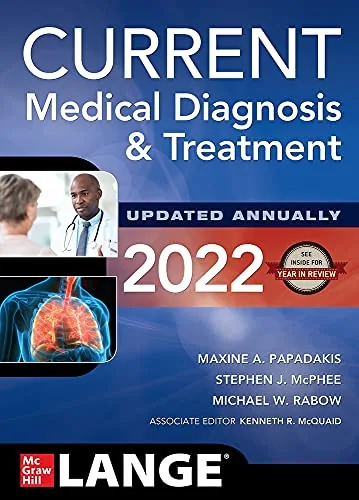
Current Medical Diagnosis & Treatment 2022, 61st Edition surveys adult medicine with emphasis on diagnostic findings and patient management. The annual volume covers disease presentations, treatment approaches, drug information, prevention, infectious diseases, and geriatric considerations. It is intended for clinicians, residents, and students studying internal medicine in hospital and ambulatory settings.
Inside this title
Adult disease diagnosis across hospital and ambulatory settings
Current listed price $26.99Regular price $65.00Digital ebook
CMDT 2022 concentrates on clinical diagnosis and management across adult medicine. Its disease discussions bring together diagnostic criteria, distinguishing clinical findings, and treatment approaches, supported by drug information and management algorithms. The range is relevant to both hospital-based and ambulatory medicine.
Preventive care, infectious diseases, and the special considerations of older patients extend the discussion beyond individual diagnostic categories. The text addresses medication dosages, contraindications, and adverse effects within the material of this annual edition. Internists, primary care practitioners, residents, nurse practitioners, physician assistants, and medical students can use the volume to study how adult medical problems and treatment choices were presented in the 2022 reference.
Study guide included
Inside Current Medical Diagnosis & Treatment 2022, 61st Edition.
Current Medical Diagnosis & Treatment 2022, the sixty-first edition, is an adult-medicine reference that moves from symptoms toward diagnostic reasoning and management options. It serves clinicians, residents, and students who need a structured route through hospital and ambulatory topics, with a Year in Review marking changes emphasized at publication.
Prevention, symptom evaluation, perioperative planning, geriatric care, and palliative medicine come first, followed by organ-system and primary-care material. The reader is meant to compare explanations that overlap, place exposure history next to physical findings, and keep a possible diagnosis distinct from the proof required for it. Since the content reflects 2022, the volume also rewards a verification habit: find the chapter behind any statement, note the edition, and treat the text as a study of organization rather than current clinical guidance.
Reading the annual update
Front matter positions the volume for hospital and office use and directs attention to a Year in Review. Chapter 1 frames the clinical interview as a means of collecting history, learning what matters to the person, discussing outlook, and settling on next steps. Screening, vaccination, and lifestyle change are considered together with practical constraints, including obstacles a risk checklist would never reveal.
Locate the change before reading
Weigh screening against real constraints
Use the interview to set shared goals
Preface and Year in Review · Ch. 1
Cough, exposure, and clinical clues
For cough, the 2022 text inquires about how long it has lasted, smoking, vaping and cannabis, job and home exposures, breathlessness, and coronavirus risk. Examination and vital signs contribute evidence of another kind. Pulmonary and infection chapters then sharpen the options by linking each source to one question, for example whether airflow is involved or whether an exposure explains the history.
Chart duration, exposures, and breathlessness
Contrast history with examination data
Assign each chapter a single question
Ch. 2, 9, 32
Baseline function and personal goals
Before surgery, the text stresses the history, physical examination, medication list, and tolerance for exertion, separating patients with little apparent risk from those whose problems alter the plan. Geriatric and palliative chapters introduce atypical presentations, several coexisting illnesses, complicated drug regimens, symptom distress, and quality of life, which change what a reader looks for once a diagnosis is made.
Ask which result would alter the plan
Judge exertion tolerance explicitly
Include daily life and patient priorities
Ch. 3–5
Cross-talk among organ systems
Heart disease, hypertension, vascular problems, and hemostasis are handled through separate diagnostic and management questions, while chapters on the kidney and electrolytes add how filtration works, how fluid is balanced, and how laboratory values are read. Hormonal, glucose, cholesterol, and dietary topics then tie diagnosis to prevention, complications, and monitoring, so one abnormal result may reflect drugs, chronic disease, and several organs at once.
Read a trend, not one value
Account for drugs and chronic illness
Separate prevention settings for lipids
Ch. 10–14, 21–22, 26–29
Infection patterns and immune status
Infectious-disease content begins with a method for prolonged fever that resists explanation, then moves through chapters grouped by organism and syndrome. Exposure, travel, immune status, and tempo are read alongside objective findings. Antimicrobial material weighs probable organisms, resistance, host factors, and unwanted effects, and it helps to keep the suspected cause, the supporting evidence, and the treatment question in separate notes.
Start from the shape of the illness
Compare hosts by immune status
Keep cause and treatment apart
Ch. 30–36
General practice beyond internal medicine
Coverage reaches skin, eye and ear, and reproductive problems, then neurology, psychiatry, poisoning, oncology, and inherited disease. Orthopedic and sports chapters separate traumatic from repetitive-strain patterns. A chapter on sexual and gender minority health distinguishes identity from orientation, showing how personal context belongs in prevention and follow-up even within a general adult reference.
Let the Year in Review point you to a change, then read the whole chapter before trusting it.
Sort symptom clues into timing, exposure, and effect on daily activity before drawing them together.
Hold the leading explanation, the test that would settle it, and the meaningful result apart.
Internal medicine clinicians, residents, and medical students working in hospital and ambulatory settings, plus learners who want a structured adult-medicine reference organized by symptom and system.
Topics covered
adult internal medicine
clinical diagnosis
patient management
prevention and screening
infectious disease
geriatric care
palliative care
cardiovascular disorders
Questions about this ebook.
Edition, audience, and study-guide details at a glance.
What is Current Medical Diagnosis & Treatment 2022, 61st Edition about?
Current Medical Diagnosis & Treatment 2022, 61st Edition surveys adult medicine with emphasis on diagnostic findings and patient management. The annual volume covers disease presentations, treatment approaches, drug information, prevention, infectious diseases, and geriatric considerations. It is intended for clinicians, residents, and students studying internal medicine in hospital and ambulatory settings.
Which edition of Current Medical Diagnosis & Treatment 2022, 61st Edition is this?
This listing is for the 61th edition. Check the title, ISBN, and book details above before ordering, especially if your course or reading list names a specific edition.
Who is Current Medical Diagnosis & Treatment 2022, 61st Edition for?
Internal medicine clinicians, residents, and medical students working in hospital and ambulatory settings, plus learners who want a structured adult-medicine reference organized by symptom and system.
Does this page include a study guide?
Yes. This page includes an original study guide with six thematic sections, key takeaways, and a chapter and section map for structured reading.