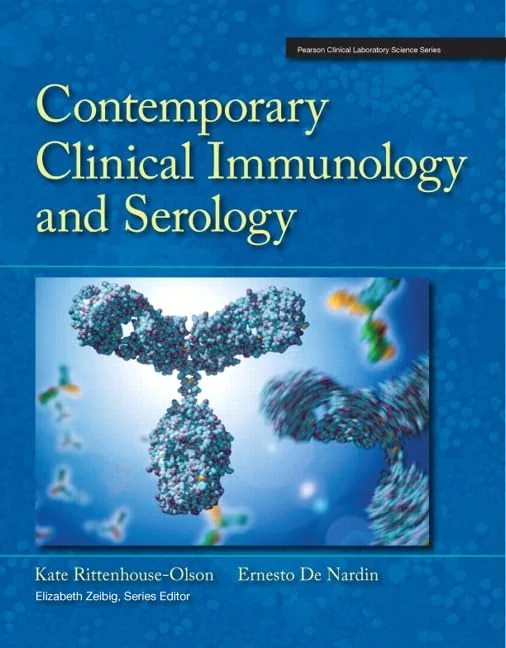
Contemporary Clinical Immunology and Serology, 1st Edition
By Kate Rittenhouse-Olson, Ernesto De Nardin
About this ebook
Contemporary Clinical Immunology and Serology introduces immune mechanisms and the laboratory methods used to investigate them. Rittenhouse-Olson and De Nardin connect antigen-antibody reactions with immunoassays, quality control, and clinical interpretation for laboratory science students and professionals, covering immune disorders and serological approaches to infectious and autoimmune disease.
Inside this title
Immune cells, antibodies, complement, cytokines, and antigen recognition
Current listed price $33.99Regular price $85.00Digital ebook
Beginning with immune cells, organs, and molecules, this first edition builds the background needed to understand serological testing. Antibodies, antigens, complement, cytokines, and major histocompatibility complex molecules lead into the principles governing antigen-antibody reactions. Laboratory methods include ELISA, Western blotting, immunofluorescence, agglutination, precipitation, and nephelometry.
Clinical applications connect laboratory findings with infectious disease, autoimmunity, hypersensitivity, immunodeficiency, and transplantation. Attention to controls, sources of error, and troubleshooting places interpretation within the wider testing process. Written for clinical laboratory science and medical technology education, the book can also support review of immunological principles by laboratory professionals. It presents the subject as both a biological system and a set of analytical methods requiring careful interpretation.
Study guide included
Inside Contemporary Clinical Immunology and Serology, 1st Edition.
This guide connects immune biology with bench evidence, treating each assay as an argument about a specific target. Readers learn what a reaction represents, how a format turns binding into signal, and which specimen, timing or technical factors could mislead the interpretation of a result.
Chapters begin with innate and acquired immunity, then move to precipitation, clumping and marker-based methods, and apply them to allergy, self-directed disease, tumors, graft care, weak immunity and infection. Laboratory arithmetic ties a measured value to the likelihood of disease, and exercises show how specimen handling, control performance and safe practice affect confidence in a result. Each technique is introduced through the target it detects and the signal it generates, so students can judge whether a result answers a diagnostic, monitoring or screening question. Worked calculations and case exercises make the reasoning explicit, and safety procedures appear as part of interpretation rather than as a separate checklist. Final chapters carry the same discipline into forensic work and molecular testing.
Innate and adaptive defense systems
Barriers limit microbial entry; once crossed, scavenger cells, cytotoxic lymphocytes, circulating mediators and the complement cascade take over. These systems read molecular patterns and issue signals that draw in or switch on additional cells, while complement also forms a bridge toward antibody responses. Adaptive immunity adds specificity: B cells secrete antibodies of differing classes, while T cells see antigens displayed on major histocompatibility molecules, with class I and II tying processing routes to distinct roles.
Match each defense to its timing
Link complement with antibody activity
Connect presentation class to T-cell role
Chs. 1–5
Antibody binding, fit and cross-reactivity
Several conditions decide if a substance will trigger a response: foreignness, size, complexity, route of exposure and the way antigen-presenting cells process it. A hapten may attach to a given antibody yet need a carrier before it can trigger immunity, a distinction that changes how reagents are chosen. Visible precipitation or agglutination requires cross-linking; large excess of either partner yields smaller complexes and a weaker apparent reaction, so dilution and handling change the picture.
Distinguish antigenicity from immunogenicity
Remember that excess can suppress visible binding
Read reaction conditions as part of the result
Chs. 2–3, 6
Formats, signals and reading results
Unlabeled methods show precipitation or clumping; labeled ones attach a marker and may take a direct, two-step, sandwich or competitive shape. Western blots separate proteins before antibody detection; flow cytometry sorts cells by scatter and fluorescence; multiplex systems query several targets at once. Sensitivity and specificity answer different questions, predictive values shift with prevalence, and a titer means little unless read with the method used and the specimen's context.
Know which component holds the marker
Check whether more target means less signal
Read predictive value against prevalence
Chs. 6–8
Immune injury and clinical disease
Hypersensitivity categories separate IgE-driven immediate reactions from antibody-mediated injury, immune complex disease and reactions driven by T cells. Naming the mechanism explains timing, which tissues suffer and why a marker helps in one pattern but not another. Autoantibodies may signal lost tolerance, yet meaning depends on target, pattern and presentation. Tumor, transplantation and immunodeficiency chapters extend the same caution to each measurement.
Classify injury by mechanism, then by timing
Pair a marker with symptoms and context
Ask what each measurement can establish
Chs. 9–15
Infection testing across methods
Host antibodies appear only after a lag and can outlast the acute episode, whereas antigen detection or nucleic acid amplification asks whether a component is present now. Examples from hepatitis, herpesviruses, HIV, bacteria, fungi and parasites show how organism and stage steer the choice. Screening assays favor detection in the population being tested; supplemental methods resolve reactive results, and some tests, such as CD4 counts, track course rather than infection.
Align the test with the stage of illness
Separate host response from direct detection
Use supplemental tests to resolve doubt
Chs. 16–20, 23
Specimen traceability and laboratory safety
Specimen identity, how it was collected, moved, prepared and kept all influence what a result means. Forensic work makes this visible with a chain-of-custody record that logs every transfer and handler, and clinical practice gains from the same habit of noting conditions that might interfere. Safety covers protective gear, universal precautions, sharps handling and post-exposure steps, while matched control samples plus contamination safeguards keep amplification trustworthy.
Record every step from collection to report
Record interference before drawing conclusions
Treat controls as evidence about the run
Chs. 21–23
Chapter and section map
Antibody and cellular immunityChs. 2–4
ComplementCh. 5
Agglutination and precipitationCh. 6
Labeled immunoassays and laboratory mathChs. 7–8
Hypersensitivity and systemic autoimmunityChs. 9–10
Transplantation and primary immunodeficiencyChs. 14–15
Infectious disease serologyChs. 16–20
Forensic serology, safety and molecular techniquesChs. 21–23
Key takeaways
Establish what a test detects, whether protein from the agent, a host antibody, whole cells or genetic material, before tying it to disease.
Read sensitivity and specificity next to predictive value, since that figure moves whenever prevalence among those tested shifts.
Review how the specimen was kept, whether controls behaved and the timing before blaming immune biology for a surprise.
Students in clinical laboratory science programs and working technologists who need to connect immunoassay design, quality control and serological interpretation with real patient or forensic specimens. Instructors will also value the exercise-based approach for teaching analytical judgment.
Topics covered
clinical immunology
clinical serology
immunoassay formats
sensitivity and specificity
autoantibody testing
infectious disease testing
laboratory quality control
laboratory biosafety
Questions about this ebook.
Edition, audience, and study-guide details at a glance.
What is Contemporary Clinical Immunology and Serology, 1st Edition about?
Contemporary Clinical Immunology and Serology introduces immune mechanisms and the laboratory methods used to investigate them. Rittenhouse-Olson and De Nardin connect antigen-antibody reactions with immunoassays, quality control, and clinical interpretation for laboratory science students and professionals, covering immune disorders and serological approaches to infectious and autoimmune disease.
Which edition of Contemporary Clinical Immunology and Serology, 1st Edition is this?
This listing is for the 1st edition. Check the title, ISBN, and book details above before ordering, especially if your course or reading list names a specific edition.
Who is Contemporary Clinical Immunology and Serology, 1st Edition for?
Students in clinical laboratory science programs and working technologists who need to connect immunoassay design, quality control and serological interpretation with real patient or forensic specimens. Instructors will also value the exercise-based approach for teaching analytical judgment.
Does this page include a study guide?
Yes. This page includes an original study guide with six thematic sections, key takeaways, and a chapter and section map for structured reading.