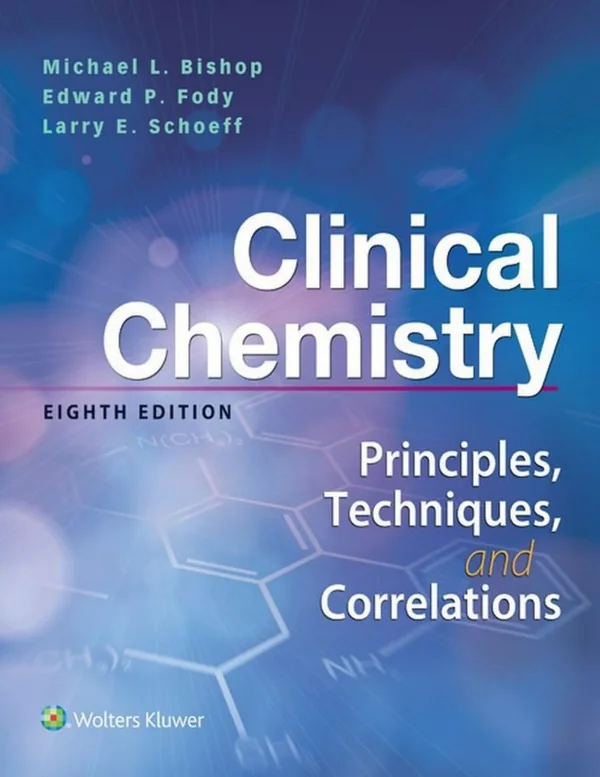
Clinical Chemistry: Principles, Techniques, and Correlations, 8th Edition
By Michael L. Bishop, Edward P. Fody, Larry E. Schoeff
About this ebook
Clinical Chemistry connects laboratory testing methods with the physiological processes and diseases they help investigate. The eighth edition introduces medical laboratory science students to analytical instrumentation, quality control, and clinical interpretation, using illustrations and case studies to move from chemical principles to the meaning of patient results.
Inside this title
Connects chemical test results with specific disease processes
Current listed price $15.99Regular price $36.00Digital ebook
Laboratory measurements become more useful when their analytical basis and physiological context are considered together. This text develops that connection through topics such as acid-base balance, electrolyte regulation, and enzyme kinetics, then relates test findings to diabetes and disorders of the liver, kidneys, heart, and endocrine system.
The methods coverage includes spectrophotometry, chromatography, immunoassay, electrophoresis, and molecular diagnostics. Discussion of analyzers and point-of-care testing sits alongside statistical quality control and proficiency testing. Illustrations and patient cases support the transition from studying individual techniques to evaluating laboratory data. Medical technology students, clinical pathology trainees, and laboratory educators can use its progression to organize coursework and review.
Study guide included
Inside Clinical Chemistry: Principles, Techniques, and Correlations, 8th Edition.
Clinical Chemistry: Principles, Techniques, and Correlations, eighth edition, links laboratory methods to the physiology and disease they help investigate. Medical laboratory science students learn instrumentation, quality control, and clinical interpretation through illustrations and case studies that carry the reader from chemical principle to the meaning of a patient result.
Basic laboratory practice, method evaluation, and analytical technology form the first part, and the next arranges measurements by analyte, moving from proteins and enzymes through electrolytes and blood gases. Organ-system chapters connect test groups to kidney, liver, heart, and endocrine physiology, and specialty chapters consider timing, exposure, and population differences. Every test is approached in the same order: identify the specimen, explain the measurement, then interpret the result in context. Analytical performance and clinical meaning remain separate claims, and a plausible result can still be wrong for reasons that begin before the instrument.
What happens before the assay
Measurement starts with identifying the patient and the specimen, then collecting, transporting, and preparing it. A delayed separation, an unsuitable tube, or material leaking from damaged cells can alter the result. Reagents, reference materials, water, buffers, and units belong to basic practice, and written procedures, labels, maintenance, and records allow another person to reconstruct exactly what happened.
Control conditions before the specimen is analyzed
Explain why consistency matters
Make the whole process reproducible
Chs. 1–2 · Practices and laboratory safety
Precision, bias, and control charts
Replicate measurements estimate precision, while comparison with a suitable reference exposes systematic difference. Evaluation also weighs interference, recovery, the reportable range, and fitness for the intended use, since a method may be precise and still biased. Control samples followed over time reveal a shift in the mean or a widening of scatter, whereas reference intervals describe how values fall in a defined population.
Ask how well the method measures
Separate precision from systematic bias
Follow controls across time
Chs. 3–4 · Method evaluation and quality improvement
Signals, separation, and detection
Spectrophotometry reads changes in light, electrochemistry uses electrical behavior, and immunoassays depend on binding, each with its own interferences and calibration demands. Chromatography separates components according to their interaction with phases, and mass spectrometry detects ions by mass-to-charge behavior. Automation and point-of-care devices add questions about controls, operator training, and comparable performance across sites.
Turn a chemical reaction into a signal
Decide whether separation is needed
Explain the result, not the instrument
Chs. 5–10 · Analytical techniques
Analytes within metabolic pathways
Proteins, nitrogen compounds, enzymes, carbohydrates, and lipids are tied to metabolism and transport, and the assay matters because different methods may recognize different forms of a substance. Electrolytes, blood gases, pH, and buffers demonstrate why results are often read as a group, since ventilation and metabolism both shape acid-base balance. Trace elements, porphyrins, and hemoglobin add specimen and assay complications.
Connect a value with its metabolic origin
Read related measurements as a group
Match the test to the physiological question
Chs. 11–19 · Clinical correlations and analytic procedures
Organ panels and their blind spots
Endocrine chapters follow feedback between gland and regulator; liver markers reflect injury and synthesis; cardiac markers raise questions about source and elapsed time. The renal chapter follows filtration and segment-specific nephron work, connecting kidney function to electrolyte and fluid balance and to estimates obtained from indirect markers. The measured value and the inferred organ function remain separate claims.
Distinguish injury from synthetic function
Tie a marker to its physiology
Keep the value and the inference apart
Chs. 20–29 · Assessment of organ system functions
Timing, populations, and special tests
Therapeutic drug monitoring depends on when the specimen was drawn and why monitoring is being done, while toxicology adds route, elapsed time, and specimen choice. Tumor markers are read against intended use and known limits, nutritional assessment combines laboratory data with intake and organ function, and pediatric and geriatric chapters show how physiology and collection constraints change interpretation.
Match collection time to the question
Keep screening separate from confirmation
Apply population context with care
Part IV · Specialty areas
Chapter and section map
Basic principles and practicesCh. 1
Method evaluation and quality controlCh. 3
Analytic techniquesCh. 5
CarbohydratesCh. 14
Renal functionCh. 27
ToxicologyCh. 31
Key takeaways
Treat specimen quality, analytical performance, and biological meaning as three separate questions.
Compare the mean and scatter of controls to tell a shift from a precision change.
Read related analytes together when they reflect different parts of one organ system.
Medical laboratory science students and clinical laboratory professionals who want a text linking analytical methods, quality control, and the clinical meaning of test results across organ systems.
Topics covered
clinical chemistry
laboratory quality control
analytical techniques
reference intervals
renal function tests
therapeutic drug monitoring
acid-base balance
tumor markers
Questions about this ebook.
Edition, audience, and study-guide details at a glance.
What is Clinical Chemistry: Principles, Techniques, and Correlations, 8th Edition about?
Clinical Chemistry connects laboratory testing methods with the physiological processes and diseases they help investigate. The eighth edition introduces medical laboratory science students to analytical instrumentation, quality control, and clinical interpretation, using illustrations and case studies to move from chemical principles to the meaning of patient results.
Which edition of Clinical Chemistry: Principles, Techniques, and Correlations, 8th Edition is this?
This listing is for the 8th edition. Check the title, ISBN, and book details above before ordering, especially if your course or reading list names a specific edition.
Who is Clinical Chemistry: Principles, Techniques, and Correlations, 8th Edition for?
Medical laboratory science students and clinical laboratory professionals who want a text linking analytical methods, quality control, and the clinical meaning of test results across organ systems.
Does this page include a study guide?
Yes. This page includes an original study guide with six thematic sections, key takeaways, and a chapter and section map for structured reading.