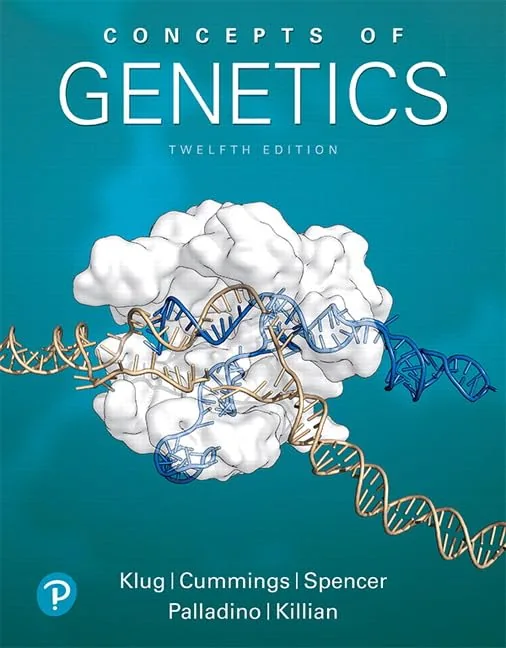
By William S. Klug, Michael R. Cummings, Charlotte A. Spencer, Michael A. Palladino, Darrell J. Killian
About this ebook
Concepts of Genetics, Twelfth Edition, connects classical inheritance with molecular genetics, genomics, and biotechnology. Designed for undergraduate biology and related life science courses, it develops genetic principles through worked examples and problems, covering chromosome behavior, gene expression, mutation, population change, and methods used to analyze and modify genetic material.
Inside this title
Mendelian inheritance and chromosome behavior explained through genetic problems
Current listed price $32.00Regular price $87.00Digital ebook
The progression from inheritance patterns to molecular processes gives students several scales at which to study genetics. Mendelian crosses and chromosome behavior introduce the transmission of traits, while DNA replication, transcription, translation, and gene regulation explain how genetic information is maintained and expressed. Mutation, repair, and recombination connect these processes with genetic variation.
Population genetics adds Hardy-Weinberg equilibrium, drift, and natural selection to the discussion. Genomics, bioinformatics, sequencing, and genetic engineering extend the foundation into analytical methods and biotechnology. Worked examples, chapter problems, and critical thinking questions encourage students to use principles in unfamiliar situations. The text is intended for undergraduate genetics study, including biology, pre-health, biochemistry, agricultural, and related programs.
Study guide included
Inside Concepts of Genetics, 12th Edition.
This guide follows genetic reasoning from counted crosses to molecular mechanisms and population data. Each chapter is treated as a testable model: state what a hypothesis predicts, compare it with observations, and mark where regulation, development or environment complicates the conclusion being drawn.
Early chapters cover cell division, Mendelian ratios, chromosome maps and the variations that complicate basic inheritance. The middle portion follows how information is stored, copied, read and controlled before turning to recombinant techniques, genomic surveys, developmental biology, cancer and variation within groups. Editing, identification and precision medicine appear as current applications. Chromosome mechanics and molecular events anchor the same explanation, and worked problems let readers rehearse the arithmetic of ratios, mapping and risk. Case material drawn from medicine, agriculture and forensic work keeps each method attached to a purpose rather than to an abstract definition. The recurring demand is to predict before measuring and to name the assumptions behind any genetic claim.
Predicting inheritance with counted ratios
Meiosis separates homologs so each gamete receives one copy of every chromosome type, which underlies segregation and independent assortment. Probability then predicts expected proportions across many offspring, though small families drift from those values by chance. Dominance explains how two alleles behave together. Partial expression, codominance, several allele forms, gene interaction and variable penetrance all widen the possible outcomes. Compare counts with predictions before adopting another model.
Derive expected counts before judging a cross
Let chance explain small departures
Expand the model only when evidence demands
Ch. 2–4
Linked genes and chromosome changes
Loci on one chromosome tend to travel together, yet crossing over can separate them and produce recombinant types. Testcross tallies distinguish parental from recombinant classes and allow rough distance estimates for nearby loci. Because double exchanges hide some events, this proportion never equals a true physical length of DNA. Altered chromosome number, sex linkage and extranuclear inheritance add further patterns.
Identify parental classes before recombinants
Treat distance estimates as approximate
Recognize when chromosome structure changes
Ch. 5–9
DNA form, copying and packaging
Complementary strands imply a copying scheme, and density-shift experiments separated competing models by predicting different bands across generations. The result supported semiconservative replication, where each new duplex keeps one old strand. Packaging differs by organism and compartment: eukaryotic DNA winds around histones into nucleosomes and then higher-order chromatin. Organization governs how sequence is copied, kept and reached, which is a separate matter from what it encodes.
Predict distinct bands before running the test
Separate sequence from physical organization
Explain how packing limits access
Ch. 10–12
From gene to protein and control
Transcription builds RNA, and the ribosome decodes triplets into a chain of amino acids; processing in eukaryotes decides which segments survive into the mature message. Mutations may alter coding regions or the sequences that govern expression, and repair plus transposition reshape genomes over time. Bacterial operons show coordinated switching, while eukaryotic control adds transcription factors, chromatin state, processing and post-transcriptional steps. Epigenetic changes alter activity without rewriting the sequence.
Trace each step from template to product
Distinguish regulation from a sequence change
Compare two cell types before concluding
Ch. 13–19
Methods, genomics and their limits
Recombinant methods isolate, amplify and modify chosen fragments. Genomic surveys describe variation and organization at scale, activity studies show which genes are switched on, and computational comparison helps make sense of both. A statistical association can suggest a candidate, though function usually needs further experiments. CRISPR-Cas sends a cutting enzyme to a chosen sequence, but the outcome depends on repair and design; feasibility alone does not justify a use.
Match each technique to the question it answers
Verify the edit before trusting the phenotype
Separate capability from justification
Ch. 20–22; Special Topic 1
Development, complex disease and demography
Developmental genetics studies how controlled expression lets cells specialize and build structures. Cancer genetics follows accumulating faults in signaling, division and repair, where inherited susceptibility raises risk without fixing an outcome. Quantitative genetics divides variation under stated assumptions, and heritability describes a group in an environment rather than an individual's share. Population genetics tracks allele frequencies shaped by selection, drift, migration, mutation and mating patterns.
Attach every genetic claim to its level
Read heritability as a group property
Name the forces acting on frequencies
Ch. 23–26
Chapter and section map
Mendelian genetics and its extensionsCh. 3–4
Chromosome mapping in eukaryotesCh. 5
Chromosomal variation and extranuclear inheritanceCh. 8–9
DNA structure, replication and organizationCh. 10–12
Gene expression and regulationCh. 13–19
Genetic technology and genomicsCh. 20–22
Organisms, quantitative traits and populationsCh. 23–26
CRISPR-Cas and genome editingSpecial Topic 1
Key takeaways
State the expected pattern and sample size before deciding that a deviation means something biological.
Keep a sequence change distinct from a shift in expression, regulation or packaging.
Read associations and heritability only within the group and setting that produced them.
Undergraduate biology and life science students taking a first genetics course, plus instructors who want worked problems and experimental reasoning rather than a survey of terminology.
Topics covered
genetics principles
Mendelian inheritance
chromosome mapping
gene expression
genome editing
population genetics
heritability estimates
DNA replication
Questions about this ebook.
Edition, audience, and study-guide details at a glance.
What is Concepts of Genetics, 12th Edition about?
Concepts of Genetics, Twelfth Edition, connects classical inheritance with molecular genetics, genomics, and biotechnology. Designed for undergraduate biology and related life science courses, it develops genetic principles through worked examples and problems, covering chromosome behavior, gene expression, mutation, population change, and methods used to analyze and modify genetic material.
Which edition of Concepts of Genetics, 12th Edition is this?
This listing is for the 12th edition. Check the title, ISBN, and book details above before ordering, especially if your course or reading list names a specific edition.
Who is Concepts of Genetics, 12th Edition for?
Undergraduate biology and life science students taking a first genetics course, plus instructors who want worked problems and experimental reasoning rather than a survey of terminology.
Does this page include a study guide?
Yes. This page includes an original study guide with six thematic sections, key takeaways, and a chapter and section map for structured reading.