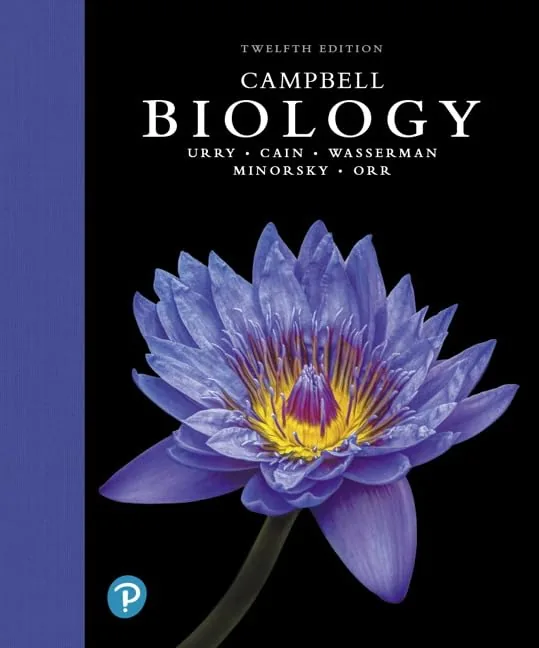
Campbell Biology, twelfth edition, surveys biology for college majors and advanced high school students. Its eight-unit structure spans molecular and cellular biology, genetics, evolution, organismal diversity, physiology, and ecology. Scientific inquiry and data interpretation accompany the subject coverage, connecting biological explanations with the evidence and experiments used to develop them.
Inside this title
Eight units covering molecular biology through ecology and conservation
Current listed price $34.99Regular price $91.00Digital ebook
Energy transformation, information transfer, and evolutionary change link the topics in this introductory biology text. Cellular respiration and photosynthesis explain how organisms obtain and use energy. Molecular genetics develops DNA replication and gene expression, while natural selection, genetic drift, and speciation provide an account of biological diversity.
Plant transport, hormones, and adaptations sit alongside animal circulation, immunity, and homeostasis. Ecological sections examine populations, communities, ecosystem cycles, conservation, and climate-related changes. The twelfth edition’s eight units and 56 chapters provide an organized course sequence, with scientific inquiry and critical examination of data connecting the content to biological research. Its scope suits students preparing for further study across the life sciences.
Study guide included
Inside Campbell Biology, 12th Edition.
Campbell Biology, twelfth edition, surveys biology for college majors and advanced high school students. Its eight units span molecular and cellular biology, genetics, evolution, organismal diversity, physiology, and ecology, pairing subject coverage with scientific inquiry and data interpretation so that explanations stay connected to the experiments behind them.
Recurring themes open the book, which then builds from chemistry and cells to heredity, evolutionary process, the branching record of life, how plants and animals work, and ecology. Figures and data questions ask readers to say what was measured and which inference follows. The organizing threads let students move knowledge into new settings, for instance linking how membranes move substances with how animals balance water, or connecting genetic differences with shifts in an ecosystem. Each unit ends by asking for that transfer explicitly, treating evidence as part of the subject matter.
Emergence and the logic of inquiry
Some biological properties appear only when parts interact: a membrane behaves unlike a loose collection of lipids, and crowding can change how often individuals meet without altering any one body. The chapter pairs that idea with inquiry, showing how a hypothesis ties a mechanism to a prediction and how a controlled comparison differs from a field observation that merely suggests a relationship.
Locate the level where the property appears
Ask what lower-level process creates it
Convert an observation into a prediction
Ch. 1 and Unit 1
Compartments, membranes, and metabolism
Membranes maintain different conditions inside and outside, and transport proteins may spend energy to move substances against a gradient. Organelles provide specialized surroundings, as when proteins are modified and routed through the endomembrane system. Enzymes lower barriers, respiration passes electrons from fuel toward ATP production, and photosynthesis uses light to move electrons and fix carbon.
Follow materials between compartments
Show where matter and energy diverge
Label carbon and energy with different arrows
Unit 2 · Chs. 6–12
Alleles, chromosomes, and expression
Homologous chromosomes separate at meiosis, and recombination plus independent assortment create new combinations. Mendelian ratios depend on assumptions about segregation, assortment, and phenotype; genes on the same chromosome may travel together more often than expected. DNA is copied and transcribed, some RNA is translated, and regulation determines when and where products appear.
Compare a ratio with the simplest model
Allow for linkage and environment
Trace information from gene to product
Unit 3 · Chs. 13–21
Evolutionary process and phylogenetic evidence
Selection changes allele frequencies when inherited traits influence reproductive success; drift matters especially in small populations, and gene flow introduces or removes alleles. Predictions from these mechanisms should be compared before selection is named as the cause. A phylogeny is a hypothesis about common ancestry, and sequence, fossil, anatomical, and developmental evidence all contribute, with branch rotation leaving relationships intact.
Separate selection, drift, and gene flow
Rotate branches without altering relationships
Combine sequence, fossil, and anatomical evidence
Units 4–5 · Chs. 22–34
How plants and animals work
Plant tissues support capture and transport at several scales: roots meet soil, leaves exchange gases, and vascular tissue carries water, minerals, and sugars. Animal physiology compares ways of obtaining nutrients, exchanging gases, removing wastes, and regulating the internal environment. Circulation connects exchange surfaces to distant tissues, while nervous and endocrine signaling coordinate responses over different time spans.
Connect plant form to resource flow
Compare animal exchange strategies
Link local demand to a system response
Units 6–7 · Chs. 35–51
Communities, ecosystems, and restoration
Climate and physical conditions set broad limits on where organisms occur, while birth, death, movement, and density alter population size locally. Predators, competitors, parasites, and mutualists change those rates. Food webs describe feeding links, and ecosystem studies add energy flow and material cycling. Restoration needs a defined target, such as recovery of a particular process, and repeated measurement over time.
Trace interactions through a community
Track energy and matter on separate paths
Define restoration success before measuring it
Unit 8 · Chs. 52–56
Chapter and section map
Evolution, themes and scientific inquiryCh. 1 · p. 2
The chemistry of lifeUnit 1 · p. 27
The cellUnit 2 · p. 92
GeneticsUnit 3 · p. 253
Mechanisms of evolutionUnit 4 · p. 467
History of biological diversityUnit 5 · p. 552
Plant and animal form and functionUnits 6–7 · pp. 757, 872
EcologyUnit 8 · p. 1163
Key takeaways
Name the level of organization before asking what mechanism a study can reveal.
Show matter, energy, and information on separate paths in a cell diagram.
Use more than one kind of evidence to separate selection from drift, gene flow, and environment.
College biology majors and advanced high school students in introductory biology, along with instructors who want a data-rich, evolution-centered survey across eight units with strong inquiry and figure-reading support.
Topics covered
molecular biology
cell structure
gene expression
evolutionary mechanisms
biological diversity
plant physiology
animal physiology
ecosystem ecology
Other editions of this title.
Compare editions, prices, and book details before you choose.
Edition, audience, and study-guide details at a glance.
What is Campbell Biology, 12th Edition about?
Campbell Biology, twelfth edition, surveys biology for college majors and advanced high school students. Its eight-unit structure spans molecular and cellular biology, genetics, evolution, organismal diversity, physiology, and ecology. Scientific inquiry and data interpretation accompany the subject coverage, connecting biological explanations with the evidence and experiments used to develop them.
Which edition of Campbell Biology, 12th Edition is this?
This listing is for the 12th edition. Check the title, ISBN, and book details above before ordering, especially if your course or reading list names a specific edition.
Who is Campbell Biology, 12th Edition for?
College biology majors and advanced high school students in introductory biology, along with instructors who want a data-rich, evolution-centered survey across eight units with strong inquiry and figure-reading support.
Does this page include a study guide?
Yes. This page includes an original study guide with six thematic sections, key takeaways, and a chapter and section map for structured reading.
Keep your curiosity going.
More books from this carefully grouped reading set.