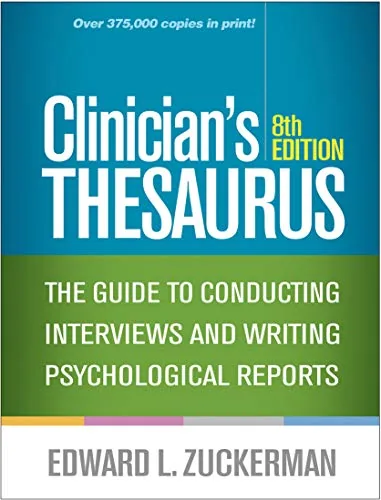
Clinician's Thesaurus, 8th Edition: The Guide to Conducting Interviews and Writing Psychological Reports
By Edward L. Zuckerman
About this ebook
Clinician's Thesaurus, 8th Edition helps mental health professionals put clinical observations into clear language. Edward L. Zuckerman brings together interview guidance, descriptive vocabulary, and report outlines for psychologists, counselors, social workers, and trainees. Its emphasis is the practical work of documenting symptoms, behavior, strengths, and assessment findings.
Inside this title
Descriptive vocabulary for mental status observations and client presentations
Current listed price $14.99Regular price $30.00Digital ebook
Clinical documentation requires choices about both content and wording. Zuckerman organizes alternative terms and phrases around the information clinicians gather, including appearance, mood, affect, thought, cognition, and insight. The reference connects interviewing with the written account that follows, giving readers a way to consider how observations become descriptions.
Report outlines address the progression from referral questions to findings, summaries, and recommendations. Treatment planning, progress notes, and sensitive subjects such as trauma and substance use also receive attention. Graduate students can use the volume while learning documentation conventions, while practitioners can consult particular sections when describing a presentation or organizing an assessment report.
Study guide included
Inside Clinician's Thesaurus, 8th Edition: The Guide to Conducting Interviews and Writing Psychological Reports.
Two clinicians can observe the same client and write radically different notes. Zuckerman's reference narrows that gap by pairing interview guidance with the vocabulary and report structures used to turn an hour of talk into a single defensible clinical record.
The volume is organised around what clinicians actually collect. It begins with the interview: referral questions, history, and the observations that structure a session. A large descriptive vocabulary follows, grouped by domain such as appearance, mood, affect, thought process, cognition, and insight, with alternative phrasings for findings that resist easy wording. Report outlines then show how those descriptions become findings, summaries, and recommendations. Treatment planning, progress notes, and sensitive areas including trauma and substance use receive their own treatment. It is a reference for wording, not a substitute for judgment.
The interview as inquiry
The interview is presented as a structured gathering process shaped by the referral question. History, current concerns, and direct observation each contribute different information, and the book shows how to keep them distinct. Wording matters here too, since the questions asked determine what a client is able to describe in response.
Begin from the referral question
Separate history from present observation
Ask questions that invite specific description
Topic 1
Appearance, speech, and behaviour
Observable presentation is described in concrete, non-judgmental terms. Appearance, grooming, posture, eye contact, speech rate, and motor behaviour give the report a factual base. The vocabulary offered favours description over inference, so that a reader of the report can tell what was seen rather than what the clinician concluded.
Describe behaviour rather than infer
Use concrete, non-judgmental terms
Distinguish observation from interpretation
Topic 2
Mood, affect, and thought
Mood and affect are separated, since one is reported and the other observed. The section supplies language for range, congruence, and stability, then moves to thought process and content, including the terms used for disordered form and fixed beliefs. Precision here matters because imprecise wording can overstate or understate what the interview revealed.
Separate reported mood from observed affect
Describe range, congruence, and stability
Distinguish thought process from content
Topic 3
Cognition, insight, and judgment
Cognitive findings, insight, and judgment are described with attention to their implications for functioning and risk. The reference distinguishes what was tested from what was inferred, and it offers alternatives when a client's presentation does not fit a familiar phrase. This is where careless wording most easily becomes an unintended clinical claim.
Note what was assessed versus inferred
Describe insight and judgment specifically
Avoid wording that overstates findings
Topic 4
Strengths and functional impact
Reports are not only catalogues of deficits. The book includes language for strengths, coping, supports, and functional impact, which keeps the description balanced and useful for planning. Describing what a client can do, and under what conditions, often says more about prognosis than a list of symptoms alone.
Record strengths and supports
Describe function, not just symptoms
Balance deficits with capacities
Topic 5
Reports, plans, and sensitive topics
Report outlines trace the path from referral question to findings, summary, and recommendations, with attention to what belongs in each. Treatment plans and progress notes require a different, more compressed language. Trauma and substance use are treated with care, since the standard phrasing in those areas can easily become stigmatising or legally consequential.
Follow referral to findings to recommendations
Compress language for notes and plans
Choose wording carefully for sensitive material
Topic 6-7
Topic map
Structuring the Clinical InterviewTopic 1
Appearance, Speech, and BehaviourTopic 2
Mood, Affect, and ThoughtTopic 3
Cognition, Insight, and JudgmentTopic 4
Strengths and Functional DescriptionTopic 5
Report Outlines and SummariesTopic 6
Treatment Plans, Progress Notes, and Sensitive TopicsTopic 7
Key takeaways
Describe what was observed before naming what it means, so the report shows its evidence.
Mood is reported and affect is observed; conflating them blurs two different findings.
Wording carries legal and clinical weight, especially in notes about trauma, risk, and substance use.
Graduate students learning documentation conventions, plus psychologists, counselors, and social workers who want consistent language for interviews, mental status descriptions, and written clinical assessment reports.
Topics covered
clinical interviewing
mental status exam
psychological reports
descriptive vocabulary
progress notes
treatment planning
clinical documentation
clinical writing
Questions about this ebook.
Edition, audience, and study-guide details at a glance.
What is Clinician's Thesaurus, 8th Edition: The Guide to Conducting Interviews and Writing Psychological Reports about?
Clinician's Thesaurus, 8th Edition helps mental health professionals put clinical observations into clear language. Edward L. Zuckerman brings together interview guidance, descriptive vocabulary, and report outlines for psychologists, counselors, social workers, and trainees. Its emphasis is the practical work of documenting symptoms, behavior, strengths, and assessment findings.
Which edition of Clinician's Thesaurus, 8th Edition: The Guide to Conducting Interviews and Writing Psychological Reports is this?
This listing is for the 8th edition. Check the title, ISBN, and book details above before ordering, especially if your course or reading list names a specific edition.
Who is Clinician's Thesaurus, 8th Edition: The Guide to Conducting Interviews and Writing Psychological Reports for?
Graduate students learning documentation conventions, plus psychologists, counselors, and social workers who want consistent language for interviews, mental status descriptions, and written clinical assessment reports.
Does this page include a study guide?
Yes. This page includes an original study guide with six thematic sections, key takeaways, and a topic map for structured reading.