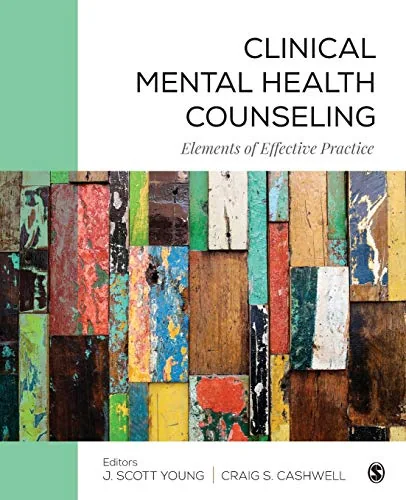
Clinical Mental Health Counseling: Elements of Effective Practice
By J. Scott Young, Craig S. Cashwell
About this ebook
Clinical Mental Health Counseling: Elements of Effective Practice introduces the profession's foundations and applied work in community and healthcare settings. J. Scott Young and Craig S. Cashwell address graduate counseling students and educators, connecting professional identity, ethics, multicultural competence, assessment, treatment planning, crisis work, and collaboration across services.
Inside this title
Professional foundations, counselor identity, advocacy, and ethical responsibilities
Current listed price $34.99Regular price $78.00Digital ebook
The book places clinical mental health counseling within its historical, philosophical, and organizational contexts. Professional identity and advocacy are considered alongside ethical and legal responsibilities, helping readers understand the counselor's role within agencies, managed care, and interdisciplinary healthcare relationships.
Applied coverage moves into assessment, diagnosis, treatment planning, crisis intervention, and culturally responsive work. Cases, discussion questions, and exercises connect these topics with decisions that arise during training and practice. Sample planning materials and supervision scenarios provide additional practical contexts. Graduate students beginning clinical mental health counseling programs can use the text for professional orientation, while educators and supervisors can draw on its examples when connecting classroom concepts with community-based clinical work.
Study guide included
Inside Clinical Mental Health Counseling: Elements of Effective Practice.
Counseling is practised inside institutions, not in a vacuum. Young and Cashwell introduce the profession as a set of roles, obligations, and relationships, then connect that identity to the practical work of assessing, planning, and responding when a client is in crisis.
The book begins with context: the history and philosophy of clinical mental health counseling, the formation of professional identity, and the advocacy role counselors take on. Ethical and legal duties are treated as part of practice rather than a separate list of rules. From there it turns to assessment, diagnosis, and treatment planning, with examples of how documentation and planning look in real agencies. Multicultural competence runs through these sections instead of sitting apart. Crisis intervention, collaboration with other services, and supervision scenarios round out the applied material.
Identity and professional context
Professional identity is presented as something built from history, philosophy, and daily role expectations. Counselors work within agencies, managed care, and interdisciplinary teams, and each setting shapes what the role looks like. Advocacy is included here, since the profession's claim to serve clients extends to arguing for conditions that make good care possible.
Trace the profession's history and philosophy
Describe the counselor's role in agencies
Connect advocacy to client welfare
Topic 1
Ethics and legal duties
Ethical practice is treated as ordinary clinical work rather than a compliance layer added afterwards. Confidentiality, informed consent, boundaries, competence, and mandated reporting are examined through situations where duties conflict. The legal framework appears alongside the ethical one, because counselors must often act where both apply and neither gives a clean answer.
Apply confidentiality and its limits
Recognise boundary and competence issues
Know reporting duties and their triggers
Topic 2
Multicultural competence in practice
Culture is not a module appended to technique but a dimension of every clinical encounter. The text examines how assumptions about family, distress, help-seeking, and authority shape assessment and relationship. Culturally responsive practice requires counselors to notice their own framing, invite the client's, and adapt rather than apply a default norm.
Examine your own cultural assumptions
Adapt assessment to the client's context
Invite the client's own explanatory frame
Topic 3
Assessment, diagnosis, and planning
Assessment gathers information through interview, instruments, and collateral sources, and diagnosis organises that information without exhausting it. Treatment planning turns both into goals, interventions, and measures of progress. The book keeps documentation in view, since plans are also records that must satisfy agencies and payers while remaining clinically meaningful.
Combine interview, instruments, and collateral
Use diagnosis without reducing the client to it
Write plans with goals and measures
Topic 4-5
Crisis intervention and safety
Crisis work compresses assessment and action into a short window. The material covers risk appraisal, immediate safety, de-escalation, and referral, with attention to the counselor's own regulation under pressure. It also considers the aftermath: documentation, consultation, and the effect of a crisis on the ongoing therapeutic relationship.
Appraise risk and establish immediate safety
De-escalate before exploring history
Document and consult after a crisis
Topic 6
Collaboration, consultation, and supervision
Counselors rarely work alone. Collaboration with medical providers, social services, and schools requires clear communication about roles and confidentiality. Supervision scenarios show trainees raising uncertainty, receiving feedback, and learning to use consultation as a routine part of practice rather than a sign of inadequacy early in training.
Clarify roles across services
Communicate within confidentiality limits
Use supervision as routine practice
Topic 7
Topic map
Professional Identity and HistoryTopic 1
Ethical and Legal ResponsibilitiesTopic 2
Multicultural and Social Justice PracticeTopic 3
Assessment and DiagnosisTopic 4
Treatment Planning and DocumentationTopic 5
Crisis InterventionTopic 6
Collaboration and SupervisionTopic 7
Key takeaways
Counselor identity is shaped by setting, so knowing the agency and its constraints is part of competence.
Ethics is exercised in conflicts among duties, not by memorising a list of prohibited acts.
Cultural responsiveness belongs inside assessment and planning, not in a separate diversity unit.
Graduate students entering clinical mental health counseling programs, plus educators and site supervisors who connect classroom foundations directly with agency-based practice, supervision, and interdisciplinary care in community settings.
Topics covered
clinical mental health counseling
professional identity
counselor ethics
multicultural competence
treatment planning
crisis intervention
clinical supervision
collaborative care
Questions about this ebook.
Edition, audience, and study-guide details at a glance.
What is Clinical Mental Health Counseling: Elements of Effective Practice about?
Clinical Mental Health Counseling: Elements of Effective Practice introduces the profession's foundations and applied work in community and healthcare settings. J. Scott Young and Craig S. Cashwell address graduate counseling students and educators, connecting professional identity, ethics, multicultural competence, assessment, treatment planning, crisis work, and collaboration across services.
Who is Clinical Mental Health Counseling: Elements of Effective Practice for?
Graduate students entering clinical mental health counseling programs, plus educators and site supervisors who connect classroom foundations directly with agency-based practice, supervision, and interdisciplinary care in community settings.
Does this page include a study guide?
Yes. This page includes an original study guide with six thematic sections, key takeaways, and a topic map for structured reading.