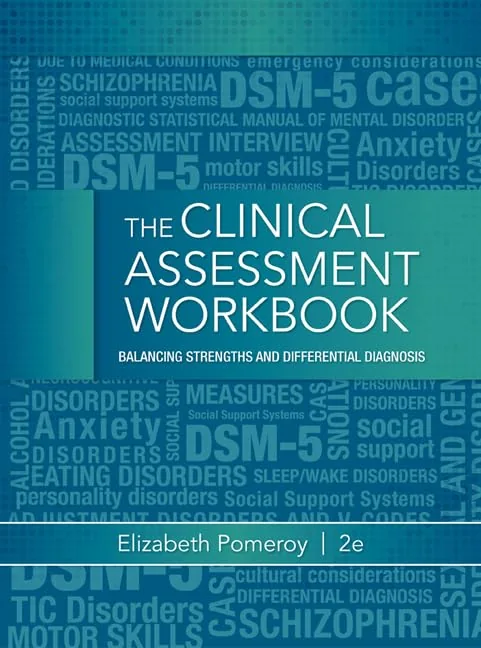
Clinical Assessment Workbook: Balancing Strengths and Differential Diagnosis, 2nd Edition
By Elizabeth Pomeroy
About this ebook
Clinical Assessment Workbook, 2nd Edition pairs differential diagnosis with attention to client strengths and resources. Elizabeth Pomeroy uses cases, worksheets, and guided exercises to develop assessment reasoning within a biopsychosocial framework. The workbook is intended for social work, counseling, and psychology students learning to connect DSM-5 concepts with individual circumstances.
Inside this title
Case exercises balancing diagnostic questions with client strengths and resources
Current listed price $30.99Regular price $75.00Digital ebook
Case-based exercises require readers to consider more than a list of symptoms. Biological, psychological, and social information are brought together as part of assessment, while client abilities and available resources remain visible alongside difficulties. This dual emphasis gives students a way to practice diagnostic distinctions without reducing a person to a diagnostic category.
The second edition uses DSM-5 concepts to examine overlapping presentations, differential diagnosis, and the relationship between assessment and treatment planning. Structured worksheets help organize information, and ethical and cultural questions address the assumptions that can shape conclusions. Instructors and graduate students can use the cases for discussion, written assessment exercises, and comparison of clinical formulations.
A study guide to Pomeroy's workbook, which pairs differential diagnosis with attention to client strengths and resources. It follows the biopsychosocial frame, DSM-5 distinctions, structured worksheets, and the ethical and cultural questions that shape assessment, for social work, counseling, and psychology students learning clinical reasoning.
The workbook asks readers to work with cases rather than memorize symptom lists. Biological, psychological, and social information are brought together, and client abilities and resources remain visible alongside difficulties. DSM-5 concepts support examination of overlapping presentations, differential diagnosis, and the link between assessment and treatment planning. Structured worksheets organize information, while ethical and cultural questions address assumptions that can shape conclusions. Cases serve for discussion, written assessment exercises, and comparison of formulations. This guide arranges the material into six themes with a topic map.
The Biopsychosocial Assessment Framework
The biopsychosocial frame requires biological, psychological, and social information to be gathered and weighed together. The theme treats this as a discipline: no single strand explains a presentation on its own. Using the frame consistently keeps assessment from collapsing into a symptom checklist and supports formulation that reflects the person's circumstances.
Biological, psychological, and social strands
Weighing all information together
No single strand explaining everything
Frame preventing checklist assessment
Book description - biopsychosocial framework
Strengths-Based Reasoning in Diagnosis
Client strengths and resources are kept visible alongside difficulties. The theme asks readers to assess capacity as carefully as they assess problems, since a formulation that records only deficits gives little basis for planning. Balancing the two is presented as a reasoning skill practiced through the cases rather than a stated value.
Assessing capacity alongside difficulties
Resources as part of the picture
Deficit-only formulations limiting planning
Balance practiced through cases
Book description - client strengths and available resources
DSM-5 Differential Diagnosis Practice
DSM-5 concepts structure the examination of overlapping presentations. The theme focuses on distinguishing among conditions that share features, and on the reasoning that separates them. Diagnosis is treated as a working formulation to be revisited, which matters when presentations are mixed or change over the course of contact.
Overlapping presentations and shared features
Reasoning that distinguishes conditions
Diagnosis as working formulation
Revisiting when presentations change
Book description - DSM-5 concepts and differential diagnosis
Structured Worksheet and Formulation Practice
Worksheets give the assessment a consistent shape and make reasoning visible. The theme presents them as tools for organizing information rather than forms to fill mechanically. A completed worksheet should show how conclusions were reached, which allows an instructor or supervisor to follow the reasoning and identify where it is thin.
Worksheets giving assessment consistent shape
Organizing information rather than filling forms
Showing how conclusions were reached
Supervision following the reasoning
Book description - structured worksheets and guided exercises
Cultural and Ethical Context
Ethical and cultural questions address the assumptions that shape conclusions. The theme asks readers to consider how norms, expectations, and their own perspective influence what they notice and how they interpret it. Cultural context is treated as part of accurate assessment, not a separate sensitivity topic added at the end.
Assumptions shaping clinical conclusions
Cultural norms and expectations
The assessor's own perspective
Context as part of accuracy
Book description - ethical and cultural questions
Assessment to Treatment Planning
The final theme connects assessment with treatment planning, so that formulation informs what happens next. Goals, focus, and the use of client resources follow from the assessment rather than being chosen independently. Cases invite readers to check whether a plan is supported by the information they gathered or rests on assumptions left unexamined.
Formulation informing the plan
Goals following from assessment
Using client resources in planning
Checking plans against gathered information
Book description - assessment and treatment planning
Topic map
Biopsychosocial Information GatheringTopic 1
Strengths and Resources in AssessmentTopic 2
Overlapping Presentations and Differential DiagnosisTopic 3
Structured Worksheets and FormulationTopic 4
Ethical Questions in AssessmentTopic 5
Cultural Context and AssumptionsTopic 6
Connecting Assessment to Treatment PlanningTopic 7
Key takeaways
Assessing strengths with the same care as symptoms produces a formulation you can plan from.
Differential diagnosis is a reasoning process, not the selection of a single label.
Assumptions left unexamined become part of the diagnosis whether or not they are accurate.
Graduate social work, counseling, and psychology students practicing assessment with cases, and instructors seeking structured exercises for formulation, differential diagnosis, and treatment planning discussions in class.
Topics covered
clinical assessment
differential diagnosis
DSM-5 diagnosis
biopsychosocial assessment
client strengths
treatment planning
assessment worksheets
cultural context
Questions about this ebook.
Edition, audience, and study-guide details at a glance.
What is Clinical Assessment Workbook: Balancing Strengths and Differential Diagnosis, 2nd Edition about?
Clinical Assessment Workbook, 2nd Edition pairs differential diagnosis with attention to client strengths and resources. Elizabeth Pomeroy uses cases, worksheets, and guided exercises to develop assessment reasoning within a biopsychosocial framework. The workbook is intended for social work, counseling, and psychology students learning to connect DSM-5 concepts with individual circumstances.
Which edition of Clinical Assessment Workbook: Balancing Strengths and Differential Diagnosis, 2nd Edition is this?
This listing is for the 2nd edition. Check the title, ISBN, and book details above before ordering, especially if your course or reading list names a specific edition.
Who is Clinical Assessment Workbook: Balancing Strengths and Differential Diagnosis, 2nd Edition for?
Graduate social work, counseling, and psychology students practicing assessment with cases, and instructors seeking structured exercises for formulation, differential diagnosis, and treatment planning discussions in class.
Does this page include a study guide?
Yes. This page includes an original study guide with six thematic sections, key takeaways, and a topic map for structured reading.