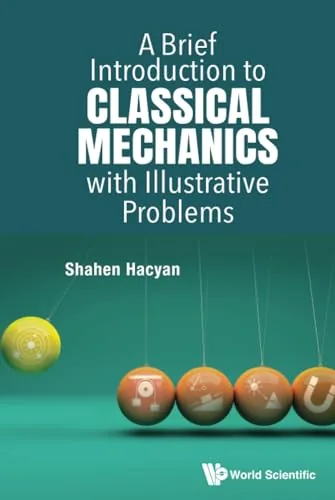
A Brief Introduction to Classical Mechanics with Illustrative Problems
By Shahen Hacyan
About this ebook
A Brief Introduction to Classical Mechanics with Illustrative Problems develops mechanics through derivations and worked applications. Shahen Hacyan addresses students who already know the basics, connecting Newtonian dynamics with Lagrangian and Hamiltonian methods while examining oscillations, rigid bodies, conservation principles, and the steps involved in solving physical problems.
Inside this title
Worked problems connect derivations with specific physical situations
Current listed price $8.99Regular price $17.00Digital ebook
Developed from lecture notes, Hacyan's text follows the mathematical reasoning behind mechanics formulas and then considers their use in specific physical situations. It revisits Newtonian laws before introducing generalized coordinates and the alternative formulations associated with Lagrange and Hamilton.
Illustrative problems accompany the theory, giving readers a way to follow the transition from physical assumptions to equations and solutions. Topics include damped and driven oscillations, rotational motion, inertia tensors, conservation laws, and phase space. Physics and engineering students with introductory mechanics experience can use the book for further study of analytical methods and for examining how different formulations describe the same underlying motion.
Study guide included
Inside A Brief Introduction to Classical Mechanics with Illustrative Problems.
Classical mechanics can be taught as a list of laws or as a set of reformulations that make hard problems tractable. This guide follows Hacyan's brief text from Newtonian foundations through generalized coordinates, Lagrange and Hamilton, oscillations, rigid bodies, and conservation, with attention to how worked problems carry the reasoning.
Hacyan's text is brief by design. It assumes prior exposure to mechanics and concentrates on the reasoning that connects assumptions to equations. Newtonian laws are revisited first, then recast through generalized coordinates and the Lagrangian. The Hamiltonian formulation and phase space extend the same systems into a different descriptive language. Oscillations, rotational motion, the inertia tensor, and conservation laws supply the physical ground for the mathematics. Worked problems are integral rather than appended, showing how a solution moves from a physical situation to a tractable equation and back to an interpretation.
Newtonian foundations revisited
The text revisits Newton's laws to establish the vocabulary and assumptions later formulations inherit. Force, mass, and acceleration are treated as the starting point rather than the whole subject. The review prepares readers to see what Lagrange and Hamilton preserve and what they replace.
Newton's laws set the shared vocabulary
Force and acceleration are the starting point
Later methods preserve some assumptions and replace others
Topic 1
Generalized coordinates and the Lagrangian
Generalized coordinates let a problem be described in terms that suit its constraints. The Lagrangian recasts motion through energy rather than force, and the book follows the derivations that connect the two views. The point is not to abandon Newton but to gain a method for complicated systems.
Coordinates are chosen to fit constraints
Energy replaces force as the organizing idea
The method extends rather than discards Newton
Topics 2-3
Hamiltonian formulation and phase space
The Hamiltonian formulation describes a system through positions and momenta, and phase space gives that description a geometry. The text presents the transformation from Lagrangian to Hamiltonian and shows what the new variables make visible. The treatment is brief but connects the formalism to physical interpretation.
Positions and momenta define the state
Phase space gives the description a geometry
New variables reveal different features
Topic 4
Damped and driven oscillations
Damped and driven oscillations provide the book's main testing ground for the formal methods. The discussion moves from the simple case to the effects of resistance and external forcing, using the mathematics to explain observed behaviour. These problems show how formulation choice affects tractability.
Resistance and forcing change the motion
The mathematics explains observed behaviour
Formulation choice affects tractability
Topic 5
Rigid bodies and the inertia tensor
Rotational motion introduces the inertia tensor and the complications of extended bodies. The text develops the description of rotation and applies it to problems where the distribution of mass matters. The section is where the analytical machinery earns its keep.
Extended bodies require more than a point mass
The inertia tensor describes mass distribution
Rotation problems test the formalism
Topic 6
Conservation laws and problem strategy
Conservation laws are used to shortcut brute-force solutions and to reveal what a system preserves. The worked problems show a strategy: identify the physical situation, choose coordinates, select a formulation, and interpret the result. Hacyan treats problem solving as part of the theory, not an appendix to it.
Conservation shortens some solutions
Coordinate choice is part of strategy
Interpretation closes the calculation
Topics 7-8
Topic map
Newtonian mechanics revisitedTopic 1
Generalized coordinatesTopic 2
Lagrangian formulationTopic 3
Hamiltonian formulation and phase spaceTopic 4
Damped and driven oscillationsTopic 5
Rigid bodies and the inertia tensorTopic 6
Conservation lawsTopic 7
Worked problems and solution strategyTopic 8
Key takeaways
Lagrangian and Hamiltonian methods change the description, not the underlying physics.
Oscillations and rigid bodies show where the formal machinery pays off.
Worked problems are part of the theory rather than an appendix to it.
Physics and engineering students who already know introductory mechanics and want a compact treatment of analytical methods with worked examples.
Topics covered
classical mechanics
Lagrangian mechanics
Hamiltonian mechanics
generalized coordinates
oscillations
rigid body rotation
inertia tensor
conservation laws
Questions about this ebook.
Edition, audience, and study-guide details at a glance.
What is A Brief Introduction to Classical Mechanics with Illustrative Problems about?
A Brief Introduction to Classical Mechanics with Illustrative Problems develops mechanics through derivations and worked applications. Shahen Hacyan addresses students who already know the basics, connecting Newtonian dynamics with Lagrangian and Hamiltonian methods while examining oscillations, rigid bodies, conservation principles, and the steps involved in solving physical problems.
Who is A Brief Introduction to Classical Mechanics with Illustrative Problems for?
Physics and engineering students who already know introductory mechanics and want a compact treatment of analytical methods with worked examples.
Does this page include a study guide?
Yes. This page includes an original study guide with six thematic sections, key takeaways, and a topic map for structured reading.