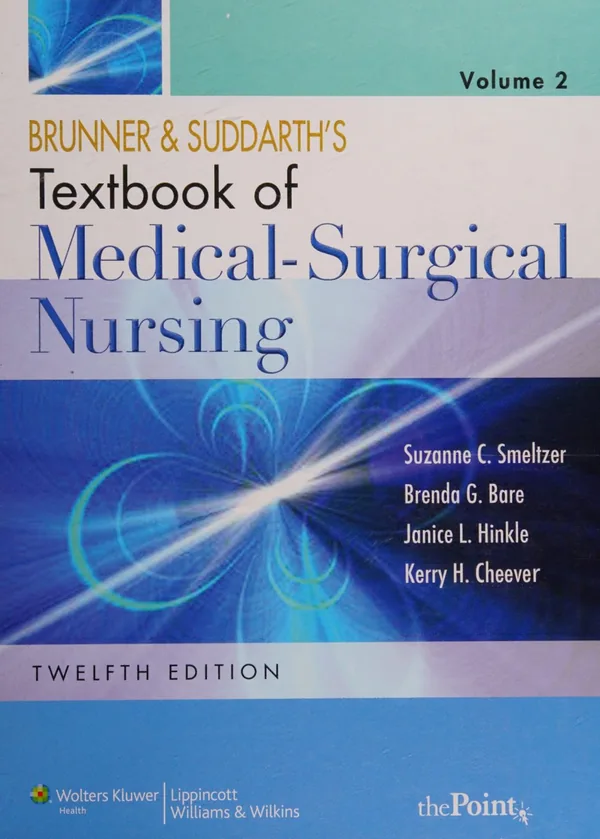
Edited by Suzanne C. Smeltzer, Brenda G. Bare, Janice L. Hinkle, Kerry H. Cheever
About this ebook
Volume 2 of Brunner & Suddarth's Textbook of Medical-Surgical Nursing, 12th Edition, belongs to a nursing text organized around body systems and patient-centered care. The work connects pathophysiology, assessment, nursing judgment, and care planning. It supports nursing students and educators studying the medical-surgical framework presented in the 2010 edition.
Inside this title
Volume 2 of the twelfth-edition medical-surgical nursing text
Current listed price $24.99Regular price $109.00Digital ebook
Brunner & Suddarth's medical-surgical nursing text relates physiological processes to the assessment and care of adult patients. Its teaching approach brings together disease mechanisms, nursing diagnoses, interventions, and evaluation within a body-system organization. Psychosocial and cultural factors are considered alongside physical findings as part of understanding the patient's situation.
The twelfth edition uses care planning, clinical reasoning exercises, and review questions to connect subject knowledge with nursing decisions. It is written for students taking medical-surgical courses and educators developing related instruction. This listing identifies Volume 2 of the 2010 edition, so readers comparing the work with course reading lists should retain both the volume designation and edition when identifying the material.
Volume two of this nursing staple carries the reader from unstable physiology into the daily work of keeping a patient safe, mobile, fed and informed. The twelfth edition keeps pathophysiology close to assessment, then asks what the nurse will notice, say, document and revise as the situation shifts.
The volume opens with clinical reasoning, ethical judgment and the nursing process, then moves into fluid and electrolyte balance and the perioperative sequence. Respiratory, cardiovascular and hematologic units follow, grouped around breathing and circulation. Immunity, musculoskeletal function and tissue integrity come next, with burns and immobility treated as threats to independence rather than isolated events. Units on digestion, hormones, the kidney and reproduction link laboratory trends to what patients must manage at home. The final units cover neurologic and sensory assessment, then emergency and disaster nursing, where the setting changes faster than the plan.
Baseline, context and the nursing process
A number means little until it is set beside the patient's usual function, the speed of the change and whatever else is happening that hour. The opening chapters put history and examination next to diet, conversation, reading ability and social setting. From there the process runs through assessment, prioritization, planning, action and evaluation, with research, clinical skill and the patient's own aims all allowed to steer it.
Set numbers against a baseline
Let the patient name priorities
Loop back and revise the plan
Units 1–2
Deterioration and the surgical pathway
Pain, shifting electrolytes and poor perfusion rarely announce themselves one at a time; they move several observations together. The text teaches the nurse to name the function involved, the signs of decline and the reading that would confirm a reply. Perioperative chapters split responsibility across the three phases around an operation, each with its own handoff. Cancer care and the end of life then ask whether the plan still matches the patient's wishes.
Read change as a pattern
Say what would show response
Reconcile goals across transitions
Units 3–4
Air, blood and oxygen delivery
Breathlessness can originate in the airway, the pump, the vessels or the blood itself, and the units are arranged to make that overlap visible. Respiratory chapters follow ventilation and gas exchange; cardiovascular chapters add rhythm, output and tissue supply; units on blood cover oxygen transport and clotting. Immediate stabilization and longer recovery pull in different directions, so education, mobility and family support belong in the same plan as the acute response.
Trace the symptom across systems
Separate rescue from recovery
Plan for the discharge setting
Units 5–7
Immunity, movement and intact tissue
Resisting infection and the harm of an overactive response are two sides of the same immune story, and the book keeps them together. Skin and burns extend the theme of a barrier that has failed. Musculoskeletal chapters pair pain and mobility with the complications of staying still, so rehabilitation is not an afterthought. Function is the measure: what the person managed previously, what they manage now, and who helps close the gap.
Treat inflammation as defense and damage
Protect skin under pressure
Measure independence, not intention
Units 8–9, 14
Intake, hormones and elimination
Digestive, endocrine, renal and reproductive chapters share a concern with what enters, what is regulated and what leaves. Because the systems overlap, a change in appetite or urine output can disturb several laboratory values at once, and the timeline matters more than any single reading. Teaching is tied to routines and obstacles rather than to instructions, with sensitive assessment given room in the reproductive and breast material.
Build a timeline of intake and output
Teach around real routines
Check understanding before discharge
Units 10–13
Senses, settings and continuity
Sight, hearing and equilibrium shape how a patient takes in an explanation, and neurologic assessment separates a new deficit from a longstanding one. Comparing with prior function is the discipline that runs through both units. The closing chapters move into infection, emergency care and disaster response, where resources tighten and teams change mid-course. Continuity then depends on handing over status and outstanding actions plainly, not on assuming everything has been read by those who follow.
Compare against previous ability
Check access before judging cognition
Hand over what is still pending
Units 15–17
Chapter and section map
Critical Thinking, Ethical Decision Making, and the Nursing ProcessCh. 3
Fluid and Electrolytes: Balance and DisturbanceCh. 13
Perioperative Concepts and Nursing ManagementUnit 4
Gas Exchange and Respiratory FunctionUnit 5
Cardiovascular and Circulatory FunctionUnit 6
Metabolic and Endocrine FunctionUnit 11
Assessment of Neurologic FunctionCh. 65
Emergency NursingCh. 72
Key takeaways
Judge a new finding against the patient's baseline, the timing and the direction of change.
Attach every priority to the observations behind it and to the reassessment that would prove a response.
Carry goals, communication needs and available help across every team and setting change.
Nursing students and instructors working through medical-surgical coursework, plus new graduates and bedside nurses who want a structured way to reason from assessment to a workable, communicable plan.
Topics covered
medical-surgical nursing
nursing process
patient assessment
perioperative care
fluid and electrolytes
care planning
clinical reasoning
patient education
Questions about this ebook.
Edition, audience, and study-guide details at a glance.
What is Brunner & Suddarth's Textbook of Medical-Surgical Nursing, 12th Edition, Volume 2 about?
Volume 2 of Brunner & Suddarth's Textbook of Medical-Surgical Nursing, 12th Edition, belongs to a nursing text organized around body systems and patient-centered care. The work connects pathophysiology, assessment, nursing judgment, and care planning. It supports nursing students and educators studying the medical-surgical framework presented in the 2010 edition.
Which edition of Brunner & Suddarth's Textbook of Medical-Surgical Nursing, 12th Edition, Volume 2 is this?
This listing is for the 12th edition. Check the title, ISBN, and book details above before ordering, especially if your course or reading list names a specific edition.
Who is Brunner & Suddarth's Textbook of Medical-Surgical Nursing, 12th Edition, Volume 2 for?
Nursing students and instructors working through medical-surgical coursework, plus new graduates and bedside nurses who want a structured way to reason from assessment to a workable, communicable plan.
Does this page include a study guide?
Yes. This page includes an original study guide with six thematic sections, key takeaways, and a chapter and section map for structured reading.