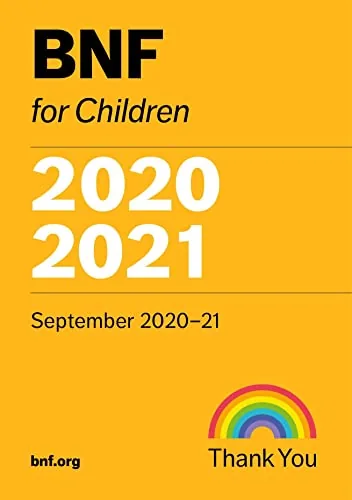
BNF for Children 2020-2021 is the edition-specific British National Formulary for Children reference on pediatric medicines. Its drug information addresses dosing, formulations, interactions, adverse reactions, and prescribing considerations across childhood. The volume is relevant to healthcare students, pharmacists, and clinicians studying the medicines guidance represented by its 2020-2021 publication period.
Inside this title
Pediatric drug monographs from the 2020-2021 formulary edition
Current listed price $14.00Regular price $36.00Digital ebook
This 2020-2021 formulary gathers information on medicines used in neonates, infants, children, and adolescents. Drug monographs are accompanied by material on age- and weight-related dosing, routes of administration, suitable formulations, and practical considerations in giving medicines to children. Interactions and adverse reactions form part of the reference coverage.
The volume also discusses unlicensed and off-label use, professional responsibilities, and medicines used in acute pediatric situations. Its organization is intended for reference and training in pediatric pharmacology and prescribing. As a dated annual edition, it documents the information and regulatory context of 2020-2021, which is relevant when comparing editions or studying the development of pediatric medicines guidance.
Study guide included
Inside BNF for Children 2020-2021.
This annual formulary collects the medicines guidance used for newborns, children, and adolescents in the 2020-2021 period. Dosing, formulations, interactions, and prescribing responsibilities are gathered in one reference, so the edition's date is part of what it documents rather than an incidental detail.
The volume gathers information on medicines used from the neonatal period through adolescence. Drug monographs are set alongside material on age- and weight-related dosing, routes of administration, suitable formulations, and the practical business of giving medicines to children. Interactions and adverse reactions form part of the coverage, as do unlicensed and off-label use and the professional responsibilities attached to prescribing. Acute paediatric situations receive attention, and the whole is arranged for reference and training in paediatric pharmacology. Because it is a dated annual edition, it records the guidance and regulatory context of a particular year, which matters when editions are compared or when the development of paediatric prescribing is studied.
A formulary fixed in time
The book is an annual edition, and its value depends on recognising that. Guidance changes as evidence and regulation change, so the 2020-2021 volume documents a specific moment rather than a permanent standard. Readers are pushed to notice the edition date, to ask what has since been revised, and to treat the text as a historical record as well as a working reference.
Read the date as part of the content
Ask what has since changed
Treat editions as historical records
Topic 1
Dosing across childhood stages
Dosing information is organised around the stages of childhood, from neonates and infants through older children to adolescents. Age and weight both matter, and the book sets out how these variables shape the amount and frequency of a medicine. The staged treatment reflects the fact that a child is not simply a smaller adult, and that prescribing must account for development.
Account for age and weight
Treat children as developing patients
Follow staged dosing guidance
Topic 2
Formulations and routes of administration
The text considers which formulations suit which patients and how medicines are actually given. Routes of administration and the practical difficulties of administering to children are treated as part of prescribing rather than an afterthought. Formulation choice can determine whether a treatment is taken as intended, so the book gives it serious attention.
Match formulation to the patient
Treat administration as clinical
Consider whether a dose is taken
Topic 3
Interactions and adverse reactions
Safety information runs through the monographs. Interactions and adverse reactions are set out so that prescribers can anticipate problems rather than discover them, and the reference assumes that medicines are rarely given in isolation. This coverage supports the kind of checking that paediatric prescribing demands, where a small margin can matter and where several products may be involved at once.
Anticipate interactions before prescribing
Check for adverse reactions
Assume medicines are combined
Topic 4
Unlicensed and off-label use
The formulary addresses the use of medicines outside their licence, a recurring reality in paediatric care. It frames such use in relation to professional responsibility, so the reader meets it as a question of justification and accountability rather than a loophole. The discussion connects prescribing decisions to the evidence available and to the clinician's duty toward the child.
Recognise when use is off-label
Frame it as professional responsibility
Connect decisions to evidence
Topic 5
Responsibility and acute care
Professional responsibilities and the medicines used in acute paediatric situations close the coverage. The book treats prescribing as an accountable act, shaped by training, guidance, and the immediate needs of a sick child. Acute care shows the reference under pressure, where correct dosing and formulation choices must be made quickly, and where the guidance has to be usable rather than merely complete.
Treat prescribing as accountable
Prepare for acute situations
Keep guidance usable under pressure
Topic 6
Topic map
Edition Context and Formulary ScopeTopic 1
Dosing for Children and NeonatesTopic 2
Formulations and RoutesTopic 3
Interactions and Adverse ReactionsTopic 4
Unlicensed and Off-Label UseTopic 5
Professional Responsibility and Acute CareTopic 6
Key takeaways
An annual formulary documents one year's guidance, so the edition date belongs to the meaning of the text.
Paediatric prescribing turns on age, weight, formulation, and administration, not on scaling an adult dose.
Off-label use in children is met as a question of justification and accountability, not as a loophole.
Healthcare students, pharmacists, and clinicians who need to study paediatric medicines guidance as represented in the 2020-2021 edition, including its dosing, safety, and prescribing conventions.
Topics covered
paediatric formulary
children medicines
age and weight dosing
drug interactions
adverse reactions
off-label prescribing
clinical pharmacology
Questions about this ebook.
Edition, audience, and study-guide details at a glance.
What is BNF for Children 2020-2021 about?
BNF for Children 2020-2021 is the edition-specific British National Formulary for Children reference on pediatric medicines. Its drug information addresses dosing, formulations, interactions, adverse reactions, and prescribing considerations across childhood. The volume is relevant to healthcare students, pharmacists, and clinicians studying the medicines guidance represented by its 2020-2021 publication period.
Who is BNF for Children 2020-2021 for?
Healthcare students, pharmacists, and clinicians who need to study paediatric medicines guidance as represented in the 2020-2021 edition, including its dosing, safety, and prescribing conventions.
Does this page include a study guide?
Yes. This page includes an original study guide with six thematic sections, key takeaways, and a topic map for structured reading.