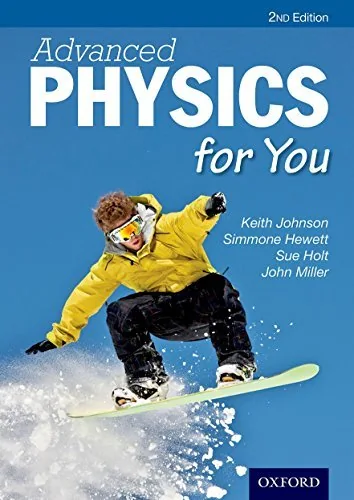
By Keith Johnson, Simmone Hewett, Sue Holt, John Miller
About this ebook
Advanced Physics for You, 2nd Edition, presents AS and A-level physics through short topic spreads, diagrams, worked examples, and practice questions. Keith Johnson, Simmone Hewett, Sue Holt, and John Miller cover mechanics, electricity, waves, thermal physics, quantum ideas, and nuclear physics for classroom learning and independent revision.
Inside this title
Short topic spreads with diagrams and examples
Current listed price $20.00Regular price $47.00Digital ebook
Single-page topics and facing-page spreads divide advanced secondary physics into manageable sections. Diagrams, worked calculations, and step-by-step derivations connect physical ideas with their mathematical expression. The organization supports focused reading of a topic before attempting related questions, whether in class or during independent study.
Coverage includes motion, forces, energy, momentum, circuits, fields, electromagnetic induction, waves, and optics. Thermal, quantum, and nuclear physics extend the treatment beyond classical mechanics, with additional material on astrophysics and cosmology. Review and exam-style questions provide opportunities to apply the concepts. This second edition, identified in the source as the 2015 edition, is aimed at students studying AS and A-level physics.
Study guide included
Inside Advanced Physics for You, 2nd Edition.
Advanced Physics for You turns AS and A-level physics into short, self-contained spreads. Each topic pairs diagrams and worked calculations with practice questions, so readers can study one idea, follow its mathematics, and then test it. The guide follows that structure across mechanics, electricity, waves, thermal, quantum, nuclear, and astrophysics material.
The second edition, identified in the source as the 2015 edition, divides advanced secondary physics into facing-page spreads. Diagrams, worked examples, and step-by-step derivations connect physical ideas with their mathematical expression, while review and exam-style questions let students apply what they have read. Coverage runs from motion and forces through circuits, fields, and induction to waves, optics, thermal, quantum, and nuclear physics, with additional material on astrophysics and cosmology. The organization supports focused reading before attempting related questions, whether in class or during independent revision.
Motion, forces, and energy
Kinematics describes how objects move, while forces explain why motion changes. The spread-based treatment connects displacement, velocity, and acceleration with Newton's laws, then links force and motion to work, energy, and power. Worked calculations show how to move between a physical situation and its equations, and practice questions test whether the relationship has been understood rather than memorized.
Link displacement, velocity, and acceleration
Apply Newton's laws to motion
Relate work, energy, and power
Topic 1 · Mechanics and Motion
Momentum and mechanical systems
Momentum gives a second way to analyze interactions, especially collisions and explosions where forces act over short times. The section connects conservation ideas with impulse and with the behavior of systems rather than single objects. Readers see how the same event can be described through energy or momentum, and how the choice of method depends on what the question asks.
Use conservation to analyze collisions
Connect impulse with change in momentum
Choose energy or momentum by question
Topic 2 · Forces, Energy, and Momentum
Circuits, fields, and induction
Electrical topics move from current, voltage, and resistance in circuits to the fields that surround charges and currents. The treatment then connects changing magnetic flux with induced current, tying together electricity and magnetism. Worked derivations make the mathematics visible, and questions ask students to apply the relationships to unfamiliar arrangements rather than recall a single result.
Relate current, voltage, and resistance
Describe fields around charges and currents
Connect changing flux to induced current
Topics 3–4 · Electricity, Fields, and Induction
Waves, superposition, and optics
Wave topics cover the behavior of oscillations, superposition, and the interference patterns that follow. Optics then applies wave ideas to reflection, refraction, and image formation. The spread format pairs each phenomenon with a diagram and a worked example, so students can see how a general principle produces a specific measured result before attempting similar questions.
Describe superposition and interference
Apply wave ideas to reflection and refraction
Connect diagrams to worked examples
Topic 5 · Waves and Optics
Thermal, quantum, and nuclear physics
This section extends the course beyond classical mechanics into thermal behavior, quantum ideas, and nuclear processes. Each area introduces concepts that challenge everyday intuition, and the text uses diagrams and calculations to make them concrete. Rather than separating topics into isolated facts, the treatment shows how evidence and models combine to explain phenomena that cannot be seen directly.
Connect thermal behavior to models
Approach quantum ideas through evidence
Relate nuclear processes to observations
Topics 6–7 · Thermal, Quantum, and Nuclear Physics
Astrophysics, cosmology, and exam practice
The final material applies physics to stars, galaxies, and the wider universe, and it revisits the whole course through review and exam-style questions. Students are asked to combine ideas from different areas and to show their reasoning under time pressure. The aim is to turn topic-level understanding into the kind of connected performance an examination requires.
Apply physics to stars and galaxies
Combine ideas across course areas
Practice reasoning under exam timing
Topic 8 · Astrophysics and Cosmology
Topic map
Mechanics and MotionTopic 1
Forces, Energy, and MomentumTopic 2
Electricity and CircuitsTopic 3
Fields and Electromagnetic InductionTopic 4
Waves and OpticsTopic 5
Thermal PhysicsTopic 6
Quantum and Nuclear PhysicsTopic 7
Astrophysics and CosmologyTopic 8
Key takeaways
Study each spread, then attempt its questions before moving on to the next topic.
Follow derivations line by line so the mathematics stays tied to the physics.
Use review and exam-style questions to combine ideas across otherwise separate topics.
AS and A-level physics students, together with teachers and tutors, who want concise topic spreads, worked calculations, and exam-style practice for classwork and independent revision.
Topics covered
A-level physics
AS physics
worked examples
exam-style questions
mechanics topics
electricity and magnetism
waves and optics
quantum physics
astrophysics topics
Questions about this ebook.
Edition, audience, and study-guide details at a glance.
What is Advanced Physics for You, 2nd Edition about?
Advanced Physics for You, 2nd Edition, presents AS and A-level physics through short topic spreads, diagrams, worked examples, and practice questions. Keith Johnson, Simmone Hewett, Sue Holt, and John Miller cover mechanics, electricity, waves, thermal physics, quantum ideas, and nuclear physics for classroom learning and independent revision.
Which edition of Advanced Physics for You, 2nd Edition is this?
This listing is for the 2nd edition. Check the title, ISBN, and book details above before ordering, especially if your course or reading list names a specific edition.
Who is Advanced Physics for You, 2nd Edition for?
AS and A-level physics students, together with teachers and tutors, who want concise topic spreads, worked calculations, and exam-style practice for classwork and independent revision.
Does this page include a study guide?
Yes. This page includes an original study guide with six thematic sections, key takeaways, and a topic map for structured reading.