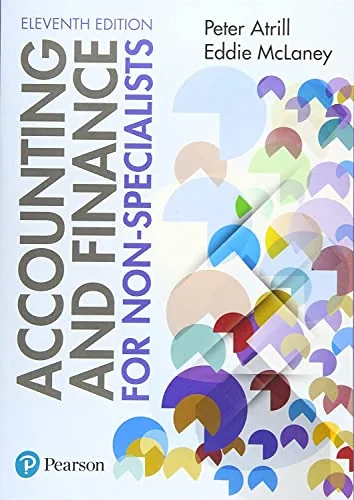
Accounting and Finance for Non-Specialists, 11th Edition
By Peter Atrill, Eddie McLaney
About this ebook
Accounting and Finance for Non-Specialists, 11th Edition, introduces financial accounting, management accounting, and financial management for students outside those specialisms. Peter Atrill and Eddie McLaney explain statements, costs, budgets, investment appraisal, and working capital. Examples and self-assessment activities connect numerical techniques with the business questions they help examine.
Inside this title
Financial statements and the mechanics of accounting records
Current listed price $9.99Regular price $24.00Digital ebook
Financial information becomes easier to interpret when its purpose is clear. Atrill and McLaney develop the basic accounting mechanisms before moving into the reading of income statements, balance sheets, and cash flow statements. The text then considers how managers use cost information, break-even analysis, and budgets to examine operating decisions.
Investment appraisal introduces methods including net present value, internal rate of return, and payback. Working capital topics connect inventories, receivables, payables, and cash with business liquidity. Examples, exercises, review problems, and self-assessment questions provide opportunities to work through the calculations. The eleventh edition is aimed at business and management students who need accounting literacy without pursuing specialist accounting training.
Study guide included
Inside Accounting and Finance for Non-Specialists, 11th Edition.
Atrill and McLaney introduce accounting and finance for students who will use financial information rather than prepare it professionally. Statements, costs, budgets, investment appraisal and working capital are explained through examples and self-assessment activities tied to business decisions. The emphasis is on interpretation, not bookkeeping drill.
The guide follows the text's movement from mechanics to judgement. It begins with the accounting equation and the records behind the statements, then shows how to read income statements, balance sheets and cash flow statements. Management accounting themes cover cost behaviour, break-even analysis and budgeting. Investment appraisal introduces net present value, internal rate of return and payback, while working capital connects inventory, receivables, payables and cash. Exercises and review questions are treated as part of learning the material. The eleventh edition assumes no specialist accounting background.
Accounting records and the equation
The accounting equation and double-entry recording explain how transactions become statements. The theme builds the mechanics that later interpretation depends on, so that figures on a balance sheet can be traced back to events rather than treated as fixed facts. Once the equation is secure, later topics can be read as variations on it.
Assets equal liabilities plus equity
Double entry keeps the equation balanced
Statements trace back to recorded transactions
Topic 1
Reading the financial statements
Income statements, balance sheets and cash flow statements answer different questions about a business. The theme shows how they connect, why profit differs from cash, and how ratios and comparisons turn a set of figures into an assessment of performance and position. Comparisons over time and against peers add context that a single year cannot supply.
Each statement answers a different question
Profit and cash are not the same
Ratios convert figures into assessment
Topics 2–3
Cost behaviour and break-even
Fixed and variable costs behave differently as activity changes, which makes break-even analysis possible. The theme covers contribution, margin of safety and the assumptions that limit simple cost models, and links them to decisions about pricing and volume. The model is a simplification, and its assumptions should be stated when it is used.
Fixed costs do not vary with output
Contribution covers fixed costs
Break-even models rest on simplifying assumptions
Topic 4
Budgets and operating control
Budgets translate plans into numbers and provide a basis for comparing intention with outcome. The theme explains preparation, variance analysis and the behavioural dimension of targets, noting that budgets can inform decisions or distort them depending on how they are used. Behavioural effects matter as much as numerical accuracy when budgets are used to manage people.
Budgets convert plans into figures
Variances compare plan with outcome
Targets can inform or distort behaviour
Topic 5
Investment appraisal methods compared
Net present value, internal rate of return and payback offer different ways to judge long-term projects. The theme compares their logic, especially the treatment of time and cash flow, and explains why a single method rarely settles an investment decision. Discounted cash flow methods share a logic that payback does not.
Net present value discounts future cash flows
Payback ignores cash flows after recovery
Methods can disagree on the same project
Topic 6
Working capital and liquidity
Inventory, receivables, payables and cash determine whether a profitable business can still run short of money. The theme covers the operating cycle and the trade-offs in managing each component, connecting liquidity to the statements and to everyday decisions. Managing each component involves a trade-off between liquidity and return.
Working capital ties up cash
The operating cycle drives liquidity needs
Profitable firms can still run out of cash
Topic 7
Topic map
Accounting Records and the EquationTopic 1
Income Statement and Balance SheetTopic 2
Cash Flow StatementsTopic 3
Cost Behaviour and Break-EvenTopic 4
Budgeting and ControlTopic 5
Investment AppraisalTopic 6
Working Capital and LiquidityTopic 7
Review and Self-AssessmentTopic 8
Key takeaways
Learn the accounting equation first; every later statement depends on that foundation.
Separate profit from cash, since a business can report both strong profit and dangerous illiquidity.
Know the assumptions behind each appraisal method before trusting a single number.
Business and management students, and professionals outside finance, who need accounting literacy for managerial decisions rather than specialist training, including readers preparing for introductory courses.
Topics covered
accounting for non-specialists
financial statements
management accounting
break-even analysis
budgeting basics
investment appraisal
working capital
Atrill and McLaney
Questions about this ebook.
Edition, audience, and study-guide details at a glance.
What is Accounting and Finance for Non-Specialists, 11th Edition about?
Accounting and Finance for Non-Specialists, 11th Edition, introduces financial accounting, management accounting, and financial management for students outside those specialisms. Peter Atrill and Eddie McLaney explain statements, costs, budgets, investment appraisal, and working capital. Examples and self-assessment activities connect numerical techniques with the business questions they help examine.
Which edition of Accounting and Finance for Non-Specialists, 11th Edition is this?
This listing is for the 11th edition. Check the title, ISBN, and book details above before ordering, especially if your course or reading list names a specific edition.
Who is Accounting and Finance for Non-Specialists, 11th Edition for?
Business and management students, and professionals outside finance, who need accounting literacy for managerial decisions rather than specialist training, including readers preparing for introductory courses.
Does this page include a study guide?
Yes. This page includes an original study guide with six thematic sections, key takeaways, and a topic map for structured reading.