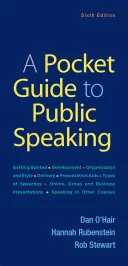
A Pocket Guide to Public Speaking, 6th Edition follows the speechmaking process from choosing a topic to delivering a presentation. Dan O'Hair, Hannah Rubenstein, and Rob Stewart offer a concise reference for college students and workplace speakers, covering audience analysis, organization, evidence, visual aids, informative speaking, and ethical persuasion.
Inside this title
Audience analysis, topic development, supporting material, and speech organization
Current listed price $19.99Regular price $35.00Digital ebook
The guide breaks speech preparation into connected tasks: defining purpose, considering the audience, developing a central idea, gathering support, and organizing material. Working and speaking outlines give readers ways to shape a presentation before moving into rehearsal and delivery.
Later guidance addresses speaking anxiety, voice, body language, and the use of slides, props, or handouts. Informative and persuasive speaking receive attention alongside the ethical handling of arguments and emotional appeals. Speech excerpts, checklists, and reference tables support the book's compact format. College public speaking students, professionals preparing presentations, and speakers developing confidence in English can use the sixth edition to review each stage of preparing and presenting a speech.
Study guide included
Inside A Pocket Guide to Public Speaking, 6th Edition.
Speaking well is mostly preparation made visible. This compact guide moves a talk from a vague topic toward a rehearsed delivery, treating audience, purpose, evidence, and structure as decisions to settle in order each time rather than improvise at the podium.
The book is organised as a sequence of practical stages rather than as essays on rhetoric. It opens with purpose and audience, moves through support and organisation, then turns to rehearsal, voice, and visual aids. Working and speaking outlines are kept separate so that planning is not confused with performing. Informative and persuasive speeches receive their own treatment, with attention to ethics, emotional appeal, and the handling of opposing views. Checklists, excerpts, and reference tables make the volume usable at a desk or in the minutes before a class.
Purpose and audience first
Every later choice depends on two answers: what the speech should accomplish and who will hear it. Audience analysis covers expectations, prior knowledge, and the setting, while a purpose statement keeps the talk from drifting. The guide treats this as front-loaded work, since a central idea is only useful once the speaker knows whom it serves.
Define one speech purpose
Profile listeners' knowledge and attitudes
State the central idea in a sentence
Topic 1
Supporting material and evidence
Examples, statistics, testimony, and narrative give a claim something to stand on. The guide asks speakers to test each item for relevance, credibility, and currency before it enters the speech, and to name sources aloud where listeners would otherwise wonder. Material is gathered broadly first, then cut, because a narrow search produces a thin argument.
Gather more material than you will use
Test relevance, credibility, and recency
Attribute sources where listeners can hear them
Topic 2
Outlines that guide structure
Main points should be few, parallel, and ordered by a logic the audience can follow. The working outline carries the full plan, including subpoints and evidence; the speaking outline reduces it to cues. Transitions and signposts are written deliberately, since a structure that exists only in the speaker's head rarely survives contact with an audience.
Keep main points few and parallel
Choose an order the audience can hear
Write transitions and signposts explicitly
Topic 3-4
Rehearsal, voice, and body
Delivery is treated as a skill built by repetition rather than a personality trait. Practice aloud reveals sentences that looked fine on paper, and it gives the speaker a chance to work on pace, volume, pauses, and eye contact. Speaking anxiety is addressed through preparation and gradual exposure, not through the promise of its disappearance.
Rehearse aloud, not silently
Work on pace, pauses, and volume
Reduce anxiety through preparation and practice
Topic 5
Visual aids as support
Slides, props, and handouts exist to help an audience follow an argument, not to hold the argument themselves. The guide stresses legibility, restraint, and timing: a visual that appears before the speaker explains it competes for attention, and a slide dense with text invites reading instead of listening.
Keep visuals legible and uncluttered
Introduce a visual when it is needed
Let the speaker carry the argument
Topic 6
Informative and persuasive ethics
Informative speaking aims at understanding, persuasive speaking at agreement or action, and the guide keeps the two goals distinct. Persuasion is examined through claims, reasons, evidence, and credibility, with emotional appeal treated as legitimate only when it rests on an honest case. Acknowledging opposing views and avoiding distortion are presented as part of arguing well.
Match the speech to its goal
Build persuasion from claims and evidence
Use emotion without manipulating the audience
Topic 7
Topic map
Purpose, Audience, and Central IdeaTopic 1
Gathering and Testing Supporting MaterialTopic 2
Organising Main Points and TransitionsTopic 3
Working and Speaking OutlinesTopic 4
Rehearsal, Voice, and Body LanguageTopic 5
Slides, Props, and HandoutsTopic 6
Informative and Persuasive SpeakingTopic 7
Key takeaways
Audience and purpose are settled before material is gathered, because they decide which evidence counts as relevant.
Separate the working outline from the speaking outline so that planning does not quietly become a script.
Slides and emotional appeals support a case; they cannot replace a claim with reasons behind it.
College public speaking students, instructors who want a compact reference, and workplace speakers preparing presentations, especially anyone building confidence in English-language delivery for the first time.
Topics covered
public speaking
audience analysis
speech outlines
visual aids
speaking anxiety
informative speaking
persuasive speaking
speech ethics
Questions about this ebook.
Edition, audience, and study-guide details at a glance.
What is A Pocket Guide to Public Speaking, 6th Edition about?
A Pocket Guide to Public Speaking, 6th Edition follows the speechmaking process from choosing a topic to delivering a presentation. Dan O'Hair, Hannah Rubenstein, and Rob Stewart offer a concise reference for college students and workplace speakers, covering audience analysis, organization, evidence, visual aids, informative speaking, and ethical persuasion.
Which edition of A Pocket Guide to Public Speaking, 6th Edition is this?
This listing is for the 6th edition. Check the title, ISBN, and book details above before ordering, especially if your course or reading list names a specific edition.
Who is A Pocket Guide to Public Speaking, 6th Edition for?
College public speaking students, instructors who want a compact reference, and workplace speakers preparing presentations, especially anyone building confidence in English-language delivery for the first time.
Does this page include a study guide?
Yes. This page includes an original study guide with six thematic sections, key takeaways, and a topic map for structured reading.