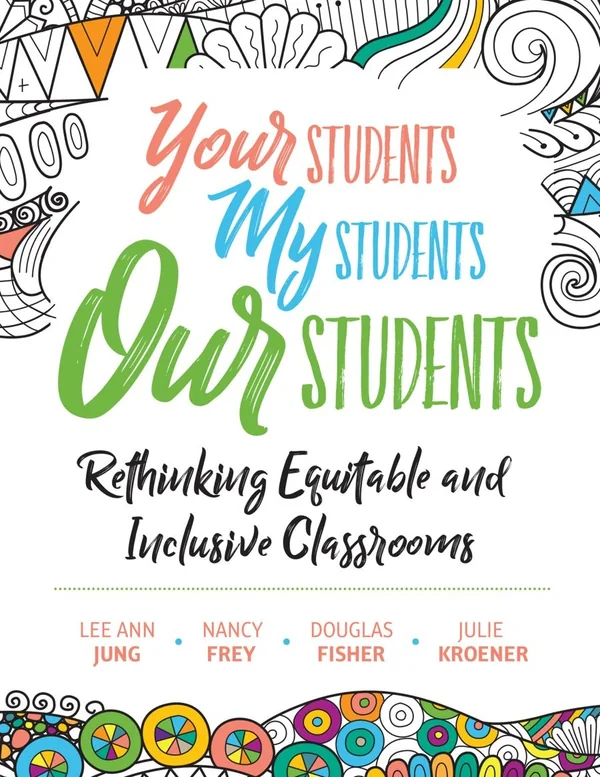
Your Students, My Students, Our Students: Rethinking Equitable and Inclusive Classrooms
By Lee Ann Jung, Nancy Frey, Douglas Fisher, Julie Kroener
About this ebook
Your Students, My Students, Our Students examines shared responsibility for learners across general and special education. Jung, Frey, Fisher, and Kroener organize their argument around changes to special education roles, placement, instruction, community, and leadership. School examples and reflection activities address K-12 teachers, administrators, and support teams working on equitable inclusion.
Inside this title
Examines shared responsibility across general and special education teams
Current listed price $11.99Regular price $24.00Digital ebook
The authors ask schools to reconsider how separate professional roles and placement decisions shape students' access to learning. Their five proposed disruptions address the purpose of special education, student placement, instruction and assessment, school community, and leadership. Inclusion is discussed as an organizational responsibility involving all adults who work with learners.
Examples show special educators as collaborative partners and explore accessible instruction, assessment of growth, and participation in grade-level content. Reflection questions and action steps provide material for individual reading and staff discussion. Classroom teachers, school leaders, and support personnel can use the book to examine the assumptions behind current arrangements and consider how collaboration relates to the opportunities available to students with differing needs.
Study guide included
Inside Your Students, My Students, Our Students: Rethinking Equitable and Inclusive Classrooms.
Inclusion fails when it is left to one department, the authors argue. Jung, Frey, Fisher and Kroener propose five disruptions that move shared responsibility across general and special education, from the purpose of services to placement, instruction, community and leadership, so that every adult who works with a learner owns the outcome.
The book's argument is structural: separate roles and separate rooms quietly decide which students reach grade-level content. Five disruptions take in why special education exists, where students are placed, how teaching and assessment work, what community means, and the role of leadership. Across them, special educators appear as collaborative partners rather than gatekeepers, and instruction is judged by access and growth rather than labels. Assessment of growth and participation in the general curriculum recur as the measures of whether inclusion is real. Reflection questions and action steps make the material usable in staff meetings, and examples keep the discussion tied to K-12 practice.
Shared ownership of every learner
The title states the thesis: a student belongs to the whole school, not to whichever adult is formally assigned. The authors argue that when ownership is divided by role, some learners fall into the gap between general and special education. Shared responsibility is presented as an organizational commitment rather than a sentiment.
Every adult owns every learner
Divided roles create gaps
Responsibility is structural, not sentimental
Topics 1-2
Rethinking the purpose of special education
The first disruption asks what special education is for. If its purpose is access to the general curriculum, then services should be judged by whether they deliver that access. The question unsettles arrangements that have become habitual and redirects attention from eligibility to outcome.
Define purpose before defending structures
Measure services by access delivered
Question habitual arrangements
Topic 1
Placement and access
Where a student is taught determines what a student can reach. The text examines placement decisions as access decisions, asking whether separate settings expand or restrict opportunity. The point is not that one setting always wins, but that placement should follow from the learning a student needs rather than from convenience or tradition.
Placement shapes access to content
Decisions should follow learning needs
Tradition is a weak justification
Topic 2
Instruction and assessment of growth
Accessible instruction and honest assessment are treated as a pair. If lessons are designed for a range of learners and assessment tracks growth rather than fixed labels, then progress becomes visible. The authors connect this to participation in grade-level content, so that support does not become a parallel, watered-down track.
Design instruction for a range of learners
Track growth instead of labels
Keep students in grade-level content
Topics 3-4
Community and belonging
Inclusion is also a matter of school community: whether students share spaces, routines and relationships. The book treats belonging as an outcome that leadership must cultivate, not something that follows automatically from placement. Community is where the abstract language of equity becomes visible to students day to day.
Shared spaces and routines matter
Belonging must be cultivated
Equity shows up in daily life
Topic 5
Leadership and collaboration
The last disruption places the burden on leadership: schedules, staffing and expectations either enable collaboration or prevent it. Special educators as partners and general educators as co-designers require time and structures that only leaders can create. The text closes by turning reflection into action steps for staff discussion.
Leaders shape time and staffing
Collaboration needs structural support
Reflection should end in action
Topics 6-7
Topic map
Rethinking the Purpose of Special EducationTopic 1
Student Placement and Access to LearningTopic 2
Accessible Instruction and Assessment of GrowthTopic 3
Instruction and Participation in Grade-Level ContentTopic 4
Building School Community and BelongingTopic 5
Leadership for Shared ResponsibilityTopic 6
Collaboration, Reflection and Action StepsTopic 7
Key takeaways
Inclusion is an organizational responsibility, not a single teacher's task.
Placement and assessment decisions either open or close access.
Collaboration requires schedules and leadership support to last.
K-12 teachers, administrators, special educators and support teams working on inclusive practice and shared responsibility.
Topics covered
equitable inclusion
inclusive classrooms
special education
general education collaboration
student placement
accessible instruction
school leadership
Jung Frey Fisher Kroener
Questions about this ebook.
Edition, audience, and study-guide details at a glance.
What is Your Students, My Students, Our Students: Rethinking Equitable and Inclusive Classrooms about?
Your Students, My Students, Our Students examines shared responsibility for learners across general and special education. Jung, Frey, Fisher, and Kroener organize their argument around changes to special education roles, placement, instruction, community, and leadership. School examples and reflection activities address K-12 teachers, administrators, and support teams working on equitable inclusion.
Who is Your Students, My Students, Our Students: Rethinking Equitable and Inclusive Classrooms for?
K-12 teachers, administrators, special educators and support teams working on inclusive practice and shared responsibility.
Does this page include a study guide?
Yes. This page includes an original study guide with six thematic sections, key takeaways, and a topic map for structured reading.