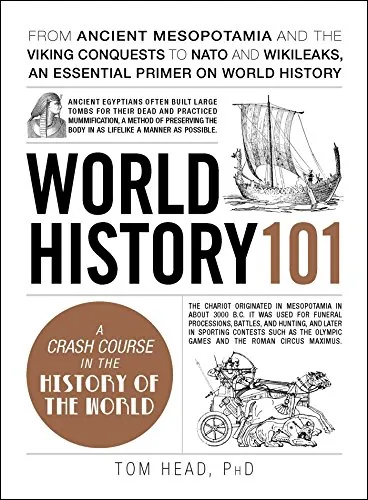
World History 101: An Essential Primer from Ancient Mesopotamia to Modern Day
By Tom Head
About this ebook
World History 101 surveys major civilizations, conflicts, religions, and political changes from ancient Mesopotamia to the modern era. Tom Head presents short, focused accounts for general readers and students seeking an introduction or refresher. The scope connects early cities and classical empires with colonialism, revolutions, world wars, and contemporary geopolitics.
Inside this title
Early cities, writing, and law in ancient Mesopotamia
Current listed price $7.99Regular price $13.00Digital ebook
This Adams 101 primer follows a broad historical arc, beginning with early urban societies and moving through empires, religious movements, exploration, and colonial encounters. Focused chapters introduce notable people and developments while relating events to larger changes in political and social organization.
Later coverage addresses revolutions, industrialization, the world wars, the Cold War, and decolonization. Modern topics extend to NATO and the digital age, showing the range of the book's survey. Its short sections suit continuous reading or selective reference when a reader needs orientation to a particular period. The book serves history beginners, students reviewing a timeline, and curious readers seeking connections across regions and eras.
Study guide included
Inside World History 101: An Essential Primer from Ancient Mesopotamia to Modern Day.
From the first cities of Mesopotamia to today's geopolitics, Tom Head offers a brisk survey of civilizations, religions, empires, revolutions and wars. Short focused sections let beginners read straight through or dip into a period, connecting events across regions without assuming prior knowledge.
This Adams 101 primer follows a broad arc, beginning with early urban societies and moving through empires, religious movements, exploration and colonial encounters. Focused sections introduce notable people and developments while relating events to larger changes in political and social organisation. Later coverage addresses revolutions, industrialisation, the world wars, the Cold War and decolonisation, with modern topics reaching NATO and the digital age. The short chapters suit continuous reading or selective reference when a reader needs orientation to a particular period. The book serves history beginners, students reviewing a timeline and curious readers looking for connections across regions and eras.
Early cities, writing and law
The survey begins with ancient Mesopotamia, where early urban life, writing and law appear together. These developments give readers a starting point for thinking about how organised societies emerge and how records and rules support them.
Mesopotamia anchors the opening survey
Writing and law accompany early cities
Urban life marks a social shift
Topics 1-2
Classical empires
Empires form the next layer of the story. The book introduces major classical powers and relates their expansion and administration to broader changes in political organisation, showing how large states shaped the societies they governed.
Classical empires expand the narrative
Administration shapes governed societies
Empires connect regions over time
Topic 3
Religions and cultural exchange
Religious movements and cultural exchange are treated as forces that crossed political boundaries. The book connects the spread of major religions with encounters among societies, helping readers see belief and culture as part of the historical arc rather than a separate topic.
Major religions spread across regions
Cultural exchange accompanies trade and conquest
Belief shapes societies and politics
Topic 4
Exploration and colonialism
Exploration and colonial encounters mark a widening of contact and conflict. The primer relates voyages and settlements to the transformation of societies on several continents, keeping the consequences of colonialism within the survey's scope.
Exploration widened global contact
Colonialism transformed societies
Encounters brought conflict and change
Topic 5
Revolutions and industrialisation
Political revolutions and industrial change reshaped how people lived and governed themselves. The book links new ideas about authority with economic and technological shifts, giving readers a way to connect ideology with material change.
Revolutions challenged established authority
Industrialisation changed daily life
Ideas and economies interacted
Topic 6
World wars, the Cold War and the modern world
The survey closes with global conflict, superpower rivalry and decolonisation. Modern topics reach NATO and the digital age, so contemporary geopolitics appears as the latest stage of a longer story about power, alliance and independence.
World wars reshaped the global order
The Cold War divided and realigned powers
Decolonisation and technology shape today
Topics 7-8
Topic map
Ancient Mesopotamia and Early CitiesTopic 1
Writing and Early LawTopic 2
Classical EmpiresTopic 3
Major Religions and Cultural ExchangeTopic 4
Exploration and Colonial EncountersTopic 5
Revolutions and IndustrialisationTopic 6
World Wars and the Cold WarTopic 7
Decolonisation, NATO and the Digital AgeTopic 8
Key takeaways
The survey links early cities and classical empires to modern political life.
Religions, exploration and colonialism are treated as forces that reshaped societies.
Short sections make the book usable both for continuous reading and quick reference.
History beginners, students reviewing a timeline, and general readers who want a concise, connected overview from ancient Mesopotamia to the modern era.
Topics covered
World History 101
Tom Head world history
world history primer
ancient Mesopotamia
classical empires
revolutions and industrialization
Cold War and decolonization
history for beginners
Questions about this ebook.
Edition, audience, and study-guide details at a glance.
What is World History 101: An Essential Primer from Ancient Mesopotamia to Modern Day about?
World History 101 surveys major civilizations, conflicts, religions, and political changes from ancient Mesopotamia to the modern era. Tom Head presents short, focused accounts for general readers and students seeking an introduction or refresher. The scope connects early cities and classical empires with colonialism, revolutions, world wars, and contemporary geopolitics.
Who is World History 101: An Essential Primer from Ancient Mesopotamia to Modern Day for?
History beginners, students reviewing a timeline, and general readers who want a concise, connected overview from ancient Mesopotamia to the modern era.
Does this page include a study guide?
Yes. This page includes an original study guide with six thematic sections, key takeaways, and a topic map for structured reading.