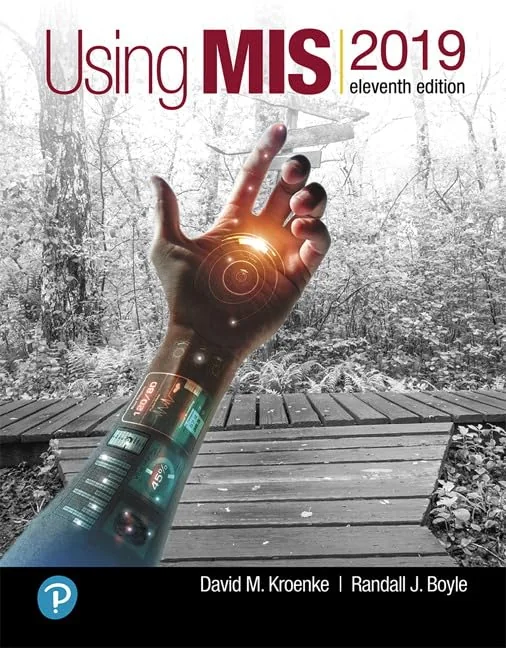
Using MIS, eleventh edition, introduces management information systems from the perspective of business use and organizational decisions. For business students and readers studying information systems, it covers business processes, databases, cloud services, analytics, artificial intelligence, and security. Technology evaluation connects these topics with operational needs and investment choices.
Inside this title
Information systems supporting organizational processes and business models
Current listed price $8.99Regular price $15.00Digital ebook
Information systems combine technology with the processes and decisions of an organization. Kroenke and Boyle introduce this relationship by examining how systems support business activity and enable different business models. Database management, information retrieval, and cloud computing form part of the technical foundation presented through a business lens.
The eleventh edition also discusses big data, analytics, artificial intelligence, and machine learning applications. Security coverage addresses organizational data and technology risks, while financial evaluation considers returns on IT investment. This combination suits introductory MIS courses in which students need to discuss both what systems do and how managers assess their relevance to organizational problems and opportunities.
Study guide included
Inside Using MIS, 11th Edition.
David M. Kroenke and Randall J. Boyle present management information systems as a business question first. The eleventh edition ties competitive strategy to the information leaders need, then surveys devices, data stores, cloud offerings, analytics, teamwork tools, process systems, security, and development, repeatedly asking which organizational task a technology should make better.
Opening chapters connect strategy with the facts a firm must have at hand. A middle block covers hardware, software, data stores, networks, and cloud offerings. Subsequent chapters show how such tools enable teamwork, operational processes, and social platforms, before the final material takes up security, governance, external providers, and system building. Running through everything is a five-part frame — staff, routines, records, applications, equipment — which warns that a capable platform can still stumble when duties, workflows, or records are left ambiguous, since success rests on all five.
Goals, value chains, and five components
Competitive analysis begins with rivalry in an industry and the tasks through which a firm delivers value. A proposed system ought to strengthen a specific activity and ease the decision or transfer that currently bottlenecks it. The technical layer supplies capability, data record events or parties, and procedures and staff determine what is entered and whether anyone responds. These parts depend on one another, so a technical upgrade may still fail when routines remain fuzzy.
Find the activity that needs strengthening
Data record events or parties
Procedures determine what is entered
Technical upgrades can still fail
Chapters 1–2
From transactions to business decisions
A stored transaction turns into information only when paired with a question, so freshness, relevance, and precision are judged against the choice being made. Different units often attach divergent meanings to one label, and settling those definitions must precede any comparison across sites or periods. Warehouses and marts shape records for reporting, while mining probes relationships, yet conclusions still mirror whatever was captured.
Judge data against the choice at hand
Settle definitions before comparing figures
Warehouses shape records for reporting
Mining mirrors whatever was captured
Chapter 3
Records, relationships, and cloud capacity
A database models entities and the links among them, keeping a customer, an order, and a line item as separate things. Keys and identifiers join records without repeating every attribute. A management system offers ways to store, query, and administer that material. Devices decide where work can occur and what can be gathered, and cloud offerings add capacity across a network, exchanging some control for availability, price, and elasticity.
Entities and links stay separate
Keys join records without repetition
Devices decide where work occurs
Cloud offerings trade control for elasticity
Chapters 4–6
Collaboration, processes, and boundaries
Teamwork software lets people exchange material, assign tasks, and review output, and its worth lies in a common objective and clear duties rather than in message counts. Operational processes cross group and company lines, where competing copies of one record easily arise. Enterprise and partner systems join activities or coordinate exchanges, and social platforms introduce a channel whose activity metrics still demand careful reading.
Common objectives outweigh message counts
Processes cross company lines
Competing copies of records easily arise
Activity metrics demand careful reading
Chapters 7–9
Security, governance, and sourcing
Security analysis names the asset or capability in danger, the route a threat might take, and the cost of a compromise. Who can reach what matters, as the Target breach case illustrates. Safeguards span identity checks, limited permissions, monitoring, and readiness to react. Governance fixes authority and standards, while outside providers may supply skill or cut expense yet also breed dependence and a hard exit. Control over data and safeguards should be stated outright.
Name the asset in danger
Who can reach what matters
Safeguards span identity checks and monitoring
Governance fixes authority and standards
Chapters 10–11
Requirements, implementation, and feedback
Gathering requirements means observing current work and asking what staff must do differently, recording inputs, outputs, choices, and limits. A familiar task might be clear already, yet a rare or seasonal one can hide a crucial exception, so the people performing that work belong in the conversation. Development converts requirements to a design, then checks whether it succeeds. Rollout also reshapes training, duties, and routines, and upkeep persists past the first release.
Watch present tasks and their exceptions
Rare tasks conceal crucial requirements
Rollout reshapes duties and routines
Upkeep persists past the first release
Chapter 12
Chapter and section map
The Importance of MIS and Strategy and Information SystemsChs. 1–2
Business Intelligence SystemsCh. 3
Hardware, Software, and Mobile SystemsCh. 4
Database Processing and The CloudChs. 5–6
Collaboration, Processes, and Social Media SystemsChs. 7–9
Information Systems SecurityCh. 10
Information Systems Management and DevelopmentChs. 11–12
Key takeaways
Identify the choice, the task, and the intended business gain before proposing any technology.
Use the five-part frame to verify that duties, routines, and records shift alongside the software.
Build security, edge cases, and measurement into requirements so a pilot can test them.
Business students and early-career managers who must assess information systems, plus readers working beside technical teams who want shared language for processes, data, and controls.
Topics covered
management information systems
business strategy
business intelligence
database design
cloud computing
information security
IT governance
system development
Questions about this ebook.
Edition, audience, and study-guide details at a glance.
What is Using MIS, 11th Edition about?
Using MIS, eleventh edition, introduces management information systems from the perspective of business use and organizational decisions. For business students and readers studying information systems, it covers business processes, databases, cloud services, analytics, artificial intelligence, and security. Technology evaluation connects these topics with operational needs and investment choices.
Which edition of Using MIS, 11th Edition is this?
This listing is for the 11th edition. Check the title, ISBN, and book details above before ordering, especially if your course or reading list names a specific edition.
Who is Using MIS, 11th Edition for?
Business students and early-career managers who must assess information systems, plus readers working beside technical teams who want shared language for processes, data, and controls.
Does this page include a study guide?
Yes. This page includes an original study guide with six thematic sections, key takeaways, and a chapter and section map for structured reading.