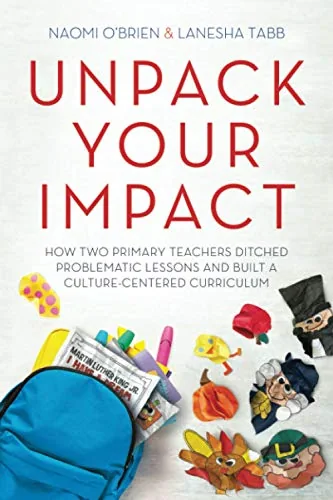
Unpack Your Impact: How Two Primary Teachers Ditched Problematic Lessons and Built a Culture-Centered Curriculum
By Naomi O'Brien, LaNesha Tabb
About this ebook
Unpack Your Impact follows Naomi O'Brien and LaNesha Tabb as they rethink primary social studies lessons through a culture-centered curriculum. Written for K-2 teachers and curriculum supporters, the book uses classroom examples to examine bias, missing perspectives, global social systems, and developmentally appropriate discussion of fairness and community.
Inside this title
Reviewing primary social studies lessons for bias and omissions
Current listed price $6.99Regular price $17.00Digital ebook
The authors begin with the lessons they had been teaching and the assumptions those lessons contained. Their classroom accounts show a process of identifying stereotypes, incomplete narratives, and overlooked voices, then rebuilding units around more varied cultural perspectives and global social systems.
Read-alouds, discussion, and project-based learning offer ways to approach questions of community, fairness, and activism with young children. The book also considers collaboration with colleagues and families, extending curriculum review beyond an individual lesson. Primary teachers, instructional coaches, and teacher educators can follow the authors' examples while examining how everyday social studies instruction represents people, histories, and relationships. Its focus stays on the practical work of revising K-2 teaching.
Study guide included
Inside Unpack Your Impact: How Two Primary Teachers Ditched Problematic Lessons and Built a Culture-Centered Curriculum.
Two primary teachers describe revising their own social studies lessons after noticing stereotypes and missing voices. The book stays close to classroom decisions, showing how a culture-centered K-2 curriculum can be rebuilt through read-alouds, discussion, and projects about community and fairness.
O'Brien and Tabb start from lessons they had already taught, then examine the assumptions those lessons carried. That reflective beginning matters: the work is presented as a process of noticing, not a verdict handed down to other teachers. Each chapter moves from a problem such as an incomplete narrative or an overlooked perspective to a practical replacement, with read-alouds, conversation, and project-based learning as the main vehicles. Collaboration with colleagues and families is treated as part of the revision, so curriculum change is not confined to one classroom or one teacher's intentions.
Auditing lessons for bias
The authors begin by looking closely at material they had used, asking which groups appear, which are absent, and what a lesson implies without stating it. This audit is practical rather than abstract: it examines books, images, examples, and wording. The point is to build a habit of noticing before designing replacements.
Examine books and images closely
Ask who is absent and why
Notice the messages lessons imply
Topic 1-2
Missing perspectives and single stories
A recurring problem is the single story, where one group's experience stands in for a whole culture or history. The authors show how incomplete narratives narrow what children can imagine about people and places. Their alternative is to widen the sources and voices in a unit rather than adding a token lesson at the end.
Reject single-story representations of cultures
Widen sources and voices
Avoid token additions at unit's end
Topic 3
Building a culture-centered unit
Culture-centered design treats students' own communities as intellectual resources and treats cultures as living and varied. Units are rebuilt around several perspectives and around systems that connect people, rather than around isolated holidays or foods. The authors keep the planning concrete, showing how big ideas become a sequence of lessons for young children.
Treat cultures as varied and living
Use community knowledge as material
Connect ideas into sequences
Topic 4
Read-alouds and classroom discussion
Read-alouds give primary children a shared text to think with, and discussion gives them room to ask questions and disagree. The authors pair careful book selection with prompts that invite observation and wonder rather than a single correct response. Talk is treated as the main route by which young students work through fairness and identity.
Choose texts with care
Ask open observational questions
Let children disagree productively
Topic 5
Projects about fairness and community
Project-based work lets children act on ideas rather than only repeat them. Projects in the book connect fairness, community, and activism to children's own experience in developmentally appropriate ways. The emphasis is on age-appropriate participation and reflection, not on assigning adult political conclusions to young children.
Let children act on ideas
Keep projects developmentally appropriate
Connect fairness to daily life
Topic 6
Revising with colleagues and families
Curriculum change survives only if it extends beyond one teacher's room. The authors describe working with colleagues and communicating with families about why lessons changed. That collaboration surfaces objections, adds perspectives, and makes the revision a shared professional effort rather than a private choice made alone.
Bring colleagues into revision
Explain changes to families
Treat revision as shared work
Topic 7
Topic map
Reviewing Lessons for BiasTopic 1
Stereotypes and OmissionsTopic 2
Culture-Centered Curriculum DesignTopic 3
Global Social Systems for Young LearnersTopic 4
Read-Alouds and Classroom DiscussionTopic 5
Projects on Fairness and CommunityTopic 6
Collaboration with FamiliesTopic 7
Key takeaways
Start by auditing lessons you already teach; the assumptions are easier to see in familiar material than in someone else's.
Replacing a single story means widening voices across a unit, not inserting one diverse lesson as an add-on.
Young children can examine fairness and community when the talk and projects are pitched at their level.
K-2 teachers, instructional coaches, teacher educators, and curriculum supporters who want practical, classroom-tested examples of revising primary social studies around culture, identity, and fairness in real classrooms.
Topics covered
culture-centered curriculum
primary social studies
K-2 teaching
lesson bias
inclusive read-alouds
fairness projects
curriculum revision
student community
Questions about this ebook.
Edition, audience, and study-guide details at a glance.
What is Unpack Your Impact: How Two Primary Teachers Ditched Problematic Lessons and Built a Culture-Centered Curriculum about?
Unpack Your Impact follows Naomi O'Brien and LaNesha Tabb as they rethink primary social studies lessons through a culture-centered curriculum. Written for K-2 teachers and curriculum supporters, the book uses classroom examples to examine bias, missing perspectives, global social systems, and developmentally appropriate discussion of fairness and community.
Who is Unpack Your Impact: How Two Primary Teachers Ditched Problematic Lessons and Built a Culture-Centered Curriculum for?
K-2 teachers, instructional coaches, teacher educators, and curriculum supporters who want practical, classroom-tested examples of revising primary social studies around culture, identity, and fairness in real classrooms.
Does this page include a study guide?
Yes. This page includes an original study guide with six thematic sections, key takeaways, and a topic map for structured reading.