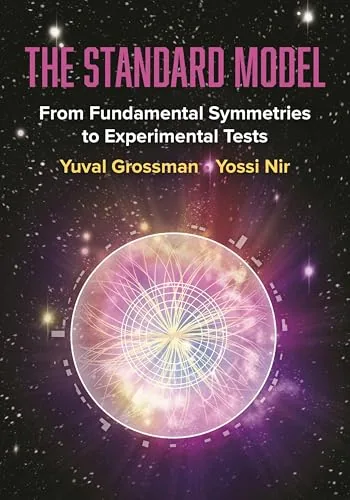
The Standard Model: From Fundamental Symmetries to Experimental Tests
By Yuval Grossman, Yossi Nir
About this ebook
The Standard Model links the mathematical foundations of particle physics with the experiments used to investigate them. Yuval Grossman and Yossi Nir cover gauge symmetry, electroweak theory, strong interactions, flavor, and neutrinos. The graduate-level text suits physics students with quantum field theory preparation and readers interested in particle phenomenology.
Inside this title
Gauge symmetry, electroweak symmetry breaking, and Higgs physics
Current listed price $29.99Regular price $68.00Digital ebook
Symmetry supplies the organizing language for this treatment of the Standard Model. Gauge theories, spontaneous symmetry breaking, and renormalization are developed in relation to the physical questions they address. The discussion moves through the Higgs mechanism and quantum chromodynamics to flavor physics, giving readers a framework for relating different sectors of particle theory.
Experimental tests are considered alongside the theoretical account, including precision electroweak measurements and collider investigations. Neutrino oscillations, mass models, the CKM matrix, and anomaly cancellation broaden the scope. The assumed background in quantum field theory, relativistic quantum mechanics, and group theory makes the book most suitable for graduate study or advanced work connecting theoretical predictions with observations.
Study guide included
Inside The Standard Model: From Fundamental Symmetries to Experimental Tests.
Grossman and Nir present the Standard Model through symmetry, building the theory from gauge principles and then testing it against experiment. Electroweak theory, the Higgs mechanism, quantum chromodynamics, flavor physics and neutrinos are developed for readers who already have quantum field theory, with precision measurements treated as part of the argument.
Grossman and Nir use symmetry as the organizing language of particle physics. Gauge theories, spontaneous symmetry breaking and renormalization are developed alongside the physical questions they answer, moving through the Higgs mechanism and quantum chromodynamics toward flavor physics. Theoretical chapters are paired with the experiments that test them, including precision electroweak measurements and collider investigations. The CKM matrix, neutrino oscillations, mass models and anomaly cancellation extend the scope. The assumed background in quantum field theory, relativistic quantum mechanics and group theory places the book at graduate level and rewards readers who have it.
Symmetry as the organizing principle
Grossman and Nir build the subject around symmetry rather than around particles one at a time. Gauge principles constrain the possible interactions, and the particle content follows from the representations chosen. This approach explains why the Standard Model has the structure it does, and it gives readers a way to see the separate sectors as parts of one framework.
Symmetry constrains allowed interactions
Particle content follows from representations
Structure is explained, not catalogued
Topic 1
Gauge theories and symmetry breaking
Gauge invariance and spontaneous symmetry breaking are developed with attention to what each accomplishes. The first restricts the Lagrangian; the second allows masses without violating the symmetry of the underlying theory. The text is careful about the distinction between a symmetry of the theory and a symmetry of the vacuum, which is where many of the conceptual difficulties begin.
Gauge invariance restricts the Lagrangian
Breaking protects the underlying symmetry
Vacuum symmetry differs from theory symmetry
Topic 2
The Higgs mechanism and mass
The Higgs mechanism is presented as a consequence of the electroweak symmetry-breaking structure, not as an isolated addition. The chapter follows how gauge bosons acquire mass, how fermion masses are generated through couplings, and what the discovery of the Higgs boson did to the framework. Open questions about the mechanism's stability are noted rather than resolved.
Boson masses follow from the mechanism
Fermion masses enter through couplings
Discovery confirmed structure but not stability
Topic 3
Quantum chromodynamics and strong interactions
QCD serves as the model for a non-abelian gauge theory in practice. The chapter covers asymptotic freedom, confinement and the running of the coupling, and it explains why the strong sector behaves so differently from the electroweak one at low energies. The discussion supplies the tools later chapters need when hadronic effects enter precision calculations.
Asymptotic freedom changes with scale
Confinement explains low-energy behavior
Hadronic effects matter for precision
Topic 4
Flavor physics and the CKM matrix
Flavor mixing is treated as a place where the theory's structure and experiment meet most sharply. The CKM matrix and its parametrization are developed, along with the measurements that constrain it and the role of CP violation. The chapter shows how a compact piece of notation encodes a large experimental program.
Mixing is parametrized by the CKM matrix
CP violation is a central observable
Compact notation encodes a research program
Topic 5
Neutrinos and experimental tests
Neutrino oscillations extend the framework in a direction the original model did not anticipate. Mass models and mixing are discussed alongside the experiments that established oscillation, and the chapter is candid about what remains unsettled. Precision electroweak measurements and collider results then serve as tests of the framework as a whole rather than as separate topics.
Oscillation implies neutrino mass
Mass models remain unsettled
Precision tests probe the whole framework
Topics 6–8
Topic map
Gauge Theories and SymmetryTopic 1
Electroweak TheoryTopic 2
The Higgs MechanismTopic 3
Quantum ChromodynamicsTopic 4
Flavor Physics and the CKM MatrixTopic 5
Neutrino Oscillations and MassTopic 6
Precision Tests and CollidersTopic 7
Anomalies and Open QuestionsTopic 8
Key takeaways
Work through the symmetry argument before the experimental chapters, or the tests lose their point.
Keep track of which sector each chapter addresses; notation shifts between them.
Treat precision measurements as tests of the framework rather than separate topics.
Graduate physics students with quantum field theory preparation, researchers entering particle phenomenology, and instructors who want a symmetry-first treatment of the Standard Model and its experimental tests.
Topics covered
Standard Model
particle physics
gauge symmetry
electroweak theory
quantum chromodynamics
flavor physics
neutrino oscillations
Grossman and Nir
Questions about this ebook.
Edition, audience, and study-guide details at a glance.
What is The Standard Model: From Fundamental Symmetries to Experimental Tests about?
The Standard Model links the mathematical foundations of particle physics with the experiments used to investigate them. Yuval Grossman and Yossi Nir cover gauge symmetry, electroweak theory, strong interactions, flavor, and neutrinos. The graduate-level text suits physics students with quantum field theory preparation and readers interested in particle phenomenology.
Who is The Standard Model: From Fundamental Symmetries to Experimental Tests for?
Graduate physics students with quantum field theory preparation, researchers entering particle phenomenology, and instructors who want a symmetry-first treatment of the Standard Model and its experimental tests.
Does this page include a study guide?
Yes. This page includes an original study guide with six thematic sections, key takeaways, and a topic map for structured reading.