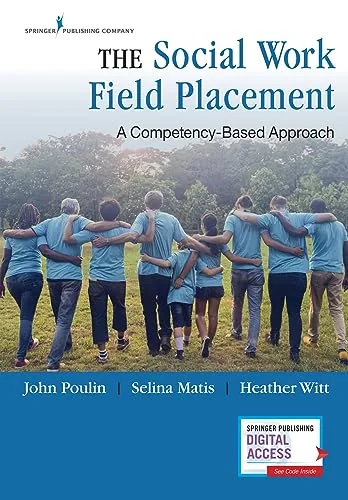
The Social Work Field Placement: A Competency-Based Approach
By John Poulin, Selina Matis, Heather Witt
About this ebook
The Social Work Field Placement guides BSW and MSW students through placement learning using a competency-based framework. John Poulin, Selina Matis, and Heather Witt connect professional ethics, engagement, assessment, intervention, and evaluation with field activities, supervision preparation, reflection, and documentation of developing practice skills in agencies.
Inside this title
Competency-based activities connecting coursework with agency placement experiences
Current listed price $31.99Regular price $79.00Digital ebook
Field education asks students to translate classroom knowledge into work with people, organizations, and communities. This book organizes that transition around social work competencies, connecting learning agreements and placement activities with professional development. Topics encompass ethical behavior, diversity, justice, research, policy, and the stages of direct practice.
Exercises, case examples, and reflection prompts encourage students to examine experiences rather than simply record completed tasks. Guidance on supervision and portfolio development supports conversations about learning needs and evidence of progress. BSW and MSW students can read it alongside a placement seminar, while field instructors and faculty can draw on its structured activities when planning assignments and discussing performance.
Study guide included
Inside The Social Work Field Placement: A Competency-Based Approach.
Field education asks students to turn classroom knowledge into work with people, organizations, and communities. Poulin, Matis, and Witt organize that transition around social work competencies, pairing placement activities with supervision, reflection, and portfolio evidence so learning is documented rather than merely experienced.
The book frames the placement as a structured learning environment built on competencies. Learning agreements connect agency tasks to professional development, while chapters address ethics, diversity, justice, research, and policy alongside the stages of direct practice. Engagement, assessment, intervention, and evaluation are treated as connected activities rather than isolated skills. Exercises, case examples, and reflection prompts push students to interpret what happens in the field instead of simply logging hours. Guidance on supervision and portfolio development supports conversations about learning needs and progress, and field instructors can draw on the same activities when planning assignments and discussing performance.
Competencies and Learning Agreements
Competencies give the placement its structure, and learning agreements translate them into specific activities and expectations. The book shows how to connect agency work to stated learning goals so that supervision and evaluation rest on something explicit.
Map placement tasks to social work competencies
Draft learning agreements with clear expectations
Use goals to guide supervision conversations
Topic 1
Ethics and Professional Values
Ethical behavior is treated as part of daily practice rather than a separate code to memorize. Students encounter situations where values, agency expectations, and client interests pull in different directions, and are asked to reason through them.
Apply professional ethics to placement situations
Recognize value conflicts as they arise
Reason through dilemmas with supervision
Topic 2
Diversity, Justice, and Context
Diversity and justice are woven into practice rather than appended as a topic. The material asks students to notice how context, identity, and structural conditions shape both the problems clients face and the options available to them.
Consider identity and context in practice
Examine structural influences on clients
Reflect on power in the helping relationship
Topics 3 and 6
Engagement and Assessment
Engagement and assessment are presented as the opening phase of direct practice, where relationship and information gathering depend on each other. Students learn to build enough trust to understand a situation and to organize what they learn into a working picture.
Build rapport with clients and systems
Gather and organize assessment information
Link assessment to planning
Topic 4
Intervention
Intervention follows assessment as purposeful action rather than a repertoire of techniques applied at random. The book connects chosen approaches to the assessment and to the client's context, keeping the reasoning visible for supervision and review.
Select interventions consistent with assessment
Adapt plans to client context
Explain practice decisions to supervisors
Topic 5
Supervision, Reflection, and Portfolio
Supervision is treated as a structured learning relationship, and reflection as the habit that turns experience into knowledge. Portfolio development collects evidence of growing competence, supporting conversations about progress and remaining learning needs.
Prepare for supervision with specific questions
Write reflectively about placement experience
Assemble portfolio evidence of competence
Topic 7
Topic map
Competency framework and learning agreementsTopic 1
Professional ethics and values in the fieldTopic 2
Diversity, justice, and client contextTopic 3
Engagement and assessmentTopic 4
Intervention planning and actionTopic 5
Evaluation, research, and policy connectionsTopic 6
Supervision, reflective writing, and portfolioTopic 7
Key takeaways
A placement becomes educative when activities are tied to explicit competencies and learning goals.
Reflection and supervision convert field experience into transferable professional knowledge.
Ethics, diversity, and policy are embedded in practice decisions, not separate chapters of the job.
BSW and MSW students entering field placements, placement seminar instructors, and field supervisors who plan assignments and evaluate developing practice.
Topics covered
social work field placement
competency based field education
BSW MSW practicum
social work supervision
reflective practice
professional portfolio
social work ethics
practice evaluation
Questions about this ebook.
Edition, audience, and study-guide details at a glance.
What is The Social Work Field Placement: A Competency-Based Approach about?
The Social Work Field Placement guides BSW and MSW students through placement learning using a competency-based framework. John Poulin, Selina Matis, and Heather Witt connect professional ethics, engagement, assessment, intervention, and evaluation with field activities, supervision preparation, reflection, and documentation of developing practice skills in agencies.
Who is The Social Work Field Placement: A Competency-Based Approach for?
BSW and MSW students entering field placements, placement seminar instructors, and field supervisors who plan assignments and evaluate developing practice.
Does this page include a study guide?
Yes. This page includes an original study guide with six thematic sections, key takeaways, and a topic map for structured reading.