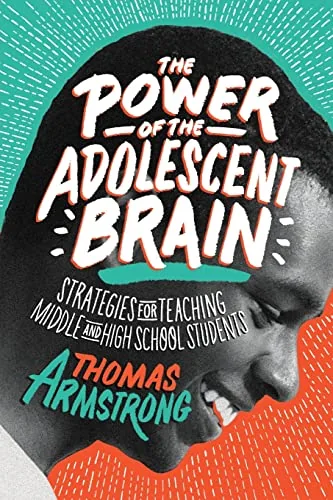
Thomas Armstrong's The Power of the Adolescent Brain connects adolescent development with teaching in grades 6-12. Taking a strengths-based perspective, it pairs eight findings about the developing brain with classroom practices addressing emotion, motivation, choice, social connection, movement, executive function, and opportunities for creativity and reflection.
Inside this title
Eight developmental findings paired with corresponding adolescent classroom practices
Current listed price $10.00Regular price $19.00Digital ebook
Armstrong uses adolescent brain development as a starting point for thinking about classroom design. Synaptic pruning, myelination, the prefrontal cortex, and the amygdala contribute to the developmental picture, while the book emphasizes adolescents' capacity for learning and change.
Eight corresponding teaching practices translate that perspective into classroom examples. Topics include structured choices, emotional engagement, collaborative tasks, physical activity, and support for planning and self-regulation. Reflection questions and implementation suggestions invite teachers to relate the material to their own lessons. The book is aimed at middle and high school educators who want to examine how teaching environments can respond to the social, emotional, and cognitive characteristics of adolescence.
Study guide included
Inside The Power of the Adolescent Brain.
Adolescence is often described through risk, but Armstrong starts from capacity. He pairs findings about the developing brain, including pruning, myelination and the still-maturing prefrontal cortex, with eight classroom practices that use adolescents' emotional, social and cognitive strengths rather than working against them.
The book sets a developmental picture before it recommends teaching. Synaptic pruning and myelination shape neural circuits, the prefrontal cortex continues to mature, and the amygdala contributes to emotional intensity. Armstrong reads these features as opportunities as well as constraints. Eight teaching practices follow, translated into classroom examples: structured choice, emotional engagement, collaborative work, physical movement, social connection, support for planning and self-regulation, creativity and reflection. Questions invite teachers to relate each practice to their own lessons, and implementation suggestions make the move from principle to routine. The intended setting is grades 6 through 12, where developmental variation among students is wide and a strengths-based stance matters.
The developmental picture
Synaptic pruning, myelination, prefrontal cortex development and the amygdala provide the book's scientific starting point. Armstrong explains these processes in accessible terms and emphasizes that adolescent brains are changing rapidly rather than simply lacking adult capacities. This framing matters because the same features that produce impulsive or emotional behavior also support learning, flexibility and social motivation when an environment engages them.
Pruning and myelination shape neural circuits
The prefrontal cortex continues to mature
The amygdala contributes to emotional intensity
Topic 1
A strengths-based perspective
The book deliberately counters deficit views of adolescence. Instead of treating development as a set of problems to be managed, Armstrong asks what adolescents are especially prepared to do well. The shift is not optimism for its own sake: it changes what a teacher notices, which behaviors are read as assets, and how classroom tasks are designed to use energy and social drive rather than suppress them.
Adolescence is framed through capacity
Attention shifts from deficits to strengths
Framing changes task design and interpretation
Topic 2
Choice and emotional engagement
Structured choice gives adolescents a measure of autonomy while keeping work within a teacher's design. Emotional engagement connects content to what students care about, using the intensity of the age rather than asking them to set it aside. The two practices work together: choice increases ownership, and emotional relevance makes the choice meaningful rather than merely procedural.
Structured choice builds autonomy
Emotional relevance connects content to students
Ownership and relevance reinforce each other
Topic 3
Movement and social connection
Physical activity and peer interaction are treated as conditions for learning rather than interruptions to it. The book describes ways to build movement into lessons and to use collaborative tasks that draw on adolescents' strong social motivation. The point is not constant activity but purposeful design, so that energy and talk serve the learning goal instead of competing with it.
Movement can be built into lessons
Peer interaction supports learning
Purposeful design channels energy
Topic 4
Executive function and self-regulation
Planning, organization, impulse control and self-monitoring are still developing in adolescence, so the book treats them as skills to support rather than assumptions to make. Teachers can supply structures, prompts and routines that scaffold these capacities while students build them. The approach avoids both lowered expectations and the assumption that students should already manage complex work independently.
Executive skills are still developing
Scaffolds support planning and self-monitoring
Support avoids both low expectations and false assumptions
Topic 5
Creativity and reflection
The final practices concern what adolescents can do with what they learn. Creativity gives them room to make, test and revise, while reflection helps them connect effort to outcome. Reflection questions in the book invite teachers to apply the same discipline to their own practice, turning the eight practices into a lens for reviewing lessons rather than a checklist to be completed once.
Creativity allows making and revision
Reflection connects effort to outcome
Teachers apply the lens to their own lessons
Topic 6
Topic map
Adolescent Brain DevelopmentTopic 1
A Strengths-Based FrameTopic 2
Structured Choice and Emotional EngagementTopic 3
Movement and Social LearningTopic 4
Executive Function and Self-RegulationTopic 5
Creativity, Reflection and ImplementationTopic 6
Key takeaways
Read adolescent development as a mix of capacity and constraint, not as a list of deficits.
Design lessons that use movement, social drive and emotion purposefully rather than treating them as interruptions.
Scaffold planning and self-regulation while adolescents are still building those skills.
Middle and high school teachers, instructional coaches and school leaders who want classroom practices grounded in adolescent development, plus educators looking for a strengths-based alternative to deficit framing.
Topics covered
adolescent brain development
teaching grades 6-12
strengths-based teaching
executive function
self-regulation
student engagement
social and emotional learning
classroom movement
Questions about this ebook.
Edition, audience, and study-guide details at a glance.
What is The Power of the Adolescent Brain about?
Thomas Armstrong's The Power of the Adolescent Brain connects adolescent development with teaching in grades 6-12. Taking a strengths-based perspective, it pairs eight findings about the developing brain with classroom practices addressing emotion, motivation, choice, social connection, movement, executive function, and opportunities for creativity and reflection.
Who is The Power of the Adolescent Brain for?
Middle and high school teachers, instructional coaches and school leaders who want classroom practices grounded in adolescent development, plus educators looking for a strengths-based alternative to deficit framing.
Does this page include a study guide?
Yes. This page includes an original study guide with six thematic sections, key takeaways, and a topic map for structured reading.