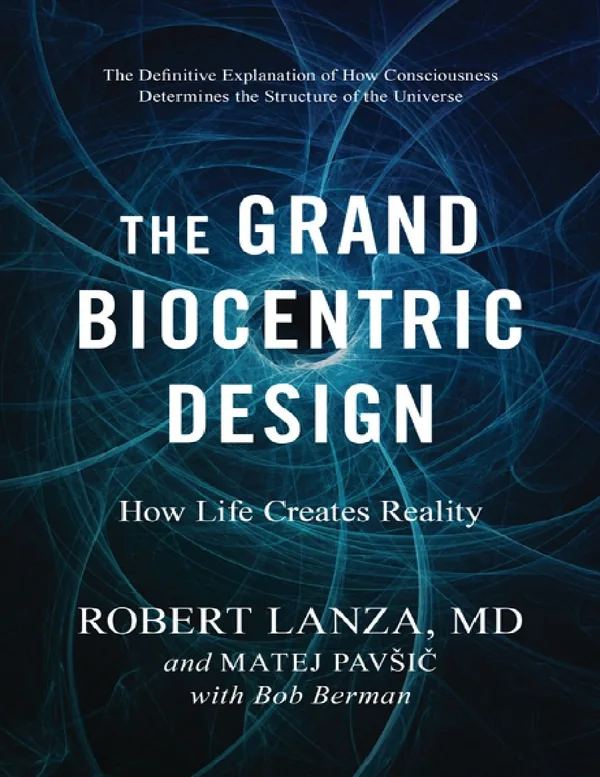
The Grand Biocentric Design: How Life Creates Reality
By Robert Lanza, Matej Pavšič, Bob Berman
About this ebook
The Grand Biocentric Design presents Robert Lanza, Matej Pavšič, and Bob Berman's argument that life and consciousness are central to reality. Written for general readers interested in science and philosophy, the book interprets quantum experiments, cosmology, space, and time through the authors' proposed framework of biocentrism.
Inside this title
The authors' seven principles linking life, observers, and reality
Current listed price $6.99Regular price $13.00Digital ebook
The third book in the biocentrism series develops the authors' position that the observer has a central role in understanding the universe. Its seven principles provide a framework for considering the relation between experience, physical description, and the concepts of space and time.
Quantum experiments, including double-slit and quantum eraser arrangements, are discussed alongside cosmological fine-tuning, evolution, and questions about consciousness. These examples form part of the authors' case for a biocentric interpretation of reality. The book suits readers interested in examining an argument at the boundary of popular science and philosophy, especially those following debates about observers, perception, and explanations of the physical world.
Study guide included
Inside The Grand Biocentric Design: How Life Creates Reality.
Biocentrism proposes that life is not a byproduct of the universe but central to how reality is constituted. Lanza, Pavšič and Berman develop that claim through seven principles, then read quantum experiments, cosmology, space and time in its light, writing for general readers willing to follow an argument across science and philosophy.
This third book in the biocentrism series restates the framework and extends it. Seven principles organize the authors' position on observers, experience and physical description. Quantum experiments, including double-slit and quantum eraser arrangements, are used to argue that observation cannot be separated from what is observed. Cosmological fine-tuning, the nature of space and time, evolution and consciousness enter the case as supporting material. The result is not a textbook of physics but an interpretation offered for general readers. Its value lies in following a sustained argument at the boundary between popular science and philosophy, and in weighing where evidence ends and interpretation begins. Readers should expect a committed thesis rather than a survey of competing views.
The seven principles
The principles provide the book's framework. They state the authors' commitments about observers, experience and the physical world, and later chapters return to them as a reference point. Reading the principles carefully is useful because they do conceptual work that the examples then illustrate; disagreement with the book often begins with one of these starting assumptions rather than with a particular experiment.
The principles state the framework's assumptions
Later chapters return to them as reference
Disagreement often begins with these premises
Topic 1
Observers and quantum experiments
Double-slit and quantum eraser arrangements are central to the argument. The book uses them to claim that the observer's role cannot be removed from an account of what occurs. A reader benefits from separating three things: what the experiments show, how physicists interpret them, and the further philosophical conclusion the authors draw. Keeping those levels distinct is essential to evaluating the thesis.
Observer participation is the authors' central claim
Experimental results and interpretation are distinct
Philosophical conclusions go beyond the data
Topic 2
Space and time as experience
The book argues that space and time are not independent containers but are bound up with observation and experience. This is one of its most philosophically loaded moves, since it reframes questions about the universe's structure in terms of what can be experienced. The discussion invites the reader to ask whether this is a scientific proposal, a philosophical interpretation, or a mixture of both.
Space and time are tied to observation
The claim is philosophically loaded
Its status as science or interpretation is at issue
Topic 3
Cosmological fine-tuning
Fine-tuning arguments note that physical constants appear adjusted for life. The book places them within the biocentric framework, treating the apparent fit as evidence for the centrality of life rather than as a coincidence to be explained otherwise. The section is a good place to examine how an empirical observation can be recruited for a metaphysical position, and what alternative explanations remain available.
Constants appear suited to life
The authors read this as support for biocentrism
Alternative explanations remain available
Topic 4
Evolution and consciousness
Evolution and consciousness enter the argument as further support. The book discusses how life develops and how subjective experience fits into a biocentric picture. These topics raise the hardest questions for any framework, since consciousness is precisely what resists treatment as ordinary physical stuff. The authors use that difficulty as motivation for their position rather than as a problem to be deferred.
The book deliberately operates where popular science meets philosophy. Its evidence is drawn from physics, but its conclusions concern the nature of reality in a way that exceeds experimental test. Recognizing that boundary is the key to reading it well: the reader can appreciate the argument's ambition while asking which claims are empirically constrained and which rest on interpretation.
Evidence comes from physics
Conclusions exceed experimental test
Distinguish constrained claims from interpretation
Topic 6
Topic map
The Seven Principles of BiocentrismTopic 1
Observers and Quantum ExperimentsTopic 2
Space and Time in Biocentric TermsTopic 3
Cosmological Fine-TuningTopic 4
Evolution and ConsciousnessTopic 5
Science, Philosophy and the Limits of EvidenceTopic 6
Key takeaways
Read the seven principles first, since the case is built on their starting assumptions.
Separate experimental results from the interpretation placed on them when evaluating the quantum chapters.
Ask which claims are empirically testable and which are philosophical conclusions, since the book deliberately crosses that boundary.
General readers interested in science and philosophy, especially those following debates about consciousness, observation and cosmology, and readers of the earlier biocentrism books who want the argument extended.
Topics covered
biocentrism
Grand Biocentric Design
consciousness and reality
quantum experiments
observer effect
cosmological fine-tuning
space and time
science and philosophy
Questions about this ebook.
Edition, audience, and study-guide details at a glance.
What is The Grand Biocentric Design: How Life Creates Reality about?
The Grand Biocentric Design presents Robert Lanza, Matej Pavšič, and Bob Berman's argument that life and consciousness are central to reality. Written for general readers interested in science and philosophy, the book interprets quantum experiments, cosmology, space, and time through the authors' proposed framework of biocentrism.
Who is The Grand Biocentric Design: How Life Creates Reality for?
General readers interested in science and philosophy, especially those following debates about consciousness, observation and cosmology, and readers of the earlier biocentrism books who want the argument extended.
Does this page include a study guide?
Yes. This page includes an original study guide with six thematic sections, key takeaways, and a topic map for structured reading.