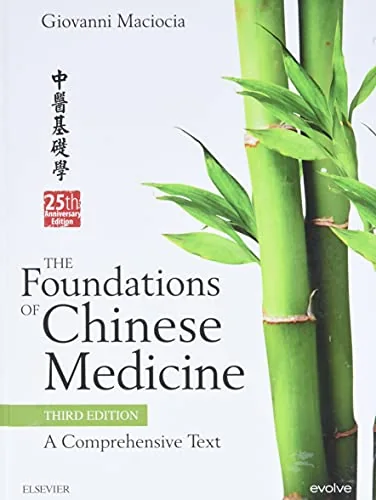
The Foundations of Chinese Medicine, Third Edition, introduces the theoretical system of traditional Chinese medicine for acupuncture and Chinese medicine students. Giovanni Maciocia organizes yin-yang, five-element theory, organ relationships, causes of illness, diagnostic methods, and pattern differentiation into a structured account that connects traditional concepts with their clinical interpretation.
Inside this title
Yin-yang, five-element theory, qi, blood, and zang-fu relationships
Current listed price $43.99Regular price $128.00Digital ebook
Maciocia explains the conceptual language used in traditional Chinese medicine before relating it to diagnosis and treatment principles within that tradition. Yin-yang and the five elements establish the opening framework, followed by qi, blood, organ functions, and the relationships described through zang-fu theory. Causes of illness and patterns of disharmony extend the theoretical account.
Diagnostic material considers observation, listening, questioning, palpation, and the interpretation of pulse and tongue findings. Pattern differentiation uses frameworks such as the eight principles and organ patterns to organize observations. Illustrations support the systematic presentation. The third edition serves students of acupuncture and Chinese herbal medicine, and practitioners revisiting the traditional reasoning systems underlying their field's terminology and methods.
Study guide included
Inside The Foundations of Chinese Medicine, 3rd Edition.
Maciocia builds traditional Chinese medicine as a connected system of concepts before applying it to diagnosis. Yin-yang, the five elements, vital substances and organ functions establish a vocabulary, and that vocabulary is then used to read causes of illness, interpret signs, distinguish patterns, and explain why particular points are combined.
The book is ordered as a course of study. It opens with the complementary categories of yin and yang, the five elements, and the vital substances, then describes the functions attributed to the internal organs and the dependencies among them. Causes of disease and the mechanisms of pathology follow, including the distinction between full and empty presentations and the movement of qi. Diagnostic chapters gather findings from observation, questioning, palpation, pulse and tongue before the eight principles and other frameworks narrow the possibilities. A long central section compares organ, substance and classical pattern systems. The final parts organize acupuncture points by category and channel, then connect treatment principles back to the pattern already identified.
Yin-yang, elements and vital substances
The opening part sets out the relational categories the rest of the book depends on. Yin and yang are presented as relative and interdependent qualities rather than fixed labels, and the five elements as a scheme of generating and controlling relationships. Qi, blood, essence and body fluids are then introduced as the substances whose formation, movement and storage the tradition describes.
Yin and yang are relative, not fixed
The elements describe generating and controlling relations
Vital substances are defined by production and movement
Part 1 · p. 1
Organ networks and their interrelations
Chapters on the yin and fu organs describe functions such as storing, transporting and transforming. Each network is linked to tissues, sensory functions and emotions, so a pattern can be followed across several findings. A separate discussion of interrelationships explains why the book often describes combined presentations rather than single-organ pictures.
Organs are networks of function
Each network links to tissues and emotions
Interrelations explain combined patterns
Part 2 · p. 93
Causes, pathology and the Qi mechanism
Causes of illness are grouped as internal, external and miscellaneous, with emotions, climate, diet and other circumstances each considered. The pathology chapters distinguish full from empty states and trace imbalance between yin and yang. Qi movement supplies a further vocabulary of ascending, descending, entering and exiting, which lets the text describe reversal or obstruction.
Causes are grouped internal, external, miscellaneous
Full and empty describe the character of a pattern
Qi movement names direction and blockage
Parts 3 and 5 · pp. 247 and 401
Turning observations into patterns
Diagnosis is treated as the collection of evidence through several modes: observation, questioning, palpation, hearing and smelling. No single finding is allowed to settle the interpretation. The eight principles then organize the evidence along the axes of interior and exterior, hot and cold, full and empty, and yin and yang before more specific pattern descriptions refine it.
Several diagnostic modes supply evidence
The eight principles give first orientation
Conflicting signs must be accounted for
Parts 4 and 6 · pp. 297 and 439
Comparing pattern systems
The book presents more than one way to organize the same clinical material. Organ and substance patterns describe clusters of signs, while pathogenic factors, the six stages, four levels, three burners, channels and the five elements each emphasize a different kind of location, depth or progression. The comparison shows what each framework is designed to clarify and where categories overlap.
Organ patterns describe sign clusters
Classical systems emphasize depth or progression
Frameworks overlap and answer different questions
Part 6 · p. 439
Points, channels and treatment logic
The point reference groups acupuncture points by traditional function and also follows them along named channels, so the same point can be found in two ways. Treatment chapters then begin from the identified pattern and explain how points are combined to serve its strategy. The reasoning runs from assessment to combination, not from a symptom to a memorized list.
Points are grouped by category and channel
Combinations follow a stated strategy
Treatment reasoning starts from the pattern
Parts 7 and 8 · pp. 825 and 1169
Chapter and section map
General Theoryp. 1
The Functions of the Internal Organsp. 93
The Causes of Diseasep. 247
Diagnosisp. 297
Pathologyp. 401
Identification of Patternsp. 439
The Acupuncture Pointsp. 825
Principles of Treatmentp. 1169
Key takeaways
Read organ names and vital substances as terms inside the tradition, not as biomedical equivalents.
Build a pattern from several kinds of evidence and name what would weaken the interpretation.
Follow the point reference only after the pattern has been established.
Students of acupuncture and Chinese herbal medicine, and practitioners returning to the theoretical systems behind their clinical terminology.
Topics covered
traditional Chinese medicine
yin yang and five elements
zang fu organ theory
pattern differentiation
Chinese medicine diagnosis
acupuncture points
treatment principles
Giovanni Maciocia
Questions about this ebook.
Edition, audience, and study-guide details at a glance.
What is The Foundations of Chinese Medicine, 3rd Edition about?
The Foundations of Chinese Medicine, Third Edition, introduces the theoretical system of traditional Chinese medicine for acupuncture and Chinese medicine students. Giovanni Maciocia organizes yin-yang, five-element theory, organ relationships, causes of illness, diagnostic methods, and pattern differentiation into a structured account that connects traditional concepts with their clinical interpretation.
Which edition of The Foundations of Chinese Medicine, 3rd Edition is this?
This listing is for the 3rd edition. Check the title, ISBN, and book details above before ordering, especially if your course or reading list names a specific edition.
Who is The Foundations of Chinese Medicine, 3rd Edition for?
Students of acupuncture and Chinese herbal medicine, and practitioners returning to the theoretical systems behind their clinical terminology.
Does this page include a study guide?
Yes. This page includes an original study guide with six thematic sections, key takeaways, and a chapter and section map for structured reading.