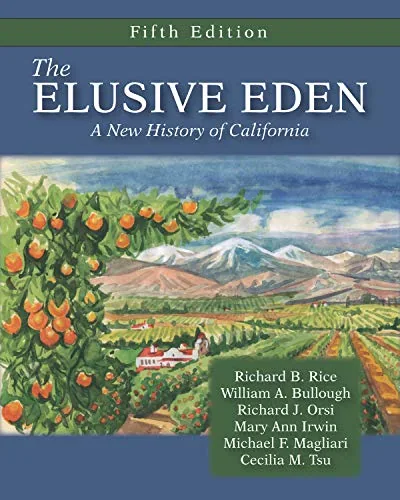
The Elusive Eden: A New History of California, 5th Edition
By Richard B. Rice, William A. Bullough, Richard J. Orsi, Mary Ann Irwin, Michael F. Magliari, Cecilia M. Tsu
About this ebook
The Elusive Eden: A New History of California, Fifth Edition, traces the state's history through its environments, peoples, institutions, and conflicts. Written for California history students and general readers, it connects Native societies, Spanish and Mexican rule, the Gold Rush, reform, industrial growth, suburbanization, and multicultural politics in a chronological narrative.
Inside this title
Native cultures, Spanish missions, Mexican ranchos, and American statehood
Current listed price $25.99Regular price $54.00Digital ebook
Landscape and climate remain active forces in this history rather than serving only as background. The narrative begins with California's diverse Native cultures and follows the transformations associated with Spanish missions, Mexican ranchos, American rule, and the Gold Rush. Migration, landholding, settlement, and economic development connect these eras.
Later sections examine Progressive reforms, labor movements, wartime industry, defense spending, and the expansion of suburbs. Environmentalism and multicultural politics bring social and environmental themes into the account of modern California. Six historians contribute perspectives across the chronology, making the fifth edition suitable for California history and American West courses as well as readers seeking historical context for the state's regional differences and changing public life.
Study guide included
Inside The Elusive Eden: A New History of California, 5th Edition.
Six authors retell California's past as a sequence of rearranged land, labor, and political power. The narrative runs from Indigenous societies and Spanish missions through gold, railroads, depression, war, and the technology economy, always asking who gained from each boom, who was displaced, and which ecological limits the gains ran into.
The fifth edition opens with the state's geology, climate, and Native peoples, then follows Spanish colonization, Mexican independence, and U.S. annexation. Mining and rail chapters link markets to migration and legal exclusion. Later sections bring irrigation, farm labor, Progressive reform, the Depression, wartime industry, Japanese American incarceration, and the civil rights and farmworker movements into one arc. Closing chapters follow environmental regulation, base closures, tribal gaming, energy policy, the housing collapse, and homelessness. The through-line is a question: how did a place sold as abundant end up distributing its costs so unevenly?
Geography, water, and memory
The opening chapters treat tectonics, rainfall, and seasonal dryness as forces that shaped where people settled and what they could grow. Storage and conveyance turned aridity into an asset for some users and a liability for others. A prologue then questions preservation stories that celebrate buildings while leaving out the laborers and residents who made those sites work.
Read terrain as history
Ask where water moves
Question whose story a site tells
Compare evidence with commemoration
Chs. 1–3
Missions, ranchos, and Native resistance
Spanish settlement combined religious missions, military presidios, and civilian pueblos, each with a different purpose. Mission life reorganized work, movement, and ties to land, and disease and coercion eroded Native independence. Flight, bargaining, and armed revolt show that Indigenous people answered the new order rather than merely enduring it; Estanislao's uprising anchors that point. After Mexican independence, secularization shifted authority toward ranchos without making land access equal.
Separate mission, presidio, pueblo
Keep Native agency central
Follow the hide trade
Note unequal land access
Chs. 4–9
Gold, law, and the railroads
Mining began with cheap claims and turned into a capital-heavy industry, while taxation and the 1850 Indian Act decided who could hold ground and who could be bound to labor. Statehood made ownership and legal status practical matters with unequal answers. Railroads then tied growers to distant buyers, and public land grants plus concentrated ownership gave a few firms leverage over rates and access, as Mussel Slough made visible.
Track capital in mining
Read taxes as gatekeeping
Follow rail rate power
Ask who could enter markets
Chs. 10–15
Industry, reform, and the Depression
Rail links pushed the economy toward commercial farming, manufacturing, and urban services, with Delta agriculture resting on Asian immigrant skill and labor. Unions and agrarian protesters contested concentrated power, and Progressive regulation plus women's suffrage widened the political toolkit without ending racial exclusion. Southern California grew on imported water and highways, and the Depression revived organizing and brought federal works, with the Central Valley Project tying policy to physical water management.
Link transport to farming
Follow labor bargaining power
Read reform and its limits
Connect dams to policy
Chs. 16–21
War, migration, and civil rights
Wartime demand for ships, aircraft, food, and research pulled workers toward industrial centers and left institutions that outlasted the fighting. Japanese American incarceration showed the same federal power removing homes, property, and livelihoods. Postwar arrivals needed housing, schools, roads, and recreation, while aerospace tied jobs to defense budgets. Organizing around schools, racial inequality, and farm labor followed, with Chávez and Huerta building a movement that crossed communities.
Read war as a remaking
Pair growth with incarceration
Follow the defense spending
Connect taxes to expectations
Chs. 22–27
Ecology and the recent economy
Environmental chapters trace a shift from saving scenic places toward fights over air, water, and regional planning, with the bay, Delta, coast, Tahoe, and Mono Lake showing how protection can unsettle existing development and water claims. Later chapters cover recession, base closures, tribal gaming, energy deregulation, technology, and demographic change, then set the housing collapse and homelessness beside tech wealth to test the promise of abundance.
Move from scenery to regulation
Trace a resource conflict
Set boom beside displacement
Reopen the title's question
Chs. 28–30
Chapter and section map
The Natural Settingp. 9
The Native Peoplesp. 25
Spanish Californiap. 65
The New El Doradop. 139
The Coming of the Railroadp. 191
The Depression Decadep. 319
World War IIp. 352
California: Eden or Wasteland?p. 443
Key takeaways
Set civic celebrations beside records of who held land, did the work, and could vote.
Follow water from its source to its users, and note who absorbs the losses downstream.
Treat migration and labor organizing as forces that built the economy and divided its rewards.
Students in California history and ethnic studies courses, along with general readers who want a documented narrative rather than a booster account of the state.
Topics covered
California history
Gold Rush
Spanish missions
water politics
railroad history
environmental history
Japanese American incarceration
farmworker movement
Questions about this ebook.
Edition, audience, and study-guide details at a glance.
What is The Elusive Eden: A New History of California, 5th Edition about?
The Elusive Eden: A New History of California, Fifth Edition, traces the state's history through its environments, peoples, institutions, and conflicts. Written for California history students and general readers, it connects Native societies, Spanish and Mexican rule, the Gold Rush, reform, industrial growth, suburbanization, and multicultural politics in a chronological narrative.
Which edition of The Elusive Eden: A New History of California, 5th Edition is this?
This listing is for the 5th edition. Check the title, ISBN, and book details above before ordering, especially if your course or reading list names a specific edition.
Who is The Elusive Eden: A New History of California, 5th Edition for?
Students in California history and ethnic studies courses, along with general readers who want a documented narrative rather than a booster account of the state.
Does this page include a study guide?
Yes. This page includes an original study guide with six thematic sections, key takeaways, and a chapter and section map for structured reading.