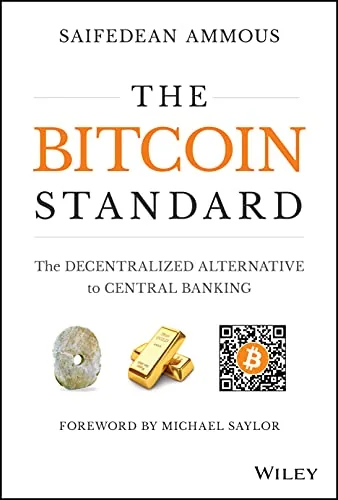
The Bitcoin Standard: The Decentralized Alternative to Central Banking
By Saifedean Ammous
About this ebook
The Bitcoin Standard presents Saifedean Ammous's economic argument for Bitcoin through a history of monetary systems. The book compares commodity money, gold, fiat currency, and decentralized digital money, focusing on scarcity and monetary institutions. It suits readers interested in monetary history, Austrian economics, and the ideas behind Bitcoin's proposed monetary role.
Inside this title
Historical comparison of commodity money, gold, and fiat currency systems
Current listed price $12.99Regular price $21.00Digital ebook
Ammous begins with historical forms of money and the characteristics that allow a monetary good to function. Durability, portability, divisibility, and scarcity inform his comparison of commodities, precious metals, and state-issued currency. The narrative then examines the decline of the gold standard and the author's critique of central banking.
The second part applies this framework to Bitcoin, discussing proof of work, its supply limit, and decentralized mining. The comparison with gold forms part of Ammous's case for Bitcoin as a monetary alternative. Readers studying economic arguments about cryptocurrency can use the book to understand this particular perspective and the connection it draws between monetary design, institutions, and economic behavior.
Study guide included
Inside The Bitcoin Standard: The Decentralized Alternative to Central Banking.
Ammous argues about money by asking what makes a monetary good durable, portable, divisible, and scarce. From that framework he moves through commodity money, gold, and fiat currency to Bitcoin, presenting proof of work and a fixed supply as a monetary design rather than a technical curiosity.
The book has two movements. The first traces monetary history and the properties that let a good serve as money, then examines the gold standard and the author's critique of central banking. The second applies that framework to Bitcoin, describing proof of work, the supply limit, and decentralized mining. Gold recurs as the reference point against which the new asset is measured. The argument connects monetary design to institutions and to economic behaviour, and it is presented as a case for Bitcoin's monetary role. Readers should treat it as one distinctive position in an ongoing debate rather than a settled consensus.
What makes a good money
Ammous begins from the properties money needs: durability, portability, divisibility, and scarcity, among others. These are presented as criteria for comparing candidates, so that commodities, metals, and state currency can be assessed on shared ground. The framework is the book's basic instrument and recurs in every later comparison.
Compare money on shared properties
Value scarcity among the criteria
Apply the framework consistently
Topic 1-2
Commodity money and gold
Commodity money emerges from goods that already have use and can be traded. The book follows this history toward precious metals and treats gold as the strongest historical example of a scarce monetary good. Gold becomes the benchmark against which later monetary arrangements, including Bitcoin, are judged.
Trace money's emergence from trade
Explain gold's historical standing
Use gold as a benchmark
Topic 2-3
Fiat currency and central banking
The critique of fiat money and central banking is the book's argumentative core. Ammous associates state-issued currency with discretionary management of supply and with the institutional power to expand it. Readers should note that this is a contested claim advanced from a particular school of economic thought, not a neutral survey.
Identify the critique of discretion
Examine assumptions about incentives
Read the argument as a position
Topic 3-4
Decline of the gold standard
The narrative turns to the erosion of the gold standard and the shift toward managed currency. Ammous presents this as a monetary transition with consequences for saving, investment, and state capacity. The account is selective by design, serving the larger argument rather than attempting a comprehensive monetary history.
Follow the shift to managed currency
Consider consequences for saving
Notice the argument's selectivity
Topic 4-5
Bitcoin supply and proof of work
The second half applies the framework to Bitcoin. Proof of work is described as the mechanism securing the network, and the supply limit as the feature that makes digital scarcity possible. Ammous connects these design choices to the monetary properties discussed earlier, treating them as engineering answers to old monetary problems.
Explain proof of work's purpose
Connect supply limits to scarcity
Link design to monetary properties
Topic 5-6
Decentralized mining as monetary design
Decentralized mining is presented as more than an implementation detail: it distributes the production of new units and the security of the ledger. Ammous argues that this arrangement differentiates Bitcoin from centrally issued money. Whether the argument holds is a question readers should evaluate against competing accounts of the same technology.
See mining as institutional design
Compare with central issuance
Weigh competing accounts of the same design
Topic 6-8
Topic map
Properties of Sound MoneyTopic 1
Commodity Money and MetalsTopic 2
Gold and the Gold StandardTopic 3
Fiat Currency and Central BankingTopic 4
Bitcoin's Supply LimitTopic 5
Proof of Work and MiningTopic 6
Bitcoin as Monetary AlternativeTopic 7
Key takeaways
The book's argument rests on a property-based comparison of money, so following that framework is essential to evaluating its conclusions.
Ammous writes from a distinct economic tradition; his claims about central banking are argued positions, not settled findings.
Bitcoin's supply limit and proof of work are presented as monetary design choices, which is where the case is strongest or weakest.
Readers interested in monetary history, Austrian economics, and cryptocurrency who want a sustained argument for Bitcoin's monetary role rather than a technical or investing manual.
Topics covered
Bitcoin monetary theory
monetary history
Austrian economics
sound money
proof of work
central banking
fiat currency
digital scarcity
Questions about this ebook.
Edition, audience, and study-guide details at a glance.
What is The Bitcoin Standard: The Decentralized Alternative to Central Banking about?
The Bitcoin Standard presents Saifedean Ammous's economic argument for Bitcoin through a history of monetary systems. The book compares commodity money, gold, fiat currency, and decentralized digital money, focusing on scarcity and monetary institutions. It suits readers interested in monetary history, Austrian economics, and the ideas behind Bitcoin's proposed monetary role.
Who is The Bitcoin Standard: The Decentralized Alternative to Central Banking for?
Readers interested in monetary history, Austrian economics, and cryptocurrency who want a sustained argument for Bitcoin's monetary role rather than a technical or investing manual.
Does this page include a study guide?
Yes. This page includes an original study guide with six thematic sections, key takeaways, and a topic map for structured reading.