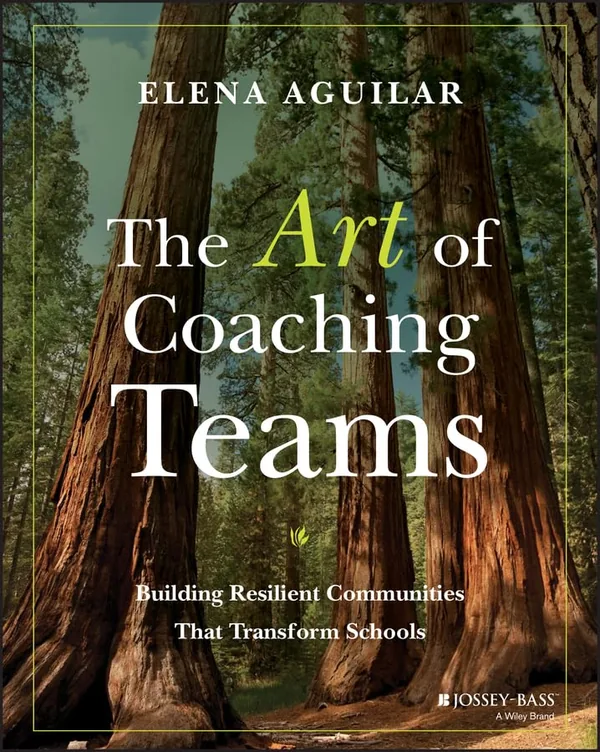
The Art of Coaching Teams addresses the work of leading collaborative groups in schools. Elena Aguilar combines meeting design, decision processes, conflict resolution, and leader resilience for instructional coaches, teacher leaders, and administrators. Examples, templates, and reflection prompts connect team development with the pressures and priorities of educational settings.
Inside this title
Agenda design that connects meeting activities with team outcomes
Current listed price $12.99Regular price $21.00Digital ebook
School teams need shared purposes as well as workable routines. Elena Aguilar examines how leaders can establish trust, clarify goals, organize participation, and make decisions together. Her account links the practical details of an agenda with the relationships and emotional conditions that influence how a group works.
The book includes examples, templates, and questions for reflection, allowing readers to revisit particular facilitation challenges. Attention to conflict and leader resilience accompanies guidance on collaborative problem-solving. Instructional coaches, principals, department leaders, and professional learning communities can use the material to consider both meeting practices and the wider culture of their teams.
Study guide included
Inside The Art of Coaching Teams: Building Resilient Communities That Transform Schools.
School teams succeed or fail on the quality of their collaboration. Aguilar connects meeting design, decision protocols, conflict navigation, and leader resilience, showing instructional coaches, teacher leaders, and administrators how to build the trust and routines that let a group of educators work well together under real pressure.
The book treats a team as something built deliberately rather than assembled and left alone. Shared purpose, trust, and clear goals come before technique, but technique matters: agendas, participation structures, and decision processes turn good intentions into workable meetings. Aguilar also addresses what happens when collaboration breaks down, offering ways to navigate conflict without avoiding it. Leader resilience receives sustained attention, on the premise that a facilitator's own state affects the room. Templates and reflection prompts let readers revisit specific challenges, and the discussion keeps returning to the culture of the school rather than stopping at individual meeting tricks.
Purpose, trust, and shared goals
A team needs more than a meeting time. The section examines how shared purpose and trust are established, arguing that collaboration depends on clarity about why the group exists. Goals give the work direction, while trust allows members to disagree without withdrawing. Readers are asked to treat these foundations as ongoing work rather than a one-time kickoff.
Establish why the team exists
Build trust that permits disagreement
Treat foundations as ongoing work
Topic 1 · Purpose, Trust, and Goals
Agenda design for real outcomes
An agenda is a design decision, not a formality. The section connects meeting activities with the outcomes a team is trying to reach, asking facilitators to choose structures that fit the work. A well-designed agenda makes participation possible and keeps discussion from drifting, but it also leaves room for what emerges in the room.
Tie activities to intended outcomes
Choose structures that fit the work
Leave room for what emerges
Topic 2 · Agenda Design
Inclusive decisions and protocols
Decision-making is where many teams stall. The section presents protocols that clarify who decides, how input is gathered, and when a choice is final. Inclusive processes are treated as a way to improve decisions and protect relationships, not as a delay. Readers are asked to match the protocol to the stakes of the decision.
Clarify who decides and how
Match protocol to decision stakes
Use inclusion to improve, not delay
Topic 3 · Decisions and Protocols
Navigating conflict
Conflict is presented as information about what a team cares about. The section examines how facilitators can surface disagreement, keep it focused on the work, and help a group move through it. Avoiding conflict is treated as its own risk, because unspoken disagreement erodes trust and undermines later decisions.
Surface disagreement rather than avoid it
Keep conflict focused on the work
Recognize avoidance as a risk
Topic 4 · Conflict Navigation
Leader resilience and self-awareness
A facilitator's condition affects the group. The section places leader resilience inside the practice of coaching teams, asking readers to notice their own stress, triggers, and limits. Self-awareness is treated as a professional skill that supports calm and consistency, especially when a meeting becomes difficult.
Notice your own stress and triggers
Treat self-awareness as a skill
Model calm when meetings get hard
Topic 5 · Leader Resilience
Templates, reflection, and school culture
The book offers templates and reflection prompts as tools for revisiting practice. The section connects those tools with the wider culture of a school, since a team's routines either reinforce or challenge existing norms. Readers are asked to use the materials to examine their own facilitation and the conditions their school creates for collaboration.
Use templates to revisit practice
Connect team routines to school culture
Examine the conditions around collaboration
Topic 6 · Tools and Culture
Topic map
Purpose, Trust, and Shared GoalsTopic 1
Agenda DesignTopic 2
Inclusive Decision ProcessesTopic 3
Conflict NavigationTopic 4
Leader ResilienceTopic 5
Templates and ReflectionTopic 6
School Culture and Professional CommunityTopic 7
Key takeaways
Build purpose and trust before relying on meeting technique.
Match decision protocols to the stakes and make participation meaningful.
Treat your own resilience and self-awareness as part of facilitation.
Instructional coaches, teacher leaders, principals, and professional learning community facilitators who lead collaborative teams in schools.
Topics covered
team coaching
school leadership
meeting design
decision protocols
conflict resolution
teacher leadership
professional learning communities
leader resilience
Questions about this ebook.
Edition, audience, and study-guide details at a glance.
What is The Art of Coaching Teams: Building Resilient Communities That Transform Schools about?
The Art of Coaching Teams addresses the work of leading collaborative groups in schools. Elena Aguilar combines meeting design, decision processes, conflict resolution, and leader resilience for instructional coaches, teacher leaders, and administrators. Examples, templates, and reflection prompts connect team development with the pressures and priorities of educational settings.
Who is The Art of Coaching Teams: Building Resilient Communities That Transform Schools for?
Instructional coaches, teacher leaders, principals, and professional learning community facilitators who lead collaborative teams in schools.
Does this page include a study guide?
Yes. This page includes an original study guide with six thematic sections, key takeaways, and a topic map for structured reading.