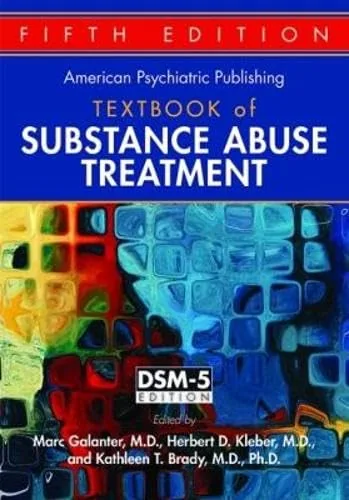
The American Psychiatric Publishing Textbook of Substance Abuse Treatment, 5th Edition
Edited by Marc Galanter, Herbert D. Kleber, Kathleen T. Brady
About this ebook
The American Psychiatric Publishing Textbook of Substance Abuse Treatment, Fifth Edition, surveys addiction science and clinical treatment. Edited by Marc Galanter, Herbert D. Kleber, and Kathleen T. Brady, this 2015 reference addresses substance-specific disorders, detoxification, rehabilitation, medication, psychosocial interventions, and special populations for addiction professionals and trainees.
Inside this title
Neurobiology, epidemiology, and substance-specific perspectives on addiction treatment
Current listed price $35.99Regular price $115.00Digital ebook
Neurobiology and epidemiology establish a research context for this multi-author addiction reference. Chapters then examine alcohol, opioids, stimulants, cannabis, and other substances, relating patterns of use and disorder to the treatment approaches discussed in the fifth edition.
Detoxification, rehabilitation, pharmacotherapy, and psychosocial methods provide several perspectives on clinical care. Attention to co-occurring disorders and special populations broadens the material beyond a single substance or treatment setting. Psychiatrists, addiction clinicians, counselors, and trainees can use the volume to study how research and treatment were brought together in this 2015 edition, or to compare approaches across different substance use disorders and stages of care.
Study guide included
Inside The American Psychiatric Publishing Textbook of Substance Abuse Treatment, 5th Edition.
Addiction treatment draws on biology, pharmacology and social context at once. Galanter, Kleber and Brady assemble those strands into a reference that moves from neurobiological and epidemiological foundations through substance-specific disorders to detoxification, rehabilitation, medication, psychosocial care and the needs of special populations.
The volume is organized so clinical topics can be studied either by substance or by stage of care. Early material sets out the neurobiology and epidemiology that frame addiction as a medical condition. Substance-focused sections address alcohol, opioids, stimulants, cannabis and other drugs, linking patterns of use to treatment implications. Later sections turn to detoxification, rehabilitation, pharmacotherapy and psychosocial interventions, then widen to co-occurring disorders and special populations. Because chapters come from many contributors, the book reads as a survey of approaches rather than a single argument. Its 2015 publication date places the material in a particular moment of addiction science and practice.
Neurobiology and epidemiology as context
The opening material supplies the scientific frame for everything that follows. Neurobiology explains how substances act on brain systems and why repeated use can become disordered, while epidemiology describes who is affected and how patterns vary across groups. Together they establish addiction as a condition to be understood rather than a simple failure of will, and they give later clinical discussions a shared vocabulary.
Neurobiology links substance effects to brain systems
Epidemiology describes who is affected and how
The two fields supply a shared clinical vocabulary
Topic 1
Substance-specific disorders
Alcohol, opioids, stimulants, cannabis and other substances each receive focused attention. The book relates the pharmacology and pattern of use of each to the treatment questions it raises, so that differences between substances are not flattened into a single model. Comparing these sections shows how withdrawal risk, intoxication effects and long-term consequences vary, and why treatment planning cannot be entirely generic.
Each substance raises distinct treatment questions
Withdrawal and intoxication risks differ by drug
Treatment planning cannot be wholly generic
Topics 2–3
Detoxification and rehabilitation
Detoxification is treated as a transition rather than a cure, with medical attention to withdrawal and its dangers. Rehabilitation extends from that point into structured care, routine and relapse prevention. The book keeps the two stages connected, since a safe withdrawal without a plan for what follows leaves the underlying disorder largely unaddressed, while rehabilitation without medical stabilization may begin on unstable ground.
Detoxification manages withdrawal but is not a cure
Rehabilitation extends into structured continuing care
Stabilization and follow-up depend on each other
Topics 4–5
Pharmacotherapy
Medication is presented as one component of treatment, with indications and limits tied to particular substances and clinical situations. The chapters discuss how pharmacological options fit alongside counseling and rehabilitation rather than replacing them. Because responses and risks vary, the material emphasizes matching a medication to the patient's condition, history and stage of care instead of assuming a single standard regimen.
Medication works alongside psychosocial care
Indications differ by substance and situation
Matching treatment to the patient matters
Topic 6
Psychosocial interventions
Counseling and behavioral approaches address the patterns, relationships and settings that sustain substance use. The book surveys intervention styles and the settings in which they are delivered, keeping the focus on how people change rather than on a single preferred method. It also acknowledges that engagement, retention and social context shape whether any intervention has a chance to work.
Behavioral approaches target patterns and settings
Engagement and retention shape outcomes
Social context affects whether treatment works
Topic 7
Co-occurring disorders and special populations
The final sections widen the frame beyond a single diagnosis or a typical patient. Co-occurring mental health conditions complicate assessment and treatment, while special populations require attention to circumstances that general guidance may overlook. The book treats these as central clinical concerns, not exceptions, and asks the reader to adapt approaches rather than apply one template across every setting.
Co-occurring conditions complicate assessment
Special populations need adapted approaches
Exceptions belong inside clinical planning
Topic 8
Topic map
Neurobiology and Epidemiology of AddictionTopic 1
Alcohol and Other Substance DisordersTopic 2
Opioid, Stimulant and Cannabis DisordersTopic 3
Detoxification and Withdrawal ManagementTopic 4
Rehabilitation and Continuing CareTopic 5
PharmacotherapyTopic 6
Psychosocial InterventionsTopic 7
Co-occurring Disorders and Special PopulationsTopic 8
Key takeaways
Read the substance-specific sections against the general chapters, since treatment differs by drug as well as by stage.
Treat detoxification as a medical transition that still requires a plan for continuing care.
Keep co-occurring conditions and special populations in view rather than treating them as afterthoughts.
Psychiatrists, addiction clinicians, counselors and trainees who want a broad reference survey of addiction science, substance-specific disorders and the range of treatment approaches as presented in 2015.
Topics covered
substance abuse treatment
addiction psychiatry
detoxification
pharmacotherapy
psychosocial interventions
co-occurring disorders
substance use disorders
addiction neurobiology
Questions about this ebook.
Edition, audience, and study-guide details at a glance.
What is The American Psychiatric Publishing Textbook of Substance Abuse Treatment, 5th Edition about?
The American Psychiatric Publishing Textbook of Substance Abuse Treatment, Fifth Edition, surveys addiction science and clinical treatment. Edited by Marc Galanter, Herbert D. Kleber, and Kathleen T. Brady, this 2015 reference addresses substance-specific disorders, detoxification, rehabilitation, medication, psychosocial interventions, and special populations for addiction professionals and trainees.
Which edition of The American Psychiatric Publishing Textbook of Substance Abuse Treatment, 5th Edition is this?
This listing is for the 5th edition. Check the title, ISBN, and book details above before ordering, especially if your course or reading list names a specific edition.
Who is The American Psychiatric Publishing Textbook of Substance Abuse Treatment, 5th Edition for?
Psychiatrists, addiction clinicians, counselors and trainees who want a broad reference survey of addiction science, substance-specific disorders and the range of treatment approaches as presented in 2015.
Does this page include a study guide?
Yes. This page includes an original study guide with six thematic sections, key takeaways, and a topic map for structured reading.