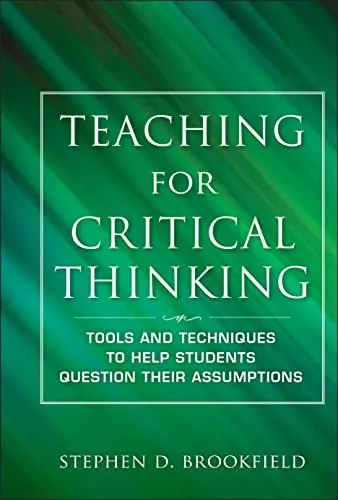
Teaching for Critical Thinking: Tools and Techniques to Help Students Question Their Assumptions
By Stephen D. Brookfield
About this ebook
Teaching for Critical Thinking offers educators methods for helping students identify assumptions, consider alternatives, and justify decisions. Stephen D. Brookfield combines discussion protocols, classroom activities, and assessment approaches with attention to resistance and cultural context, making the book relevant to teachers across disciplines and adult learning settings.
Inside this title
Classroom activities for identifying and questioning underlying assumptions
Current listed price $21.00Regular price $35.00Digital ebook
Brookfield treats critical thinking as an activity that teachers can model, organize, and examine with students. Identifying assumptions and testing them against other perspectives provide a framework for discussion and informed action. The text connects that framework to classroom procedures, prompts, and ways of assessing students' reasoning.
It also addresses the difficulty of questioning ideas that feel personally or culturally important. Student resistance, varied learning contexts, and institutional constraints appear alongside reflection on the educator's own practice. Teachers and facilitators can use the activities to plan discussions and evaluate how students explain their judgments. The book gives particular attention to making reasoning visible within the learning process.
Study guide included
Inside Teaching for Critical Thinking: Tools and Techniques to Help Students Question Their Assumptions.
Teaching for Critical Thinking gives educators methods for helping students surface assumptions, weigh alternatives, and justify judgments. Stephen Brookfield combines discussion protocols, classroom activities, and assessment with attention to resistance and cultural context, making the approach usable across disciplines and adult learning settings.
Brookfield treats critical thinking as something teachers can model, structure, and examine with students. The central move is to identify an assumption and test it against other perspectives before acting on it. The book translates that move into prompts, discussion procedures, and assessment tasks that make reasoning visible. It also faces the difficulty of questioning ideas students hold personally or culturally, discussing resistance without dismissing it. Reflection on the educator's own practice runs alongside the classroom techniques. Teachers and facilitators can use the activities to plan discussions and evaluate how students explain their judgments.
Surfacing Hidden Assumptions in Class
Critical thinking begins when an assumption becomes visible. Brookfield offers prompts and activities that help students notice the beliefs shaping their reasoning. Once named, an assumption can be examined instead of silently guiding a conclusion, which makes later discussion more honest and specific about what is actually being claimed.
Use prompts that make assumptions visible
Name beliefs shaping student reasoning
Examine assumptions instead of accepting them
Read before designing a discussion prompt
Testing Ideas Against Alternatives
Questioning an assumption requires exposure to other perspectives. The book describes ways to bring competing views into discussion so students can compare and revise. Testing ideas becomes a social process, not a private exercise, and disagreement becomes material for learning rather than an obstacle to be managed away.
Bring competing perspectives into discussion
Compare ideas rather than defend them
Revise judgments as evidence shifts
Read with a contested topic in mind
Discussion Protocols That Make Reasoning Visible
Structured discussion protocols give critical thinking a procedure. Brookfield shows how turns, roles, and question sequences can slow reasoning down enough to examine it. Protocols also distribute participation beyond the loudest voices, which improves the range of perspectives a class hears and makes reasoning available for comment.
Use structured turns, roles, and questions
Slow reasoning down enough to examine it
Distribute participation across the group
Read before running a structured discussion
Classroom Activities and Prompts
The book supplies activities that can be adapted to different subjects and levels. Each activity targets a specific thinking move, such as identifying an assumption or evaluating evidence. Facilitators can select and modify them for their own context rather than applying a fixed script, which keeps the approach usable across disciplines.
Choose activities targeting specific thinking moves
Adapt prompts to subject and level
Modify exercises for your own context
Read while building an activity sequence
Assessing Explanations and Analytical Development
Assessment focuses on how students explain and justify, not just what they conclude. Brookfield suggests tasks that reveal reasoning and show development over time. Feedback then addresses the quality of argument rather than only the correctness of the final answer, giving students something concrete to improve.
Assess explanations and justification, not only answers
Design tasks that reveal student reasoning
Give feedback on the quality of argument
Read before writing an assessment task
Resistance, Culture, and Reflective Practice
Questioning assumptions can feel threatening, especially when beliefs are culturally rooted. The book examines student resistance with care and asks educators to reflect on their own practice and constraints. Critical thinking is presented as a demanding, contextual activity rather than a neutral technique that works the same way everywhere.
Expect resistance when beliefs feel personal
Consider cultural context and institutional constraints
Reflect on your own assumptions as a teacher
Read when a discussion becomes tense
Topic map
Assumption IdentificationTopic 1
Testing Assumptions Against AlternativesTopic 2
Discussion ProtocolsTopic 3
Classroom Activities and PromptsTopic 4
Assessing Student ReasoningTopic 5
Student ResistanceTopic 6
Cultural and Institutional ContextTopic 7
Reflective Teaching PracticeTopic 8
Key takeaways
Make reasoning visible through protocols and prompts so assumptions can be examined rather than left implicit.
Assess how students justify their conclusions, not merely which conclusion they finally reach.
Expect resistance when core beliefs are questioned and treat it as part of the work.
Teachers, faculty developers, and adult educators who want practical classroom methods for teaching critical thinking, running structured discussions, assessing reasoning, and working with student resistance.
Topics covered
critical thinking pedagogy
questioning assumptions
discussion protocols
classroom activities
assessing reasoning
student resistance
reflective teaching
adult learning
Questions about this ebook.
Edition, audience, and study-guide details at a glance.
What is Teaching for Critical Thinking: Tools and Techniques to Help Students Question Their Assumptions about?
Teaching for Critical Thinking offers educators methods for helping students identify assumptions, consider alternatives, and justify decisions. Stephen D. Brookfield combines discussion protocols, classroom activities, and assessment approaches with attention to resistance and cultural context, making the book relevant to teachers across disciplines and adult learning settings.
Who is Teaching for Critical Thinking: Tools and Techniques to Help Students Question Their Assumptions for?
Teachers, faculty developers, and adult educators who want practical classroom methods for teaching critical thinking, running structured discussions, assessing reasoning, and working with student resistance.
Does this page include a study guide?
Yes. This page includes an original study guide with six thematic sections, key takeaways, and a topic map for structured reading.