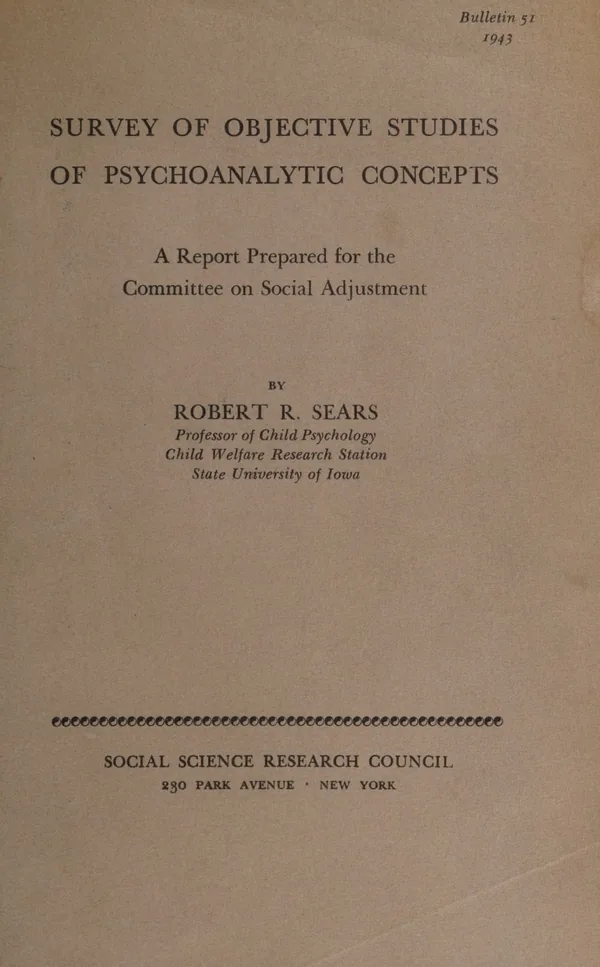
Survey of Objective Studies of Psychoanalytic Concepts
By Robert R. Sears
About this ebook
Robert R. Sears' Survey of Objective Studies of Psychoanalytic Concepts examines experimental and observational research on Freudian theory available in 1943. Written for psychology researchers, students, and historians, the report evaluates methods and evidence surrounding psychoanalytic ideas, providing a historical view of attempts to test clinical concepts empirically.
Inside this title
Experimental and observational investigations of concepts from Freudian theory
Current listed price $19.99Regular price $40.00Digital ebook
Prepared for the Committee on Social Adjustment, this report gathers studies that translated psychoanalytic concepts into problems for experimental and observational investigation. Sears considers both the findings and the ways researchers obtained them, making research design part of the discussion rather than treating published conclusions as settled facts.
Repression, regression, and the Oedipus complex are among the concepts considered within this early research landscape. The survey can support work on personality theory, the history of psychology, and the relationship between clinical interpretation and empirical testing. Its value lies in documenting the evidence and methodological debates of its period.
Study guide included
Inside Survey of Objective Studies of Psychoanalytic Concepts.
A 1943 report reviewing experimental and observational work on Freudian ideas. Sears examines how psychoanalytic concepts were translated into research problems, weighing methods and evidence on repression, regression, and the Oedipus complex, and offering historians and psychologists a record of early attempts to test clinical theory empirically.
Prepared for the Committee on Social Adjustment, the survey gathers studies that turned psychoanalytic concepts into questions for experiment and observation. Sears discusses not only findings but how researchers reached them, treating design and evidence as part of the subject. Repression, regression, and the Oedipus complex appear within this early research landscape. The report is valuable less as a verdict than as documentation: it shows what could be tested, what methods were available, and where interpretation outran evidence. Readers interested in personality theory, the history of psychology, and the relationship between clinical ideas and empirical inquiry will find a period portrait of methodological debate.
Purpose and Committee Context
The survey was written for a committee concerned with social adjustment, which shapes what it asks and how it reports. Sears frames the review as an assessment of evidence rather than advocacy for a school. Understanding that setting clarifies the report's tone and selection.
Situate the report in its committee setting
Identify its evaluative aim
Note the period's research climate
Topic 1
Turning Concepts into Testable Problems
A central difficulty is converting clinical concepts into research questions. The text examines how psychoanalytic claims were reformulated so that observation or experiment could bear on them. This translation step is treated as an object of study in its own right.
Reformulate clinical claims as questions
Assess operational definitions
Note where translation changes meaning
Topic 2
Experimental and Observational Methods
The survey weighs the methods available to researchers of the period. Experimental and observational approaches are compared for what they can show and where they fall short. Sears keeps methodological appraisal close to the findings it supports.
Distinguish experimental from observational designs
Assess what each can demonstrate
Connect method to conclusion
Topic 3
Findings on Repression and Regression
Repression and regression are among the concepts examined through the collected studies. The discussion pairs reported results with questions about how the phenomena were defined and measured. Readers see the gap between rich clinical description and controlled evidence.
Review repression studies
Review regression studies
Compare definitions and measures
Topics 4–5
The Oedipus Complex Under Study
The Oedipus complex poses particular problems for objective research because of its interpretive content. The survey considers attempts to examine it and the limits those attempts encountered. The material illustrates the challenge of testing concepts that resist simple operationalization.
Examine research on the complex
Identify measurement difficulties
Weigh interpretive versus empirical evidence
Topic 6
Appraisal, Legacy, and Historical Reading
Sears's own appraisal draws the evidence together without declaring the matter closed. Read historically, the survey documents a moment when psychology tried to subject clinical theory to empirical scrutiny. Its continuing interest lies in that record of method and debate.
Summarize the report's judgments
Place it in psychology's history
Study empirical testing of clinical concepts
Topic 7
Topic map
Scope of the report and its committee contextTopic 1
Translating psychoanalytic concepts into testable problemsTopic 2
Experimental and observational methodsTopic 3
Evidence on repressionTopic 4
Evidence on regressionTopic 5
The Oedipus complex under objective studyTopic 6
Methodological appraisal and historical significanceTopic 7
Key takeaways
Testing a clinical concept begins with the hard work of turning it into a researchable question.
Method and evidence must be read together, since each shapes what a study can claim.
Historical surveys show which questions a period could ask and which it could not yet answer.
Psychology students and researchers interested in personality theory, historians of psychology, and readers examining how clinical concepts have been subjected to empirical study.
Topics covered
psychoanalytic concepts
Robert Sears
history of psychology
repression
regression
Oedipus complex
empirical research
research methods
Questions about this ebook.
Edition, audience, and study-guide details at a glance.
What is Survey of Objective Studies of Psychoanalytic Concepts about?
Robert R. Sears' Survey of Objective Studies of Psychoanalytic Concepts examines experimental and observational research on Freudian theory available in 1943. Written for psychology researchers, students, and historians, the report evaluates methods and evidence surrounding psychoanalytic ideas, providing a historical view of attempts to test clinical concepts empirically.
Who is Survey of Objective Studies of Psychoanalytic Concepts for?
Psychology students and researchers interested in personality theory, historians of psychology, and readers examining how clinical concepts have been subjected to empirical study.
Does this page include a study guide?
Yes. This page includes an original study guide with six thematic sections, key takeaways, and a topic map for structured reading.