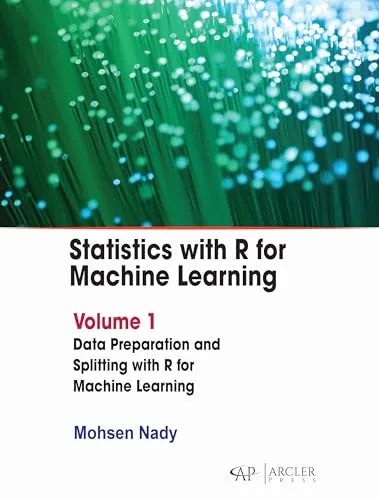
Statistics with R for Machine Learning, Volume 1, concentrates on preparing data before model training. Mohsen Nady organizes the material around cleaning, transformation, and data splitting, with R examples for beginners and practitioners studying missing values, inconsistent records, feature preparation, reproducible scripts, and the separation of training and evaluation data.
Inside this title
Three chapters focus on cleaning, transformation, and data partitioning
Current listed price $41.99Regular price $120.00Digital ebook
The volume's three-chapter structure gives sustained attention to the preparation stage of an R-based machine learning workflow. Cleaning topics include missing data, duplicates, inconsistent types, and outliers. Transformation introduces scaling, normalization, categorical encoding, and the creation of variables, with discussion of tools such as dplyr and tidyr.
Data partitioning connects preparation with later modeling and evaluation. Random sampling, stratified splits, and approaches sensitive to time ordering illustrate why the structure of a dataset matters when separating training, validation, and test material. Code snippets and examples of incomplete or inconsistent data support readers developing reusable scripts. The scope is deliberately centered on preprocessing rather than a survey of machine learning algorithms.
Study guide included
Inside Statistics with R for Machine Learning, Volume 1.
Volume 1 stays on the unglamorous half of machine learning: getting data into a state worth modeling. Nady works through cleaning, transformation, and splitting in R, with attention to missing values, inconsistent records, and the leakage that ruins honest evaluation.
Because the book is confined to three chapters, each stage gets room. Cleaning covers absent values, duplicated rows, mismatched types, and unusual observations. Transformation deals with scale, distribution, categorical variables, and derived features, using dplyr and tidyr as the working tools. Partitioning then asks how to separate training, validation, and test material without letting information from the future or from the test set seep backward. Code examples and deliberately messy datasets let readers rehearse the workflow and keep scripts they can reuse on their own projects. Algorithms are outside the volume's intended scope.
Why Preparation Deserves Its Own Volume
The book's premise is that model quality is bounded by data quality. Rather than surveying algorithms, it concentrates on the decisions that precede training and are hard to undo later.
Preparation is treated as a distinct skill
Scope is limited to three stages
Emphasis falls on decisions, not just syntax
Read to calibrate what the volume does and does not cover.
Cleaning: Missing, Duplicate, Mistyped, Extreme
Each defect gets separate treatment because each has different consequences. Missingness can hide a pattern, duplicates can inflate confidence, inconsistent types can break computation, and outliers may be errors or signal.
Diagnose why values are absent
Detect duplicates and inconsistent representations
Decide deliberately what to do with extremes
The first pass over any imported dataset.
Transformation: Scale, Shape, Categories, Features
Scaling and normalization change how distances behave; encoding makes categories usable; derived variables can expose relationships the raw columns hide. Each choice carries assumptions.
Choose a scaling method with the model in mind
Encode categorical variables without losing meaning
Create features only when the rationale is clear
Where most of the practical judgment sits.
Working in R with dplyr and tidyr
The examples rely on two core tidyverse packages. dplyr handles row and column operations; tidyr reshapes data between wide and long forms. Together they make preparation steps readable and repeatable.
Verbs for filtering, mutating, grouping, summarizing
Reshaping for different analytical needs
Pipelines that read as a sequence of decisions
Follow with the code open in a session.
Splitting Data Honestly
Partitioning is presented as a design choice, not a formality. Random, stratified, and time-aware splits answer different questions and protect against different mistakes.
Random splits for general-purpose evaluation
Stratification when classes are uneven
Time-ordered splits when sequence matters
Read before touching a validation score.
Reproducibility and the Leakage Trap
Scripts should let someone else rerun the preparation and obtain the same data. Leakage occurs when information from outside the training setting influences it, and the text treats prevention as part of preprocessing.
Keep steps scripted rather than manual
Fit transformations on training data only
Watch for future information in time-based data
The discipline that makes the earlier topics trustworthy.
Topic map
Topic 1Theme 1
Topic 2Theme 2
Topic 3Theme 3
Topic 4Theme 4
Topic 5Theme 5
Topic 6Theme 6
Key takeaways
Most modeling failures begin in preparation, not in algorithm choice.
Each cleaning and transformation decision encodes an assumption worth stating.
Splitting and leakage prevention belong to preprocessing, not to a final check.
R users new to machine learning, plus practitioners who want a disciplined preprocessing workflow.
Topics covered
Statistics with R for Machine Learning Volume 1
Mohsen Nady data preparation
R data cleaning tutorial
dplyr tidyr preprocessing
feature scaling and encoding
train validation test split
data leakage prevention
machine learning preprocessing book
Questions about this ebook.
Edition, audience, and study-guide details at a glance.
What is Statistics with R for Machine Learning, Volume 1 about?
Statistics with R for Machine Learning, Volume 1, concentrates on preparing data before model training. Mohsen Nady organizes the material around cleaning, transformation, and data splitting, with R examples for beginners and practitioners studying missing values, inconsistent records, feature preparation, reproducible scripts, and the separation of training and evaluation data.
Who is Statistics with R for Machine Learning, Volume 1 for?
R users new to machine learning, plus practitioners who want a disciplined preprocessing workflow.
Does this page include a study guide?
Yes. This page includes an original study guide with six thematic sections, key takeaways, and a topic map for structured reading.