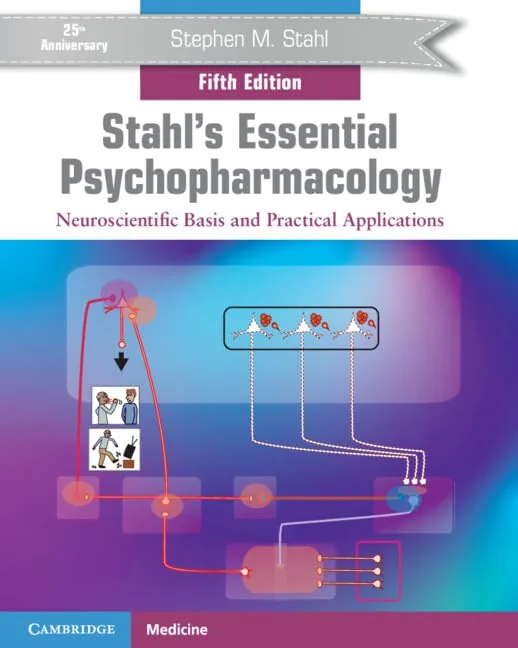
Stahl’s Essential Psychopharmacology: Neuroscientific Basis and Practical Applications, fifth edition, connects psychiatric drug action with neuroanatomy, neurotransmission, and neural circuits. Intended for psychiatry trainees, clinicians, and students of psychopharmacology, it examines major psychiatric conditions and medication classes, including antidepressants, antipsychotics, mood stabilizers, and anxiolytics, through their underlying biological mechanisms.
Inside this title
Neurotransmitter systems, receptor pharmacology, and psychiatric neural circuits
Current listed price $21.00Regular price $102.00Digital ebook
Neurotransmitter systems, receptors, and neural circuits form the explanatory framework of this text. Stahl relates molecular pharmacology and brain function to depression, bipolar disorder, schizophrenia, anxiety, and attention-deficit/hyperactivity disorder. Medication classes are considered in relation to the mechanisms they affect rather than as lists of disconnected drug facts.
The fifth edition also discusses the rationale for combination and augmentation approaches, adverse effects, and mechanisms under investigation. Connections among neuroanatomy, physiology, and drug action give readers a way to examine why different treatments are considered in psychiatric care. Its scope suits clinical and academic study of psychopharmacology, especially where an understanding of mechanisms is part of interpreting therapeutic choices.
Psychiatric drugs act on targets inside circuits, and Stahl uses that chain to explain why medicines with similar labels can behave differently and why one mechanism may shift several symptom domains at once. The fifth edition pairs illustration with practical application for trainees and working clinicians.
It begins with chemical neurotransmission and the receptors, transporters, ion channels and enzymes a drug might affect. Mechanisms are then followed through models of psychosis and mood disorders and extended to anxiety, trauma, pain, sleep, attention, dementia and addiction. Diagrams link molecular action to plausible benefit and side effect. The book states plainly that these remain models: they explain patterns and generate testable hypotheses, while any individual's response stays variable and cannot be read from a diagram. The result is a reference for understanding mechanism rather than a prescribing manual.
Follow signals across neurons
A synapse is a sequence: a presynaptic cell releases transmitter, receptors on the next cell respond, and feedback plus clearance mechanisms shape the message. The book adds volume transmission, where signals reach receptors beyond the immediate junction, and retrograde signalling, where the receiving cell talks back. Targets differ by role, so agonists, antagonists, partial agonists and modulators all alter timing and availability in distinct ways.
Read release, binding and clearance in order
Separate receptor, transporter, enzyme, channel
Note where a signal is not synaptic
Chapters 1–3
Map psychosis across pathways
Models of psychosis tie positive symptoms to dopamine activity in mesolimbic routes and ask how other circuits relate to cognition and motivation, with glutamate and serotonin offering indirect paths. The crucial point is location: the same receptor action can produce quite different consequences depending on the pathway involved, which is why movement and prolactin effects sit apart from symptom change.
Place each receptor action in its circuit
Keep positive symptoms separate from side effects
Treat the model as hypothesis, not diagnosis
Chapters 4–5
Relate mood to networks
Mood chapters trace energy, interest, cognition, sleep and emotional regulation, distinguishing unipolar from bipolar patterns and stressing course over time. Diagrams attach these experiences to candidate networks, but similar symptoms can travel different routes. The text separates the immediate event at a target from the adaptations that follow, which is how agents with unlike mechanisms end up sharing uses while differing in side-effect profile.
Track symptoms as dimensions over time
Divide immediate action from later adaptation
Compare profiles rather than class names
Chapters 6–7
Trace threat and pain circuits
Fear leans on amygdala-centred routes while worry involves loops linking cortex, striatum and thalamus, and the account of trauma draws on learning and the persistence of threat responses. Pain runs through ascending signals and modulating systems, and repeated input can reset sensitivity. Because a mechanism can serve both pain and mood, it matters which circuit is being discussed and which outcome was measured.
Distinguish fear responses from worry loops
Separate pain transmission from modulation
Name the outcome each claim measures
Chapters 8–9
Understand arousal and attention
Sleep and wakefulness come from several transmitter networks working in concert, histamine and orexin among them, with some signals promoting alertness and others promoting rest. Because a target also serves other functions, the same action can produce either the wanted effect or a shift in alertness. Attention chapters then link dopamine and norepinephrine to prefrontal focus and impulse control, where outcome depends on task and circuit state.
Treat arousal as a coordinated balance
Expect alertness effects from shared targets
Define the task before judging attention
Chapters 10–11
Track cognition, reward and habit
Dementia names a decline in thinking severe enough to disrupt everyday life and can stem from different conditions; acetylcholine matters, and the book separates symptom relief from disease process. Behaviour and cognition deserve separate attention because they move independently. Addiction is then read as learning: impulsive reward-seeking gives way to compulsive repetition as control shifts from reward circuits toward habit systems, which explains persistence despite rising costs.
Separate symptomatic relief from disease course
Assess behaviour and cognition on their own
Read addiction as shifting from reward to habit
Chapters 12–13
Chapter and section map
Chemical NeurotransmissionCh. 1
Transporters, Receptors, Enzymes and Ion ChannelsChs. 2–3
Psychosis and Dopamine, Serotonin and GlutamateChs. 4–5
Mood Disorders and Related TreatmentsChs. 6–7
Anxiety, Trauma and Chronic PainChs. 8–9
Sleep and Wakefulness and ADHDChs. 10–11
Dementia and AcetylcholineCh. 12
Impulsivity, Compulsivity and AddictionCh. 13
Key takeaways
Trace a drug from molecular target to circuit to measured effect, and keep those three levels separate.
When two drugs share a class label, compare their targets and circuit actions before assuming equivalence.
Distinguish symptomatic relief from any claim about altering the underlying disease process itself.
Psychiatry residents, clinical trainees and students of psychopharmacology who want mechanism-level explanations, plus practising clinicians refreshing how drug targets map onto symptoms and side effects.
Topics covered
clinical psychopharmacology
Stephen Stahl
neural circuits
antidepressant mechanisms
antipsychotic drugs
dopamine pathways
psychiatric medication
mood disorders
Questions about this ebook.
Edition, audience, and study-guide details at a glance.
What is Stahl’s Essential Psychopharmacology: Neuroscientific Basis and Practical Applications, 5th Edition about?
Stahl’s Essential Psychopharmacology: Neuroscientific Basis and Practical Applications, fifth edition, connects psychiatric drug action with neuroanatomy, neurotransmission, and neural circuits. Intended for psychiatry trainees, clinicians, and students of psychopharmacology, it examines major psychiatric conditions and medication classes, including antidepressants, antipsychotics, mood stabilizers, and anxiolytics, through their underlying biological mechanisms.
Which edition of Stahl’s Essential Psychopharmacology: Neuroscientific Basis and Practical Applications, 5th Edition is this?
This listing is for the 5th edition. Check the title, ISBN, and book details above before ordering, especially if your course or reading list names a specific edition.
Who is Stahl’s Essential Psychopharmacology: Neuroscientific Basis and Practical Applications, 5th Edition for?
Psychiatry residents, clinical trainees and students of psychopharmacology who want mechanism-level explanations, plus practising clinicians refreshing how drug targets map onto symptoms and side effects.
Does this page include a study guide?
Yes. This page includes an original study guide with six thematic sections, key takeaways, and a chapter and section map for structured reading.