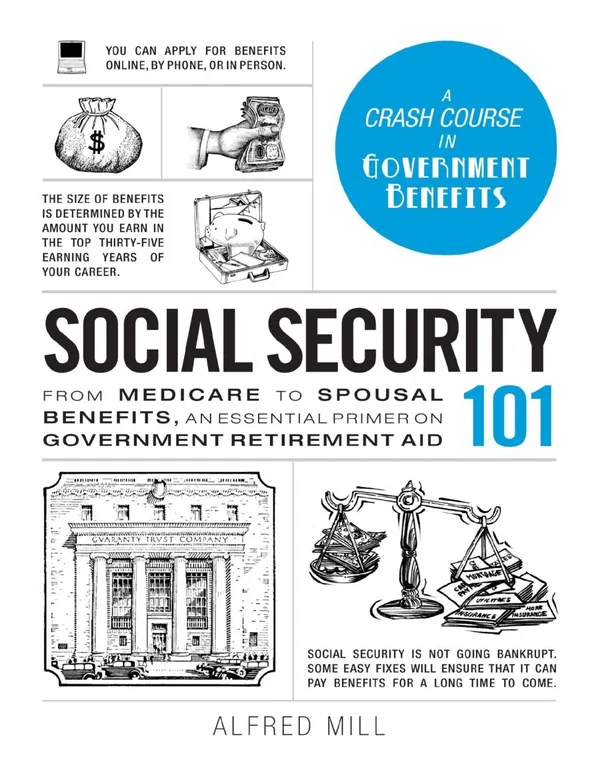
Social Security 101 introduces the U.S. benefits system for readers beginning to study retirement and related public programs. Alfred Mill's 2016 primer covers retirement, disability, spousal and survivor benefits, Medicare, claiming considerations, earnings, and taxation, using accessible explanations for workers, prospective retirees, and family members helping others understand the system.
Inside this title
Retirement, disability, dependent, spousal, and survivor benefit categories
Current listed price $3.99Regular price $6.00Digital ebook
Mill organizes this introduction around the questions people ask when trying to understand Social Security. The book explains the role of earnings history and retirement age in benefit calculations and distinguishes retirement benefits from disability, dependent, spousal, and survivor provisions. Work during retirement and cost-of-living adjustments also form part of the discussion.
Medicare receives separate attention, including its different parts and enrollment considerations. Other sections connect benefits with taxation and income sources such as pensions, IRAs, and workplace retirement accounts. Reflecting the program as discussed in a 2016 publication, the primer is suited to readers seeking historical background and basic terminology before examining more detailed information about a particular benefits situation.
Study guide included
Inside Social Security 101.
Social Security can feel like a maze of rules, ages and categories. Alfred Mill's primer walks beginners through how benefits are calculated, who qualifies for retirement, disability, spousal and survivor support, how Medicare fits, and why earnings and taxes shape what a person ultimately receives.
Mill builds the introduction around the questions people actually ask about the program. He explains how a worker's earnings history and claiming age feed into retirement benefit calculations, then separates retirement from disability and from dependent, spousal and survivor provisions. Working during retirement and cost-of-living adjustments are also part of the picture. Medicare receives its own treatment, including the different parts and enrolment questions, and later material connects benefits with taxation and other retirement income such as pensions and individual retirement accounts. Because the book reflects the program as discussed in 2016, it works best as a foundation in terminology and background before a reader checks current rules for a specific situation.
Program foundations and terminology
The primer opens by situating Social Security among the public programs that support retirement and related needs. Its aim is to give readers working vocabulary and background before they confront the details of a particular benefit, so later chapters can use terms consistently.
Social Security is framed as a public benefits system
Terminology is explained in plain language
Background prepares readers for specific questions
Topic 1
Earnings records and benefit calculation
Benefit amounts are tied to a person's earnings history, and the book explains how that record enters the calculation. Rather than presenting formulas in isolation, it shows why lifetime earnings and the age of claiming both change the result a person might expect.
Earnings history shapes benefit amounts
Claiming age affects the calculation
Records should be understood before planning
Topic 2
Retirement age and claiming choices
Retirement age and the timing of a claim are treated as connected decisions. The discussion explains why the age at which someone starts benefits matters, giving readers a way to think about the trade-offs involved in when to claim.
Claiming age is a central decision
Timing changes the benefit a person receives
Choices should be weighed deliberately
Topic 3
Disability and family benefits
Retirement is only one category. The book distinguishes disability benefits and dependent provisions, showing that different eligibility rules and circumstances govern each, and that families may encounter several categories at once.
Disability benefits follow their own rules
Dependent provisions support family members
Categories can apply together
Topics 4-5
Spousal and survivor provisions
Spousal and survivor benefits address situations where a person's own work record is not the whole story. The primer explains how these provisions differ from retirement benefits based on one's own earnings, giving family members a starting point for understanding eligibility.
Spousal benefits depend on a partner's record
Survivor benefits address a different circumstance
These differ from own-record retirement benefits
Topic 5
Medicare, taxes and other income
Medicare is given separate attention, including its parts and enrolment considerations. The closing material connects Social Security with taxation and with pensions, IRAs and workplace accounts, so that readers see benefits as one strand of retirement income rather than a complete plan.
Medicare has distinct parts and deadlines
Benefit taxation depends on other income
Social Security sits alongside other savings
Topics 6-7
Topic map
The Social Security System and Its ContextTopic 1
Earnings Records and Benefit CalculationTopic 2
Retirement Age and Claiming DecisionsTopic 3
Disability BenefitsTopic 4
Dependent, Spousal and Survivor BenefitsTopic 5
Medicare and Its PartsTopic 6
Earnings, Taxation and Other Retirement IncomeTopic 7
Key takeaways
Benefit amounts depend on earnings history and the age at which a person claims.
Retirement is only one category; disability, dependent, spousal and survivor benefits follow different rules.
Medicare, taxes and other retirement income belong in the same planning picture as Social Security.
Workers and prospective retirees new to the U.S. Social Security system, family members helping others understand benefits, and students who want plain-language grounding before consulting current official guidance.
Topics covered
Social Security 101
Alfred Mill Social Security guide
retirement benefit calculation
Social Security claiming age
disability and survivor benefits
spousal benefits explained
Medicare basics
Social Security taxation
Questions about this ebook.
Edition, audience, and study-guide details at a glance.
What is Social Security 101 about?
Social Security 101 introduces the U.S. benefits system for readers beginning to study retirement and related public programs. Alfred Mill's 2016 primer covers retirement, disability, spousal and survivor benefits, Medicare, claiming considerations, earnings, and taxation, using accessible explanations for workers, prospective retirees, and family members helping others understand the system.
Who is Social Security 101 for?
Workers and prospective retirees new to the U.S. Social Security system, family members helping others understand benefits, and students who want plain-language grounding before consulting current official guidance.
Does this page include a study guide?
Yes. This page includes an original study guide with six thematic sections, key takeaways, and a topic map for structured reading.