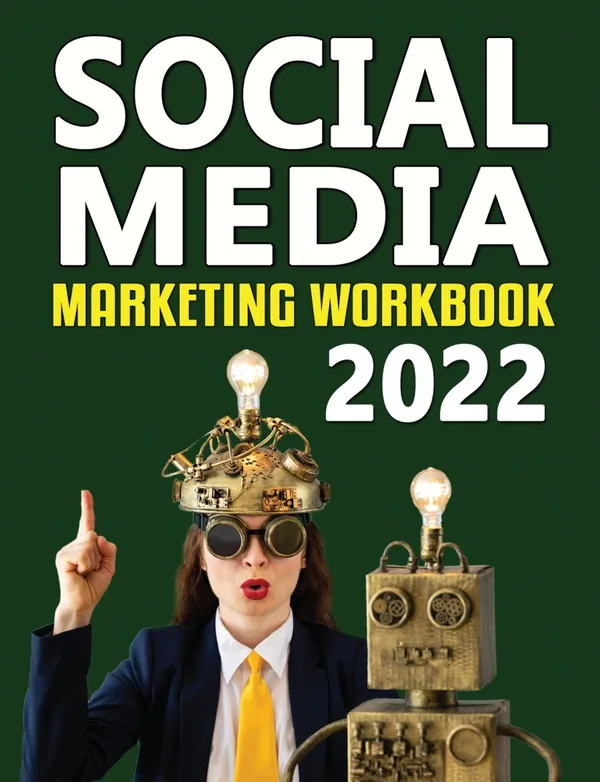
Social Media Marketing Workbook 2022 by Jason McDonald offers an exercise-oriented introduction to social content, audience engagement, and campaign planning. Small-business owners and marketing learners can explore platform-specific approaches, advertising, community development, and performance measurement through a party-hosting analogy that connects business goals with the experience of an online audience.
Inside this title
Workbook exercises connect business goals with social strategy
Current listed price $19.99Regular price $40.00Digital ebook
Jason McDonald uses the idea of hosting a party to explain the roles of content, audience participation, and community in social media marketing. The workbook format encourages readers to connect concepts with their own planning, including business objectives, content choices, and approaches to engagement. It is written for beginners as well as marketers reviewing their methods.
Platform discussions cover Facebook, Twitter, YouTube, TikTok, Instagram, Pinterest, and LinkedIn as presented in the 2022 edition. Advertising and performance analysis complement the content strategy material. Small-business readers and marketing students can use the exercises to examine how a social presence is planned and evaluated within the platform environment of that period.
Study guide included
Inside Social Media Marketing Workbook 2022.
Jason McDonald frames social marketing as hosting a party: decide who should attend, give them a reason to stay, and learn from how the evening goes. The 2022 workbook pairs that analogy with worksheets for planning channels, producing content, and measuring results across major platforms.
The book opens with a shared planning and content method, then moves platform by platform through Facebook, LinkedIn, Twitter, Instagram, YouTube, TikTok and Pinterest. A closing section on email shows how a relationship can continue after the feed ends. Exercises ask readers to study competitors, draft channel-specific plans and judge outcomes against a stated goal. Because the walkthroughs describe interfaces and features as they stood in 2022, the practical screenshots have aged, yet the underlying reasoning about audience, format and purpose still holds for anyone starting out.
Host for a chosen audience
The party metaphor turns strategy into a hosting problem. Before touching a platform, a business names the people it can genuinely help and the reason they would show up. Observing comparable businesses and communities supplies hypotheses rather than answers, and a short written channel plan records what seems to work and what stays unknown.
Name who the business can serve
Observe rivals before drafting a plan
Record open questions beside findings
Ch. 1 · Party On, Social Media Marketing
Run an ongoing content process
Rather than a burst of posts, the workbook favors a standing pipeline. Material comes from what the business owns, what it curates, what customers contribute and what prompts replies. One strong idea should be reshaped for each destination, keeping the central promise steady while length, caption and call to action change.
Keep a bank of customer questions
Reformat one idea for each channel
Vary the appeal beyond sales copy
Ch. 2 · Content Marketing
Select channels by behaviour
Platforms differ in the kind of presence they support. A public page carries a brand voice; a group hosts discussion among people who share an interest. LinkedIn suits professional exchange, Twitter suits public updates, and each only pays off if the intended customers actually take part. Staffing for replies belongs in the plan, not an afterthought.
Match page type to the relationship
Check where customers actually talk
Budget time for listening and replies
Chs. 3–5 · Facebook, LinkedIn, and Twitter
Give visuals a specific job
Image and video work best when tied to a task. Instagram supports a recognizable visual identity and recurring posts; YouTube supports searchable demonstration and longer explanation. TikTok's short clips travel through recommendation, and Pinterest rewards saved ideas. Deciding whether the viewer needs a quick contrast, a full sequence or something to keep shapes the format.
Choose the format around the viewer's task
Reuse assets instead of duplicating posts
Track an action suited to the medium
Chs. 6–9 · Instagram, YouTube, TikTok, and Pinterest
Turn attention into relationship
Social reach is borrowed; a subscriber list is closer to owned. The email chapter ties signup to a concrete benefit such as instruction or news that answers a recurring need, and insists later messages deliver it. Profiles set expectations, posts give reasons to act, and the handoff to a guide, question or consultation should be planned and traceable.
State exactly what subscribers receive
Make the next step obvious
Note which invitation produced the response
Chs. 1 and 10 · Audience invitation and email marketing
Measure, learn, then revise
Numbers help only when tied to the campaign's purpose. A goal such as qualified inquiries needs its own indicator; reach, saves and views act as clues about earlier stages. Paid promotion extends distribution for a defined reason, not as a rescue. The closing advice is to apply the same framework to new platforms instead of chasing every release.
Set the key measure before posting
Watch who acts, not only how many
Scale a topic after checking response
Chs. 1–2 and 11 · Planning, content, and revisiting the platform mix
Chapter and section map
Party On, Social Media MarketingCh. 1
Content MarketingCh. 2
Facebook and LinkedInChs. 3–4
Twitter and InstagramChs. 5–6
YouTube, TikTok, and PinterestChs. 7–9
Email Marketing and EpilogueChs. 10–11
Key takeaways
Write down the audience and the wanted action before picking a platform or building a calendar.
Treat content as a repeatable mix of owned, curated, customer and interactive material rather than one sales message.
Judge success by a business outcome, using reach and engagement to explain how people reached it.
Small-business owners, solo marketers and marketing students who want a practical, exercise-driven structure for planning social content without a large budget, an agency or prior campaign experience.
Topics covered
social media workbook
Jason McDonald
small business marketing
content calendar
platform planning
audience engagement
email list building
campaign measurement
Questions about this ebook.
Edition, audience, and study-guide details at a glance.
What is Social Media Marketing Workbook 2022 about?
Social Media Marketing Workbook 2022 by Jason McDonald offers an exercise-oriented introduction to social content, audience engagement, and campaign planning. Small-business owners and marketing learners can explore platform-specific approaches, advertising, community development, and performance measurement through a party-hosting analogy that connects business goals with the experience of an online audience.
Who is Social Media Marketing Workbook 2022 for?
Small-business owners, solo marketers and marketing students who want a practical, exercise-driven structure for planning social content without a large budget, an agency or prior campaign experience.
Does this page include a study guide?
Yes. This page includes an original study guide with six thematic sections, key takeaways, and a chapter and section map for structured reading.