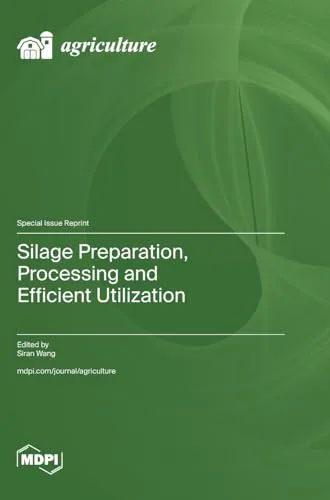
Silage Preparation, Processing and Efficient Utilization
Edited by Siran Wang
About this ebook
Silage Preparation, Processing and Efficient Utilization collects research on forage preservation, fermentation, and feed use. Edited by Siran Wang, the volume examines additives, alternative raw materials, co-ensiling, microbial communities, and stability. It is intended for agricultural researchers, graduate students, and specialists studying the relationships between silage processing, quality, and utilization.
Inside this title
Alternative silage materials, co-ensiling methods, additives, and bacterial inoculants
Current listed price $27.99Regular price $64.00Digital ebook
Eleven research articles bring experimental perspectives to the preparation and use of silage. The collection considers conventional and alternative raw materials, combinations of forages, bacterial inoculants, and chemical preservatives. Fermentation chemistry connects these processing choices with acidity, organic acids, and nutrient preservation.
Microbial community changes receive attention alongside pathogenic risks, spoilage, dry matter losses, and stability after exposure to air. The research format allows readers to compare particular materials and treatments rather than follow a general introductory manual. Forage scientists, animal nutrition researchers, and graduate readers can use the volume to investigate how raw material characteristics and microbial processes interact during storage and feed use.
Study guide included
Inside Silage Preparation, Processing and Efficient Utilization.
A research collection on how forage is preserved and used. Eleven articles examine additives, alternative raw materials, co-ensiling, fermentation chemistry, microbial communities, spoilage risks, dry matter losses, and aerobic stability, addressing quality and feed utilization for agricultural researchers and graduate readers.
The volume is a set of research articles rather than an introductory manual, so it is read for particular studies and comparisons. Contributions consider conventional and alternative raw materials, combinations of forages, bacterial inoculants, and chemical preservatives. Fermentation chemistry links these processing choices to acidity, organic acids, and nutrient preservation. Microbial community changes are examined alongside pathogenic risks, spoilage, dry matter losses, and stability after exposure to air. Because each article reports its own materials and treatments, readers compare findings across studies instead of following one continuous argument. Forage scientists, animal nutrition researchers, and graduate readers can use the collection to investigate how raw material characteristics and microbial processes interact during storage and feed use.
Alternative raw materials and forages
The collection widens the range of materials considered for ensiling beyond familiar crops. Material characteristics are treated as starting conditions that shape what fermentation can achieve.
Alternative materials bring different properties
Raw material characteristics shape fermentation
Comparisons depend on reported material details
Topic 1
Co-ensiling and forage combinations
Combining materials is examined as a way to adjust what goes into storage. The articles consider how mixtures behave relative to single materials.
Combinations change the ensiling substrate
Mixtures may balance material weaknesses
Outcomes depend on proportions and conditions
Topic 2
Additives and bacterial inoculants
Additives are studied as interventions in the fermentation process. Inoculants and chemical preservatives are assessed for their effects on the resulting silage.
Inoculants introduce selected bacteria
Chemical preservatives alter fermentation conditions
Additive effects are judged against untreated material
Topic 3
Fermentation chemistry and nutrient preservation
Acidity, organic acids, and nutrient retention connect processing choices to feed value. The chemistry is used to explain why treatments differ in outcome.
Fermentation produces organic acids
Acidity influences which microbes thrive
Nutrient preservation is a central measure of success
Topic 4
Microbial communities and pathogenic risks
Microbial populations are tracked because they drive both preservation and risk. The articles connect community composition with undesirable organisms.
Community composition changes during ensiling
Pathogenic organisms are a safety concern
Microbial shifts explain spoilage patterns
Topic 5
Spoilage, dry matter loss, and aerobic stability
Losses and stability after opening are treated as outcomes that determine how useful a silage is in practice.
Dry matter loss reduces feed value
Spoilage begins when air exposure allows degradation
Aerobic stability measures resistance after opening
Topic 6
Topic map
Alternative Raw Materials and Forage SourcesTopic 1
Co-Ensiling and Material CombinationsTopic 2
Additives and Bacterial InoculantsTopic 3
Fermentation Chemistry and Acid ProfilesTopic 4
Microbial Community DynamicsTopic 5
Pathogenic Risks and Spoilage OrganismsTopic 6
Dry Matter Loss and Aerobic StabilityTopic 7
Key takeaways
Processing choices connect raw material properties to fermentation outcomes.
Microbial communities are central to both preservation and risk.
Dry matter loss and aerobic stability measure practical feed value.
Forage and silage researchers, animal nutrition specialists, agricultural graduate students, and readers comparing experimental treatments in preserved feed.
Topics covered
Silage Preparation Processing and Efficient Utilization
silage fermentation research
forage preservation
silage additives and inoculants
co-ensiling
microbial communities in silage
aerobic stability
dry matter loss
Questions about this ebook.
Edition, audience, and study-guide details at a glance.
What is Silage Preparation, Processing and Efficient Utilization about?
Silage Preparation, Processing and Efficient Utilization collects research on forage preservation, fermentation, and feed use. Edited by Siran Wang, the volume examines additives, alternative raw materials, co-ensiling, microbial communities, and stability. It is intended for agricultural researchers, graduate students, and specialists studying the relationships between silage processing, quality, and utilization.
Who is Silage Preparation, Processing and Efficient Utilization for?
Forage and silage researchers, animal nutrition specialists, agricultural graduate students, and readers comparing experimental treatments in preserved feed.
Does this page include a study guide?
Yes. This page includes an original study guide with six thematic sections, key takeaways, and a topic map for structured reading.