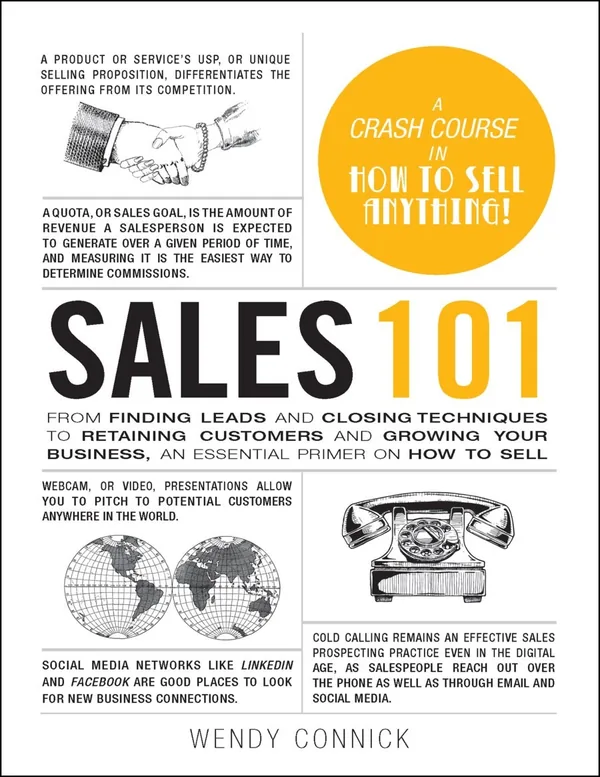
Sales 101: From Finding Leads and Closing Techniques to Retaining Customers
By Wendy Connick
About this ebook
Sales 101 introduces the stages of selling, from finding and qualifying prospects to closing and maintaining customer relationships. Wendy Connick organizes the subject into concise entries covering buyer psychology, objections, account management, and follow-up. The guide is aimed at beginning salespeople and readers seeking a structured overview of everyday selling activities.
Inside this title
Prospecting, lead qualification, buyer motivations, and sales conversations
Current listed price $7.99Regular price $14.00Digital ebook
The book follows a sale through its main stages, beginning with prospecting and lead qualification. Buyer motivation and communication provide context for presenting an offer, responding to questions, and handling objections. Closing techniques appear as one part of this broader process.
Post-sale material considers account management, retention, and the ongoing relationship with customers. Time management and follow-up connect individual conversations with a repeatable working routine. Concise, topic-focused entries allow readers to move through the sales lifecycle or revisit a particular skill. New sales representatives, small-business owners involved in selling, and readers studying customer relationships can use the guide as an introduction to the vocabulary and activities of sales.
Study guide included
Inside Sales 101: From Finding Leads and Closing Techniques to Retaining Customers.
A stage-by-stage walk through everyday selling for newcomers. Connick begins with prospecting and qualifying leads, moves into buyer motivation, presentations, objections, and closing, and carries the full process through account management, follow-up, and retention for readers new to sales work.
The guide organizes selling as a sequence rather than a collection of tricks. Prospecting and qualification come first, because effort spent on unlikely buyers is effort lost. Buyer motivation then frames how an offer is presented and how questions and objections are handled. Closing appears as one stage within that process, not as a separate performance. Post-sale chapters turn to account management, retention, follow-up, and time management, so a single conversation becomes a repeatable routine. The concise entries let readers move through the lifecycle or revisit one skill, and the book suits new representatives, small-business owners who sell, and readers learning the vocabulary of customer relationships.
Prospecting and qualifying leads
The process opens with finding possible buyers and deciding which are worth pursuing. Qualification is treated as a filter that protects time rather than a formality.
Prospecting generates candidate buyers
Qualification tests fit and readiness
Filtering saves effort later in the process
Topic 1
Buyer motivation
Selling depends on understanding why a buyer might act. The text connects motivation with how an offer is framed and which concerns are likely to surface.
Buyers act from different motives
Motivation shapes how an offer is framed
Unspoken concerns affect decisions
Topic 2
Presenting the offer and handling objections
Presentation is treated as a conversation adjusted to the buyer. Objections are expected parts of that conversation rather than signs of failure.
Presentations should match buyer concerns
Objections reveal what needs addressing
Responses should be specific to the stated concern
Topic 3
Closing techniques
Closing is placed inside the broader process instead of at its emotional peak. The text presents techniques as options whose fit depends on the situation and the buyer.
Closing follows from earlier stages
Techniques suit different situations
Pressure is not the same as persuasion
Topic 4
Account management and retention
The sale is not the end of the relationship. Account management and retention are treated as ongoing work that protects the value of what was already won.
Existing customers remain part of the pipeline
Retention requires continued attention
Account management organizes the relationship
Topic 5
Follow-up and time management
Follow-up turns isolated contacts into a routine, while time management keeps that routine sustainable. Both are presented as practical habits rather than personality traits.
Follow-up keeps opportunities from going cold
A repeatable routine reduces missed contacts
Time allocation reflects where effort pays off
Topic 6
Topic map
Prospecting for New BusinessTopic 1
Qualifying ProspectsTopic 2
Buyer Psychology and MotivationTopic 3
Presenting the Offer and Answering ObjectionsTopic 4
Closing the SaleTopic 5
Account Management and RetentionTopic 6
Follow-Up and Time ManagementTopic 7
Key takeaways
Selling is a sequence in which each stage depends on the one before.
Objections belong to the conversation, not outside it.
Retention and follow-up protect the value of a completed sale.
New sales representatives, small-business owners who handle their own selling, and readers seeking a structured introduction to the sales lifecycle.
Topics covered
Sales 101 Wendy Connick
beginner sales guide
prospecting and lead qualification
objection handling
closing techniques
customer retention
account management
sales follow-up
Questions about this ebook.
Edition, audience, and study-guide details at a glance.
What is Sales 101: From Finding Leads and Closing Techniques to Retaining Customers about?
Sales 101 introduces the stages of selling, from finding and qualifying prospects to closing and maintaining customer relationships. Wendy Connick organizes the subject into concise entries covering buyer psychology, objections, account management, and follow-up. The guide is aimed at beginning salespeople and readers seeking a structured overview of everyday selling activities.
Who is Sales 101: From Finding Leads and Closing Techniques to Retaining Customers for?
New sales representatives, small-business owners who handle their own selling, and readers seeking a structured introduction to the sales lifecycle.
Does this page include a study guide?
Yes. This page includes an original study guide with six thematic sections, key takeaways, and a topic map for structured reading.