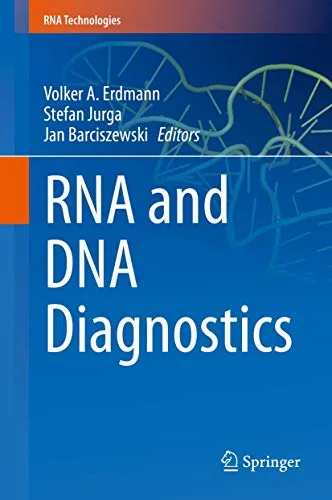
Edited by Volker A. Erdmann, Stefan Jurga, Jan Barciszewski
About this ebook
RNA and DNA Diagnostics examines methods for detecting and analyzing nucleic acids in research and clinical applications. Edited by Volker A. Erdmann, Stefan Jurga, and Jan Barciszewski, the volume covers amplification, sequencing, microarrays, and biomarkers. It serves molecular biology researchers, diagnostic laboratory readers, and students studying nucleic acid testing.
Inside this title
RNA and DNA targets share a molecular diagnostics framework
Current listed price $32.99Regular price $82.00Digital ebook
RNA and DNA targets are considered within a shared account of molecular diagnostics. Contributed chapters examine principles of detection and quantification, including PCR-based methods, sequencing, and microarray analysis. These methods are connected with the identification and validation of biomarkers rather than treated solely as laboratory procedures.
Applications include cancer, infectious disease, and inherited disorders, with attention to the interpretation of diagnostic data. Ethical and regulatory questions add context to the use of nucleic acid tests. Researchers and students can use the volume to study the relationship between a molecular target, the method chosen to measure it, and the diagnostic question under investigation in this edition.
Study guide included
Inside RNA and DNA Diagnostics.
A multi-author survey of molecular diagnostics built on nucleic acids. Edited by Erdmann, Jurga, and Barciszewski, it connects detection and quantification methods to biomarker discovery and clinical questions, covering amplification, sequencing, and microarray approaches across cancer, infection, and inherited disease.
RNA and DNA targets are handled within one diagnostic frame rather than as separate specialties. Contributed chapters explain the principles behind detection and quantification, including PCR-based amplification, sequencing, and microarray analysis. Those methods are linked to identifying and validating biomarkers, so technique serves a clinical question rather than standing alone. Applications span cancer, infectious disease, and inherited disorders, with attention to how diagnostic data are read and weighed. Ethical and regulatory considerations situate nucleic acid testing in a wider context. Researchers, laboratory readers, and students can follow the path from a molecular target through method selection to interpretation.
A Shared Molecular Diagnostic Frame
The volume treats RNA and DNA as related diagnostic targets within one framework. Contributed chapters share a concern with detecting and analyzing nucleic acids. Readers see how the two molecules are studied together rather than in isolation.
Treat RNA and DNA as linked targets
Frame detection as a diagnostic question
Read across contributed chapters
Topic 1
Amplification Methods
Amplification makes small amounts of nucleic acid measurable. The text explains PCR-based approaches and the principles that make them work. Methods are discussed in terms of the diagnostic problems they suit.
Explain PCR-based amplification
Relate amplification to detection
Match method to sample limits
Topic 2
Sequencing and Microarrays
Sequencing and microarray analysis offer different windows on nucleic acids. The book describes what each approach reveals and how results are obtained. Readers compare methods by the kind of information they produce.
Describe sequencing approaches
Explain microarray analysis
Compare information each yields
Topic 3
Biomarker Discovery and Validation
Methods are connected to finding and confirming biomarkers. The text treats validation as a step that gives a marker diagnostic value. Detection technique is tied to the evidence needed to trust a marker.
Identify candidate biomarkers
Explain validation steps
Link markers to diagnostic use
Topic 4
Applications in Disease
The volume applies molecular methods to cancer, infectious disease, and inherited disorders. Each setting raises distinct diagnostic questions. Examples show how method choice follows from the clinical problem.
Apply methods to cancer
Address infectious disease testing
Examine inherited disorder diagnostics
Topic 5
Interpretation, Ethics, and Regulation
Diagnostic data have to be interpreted, and their use carries obligations. Ethical and regulatory questions are treated as part of the field rather than an appendix. Readers consider how testing is situated in practice.
Interpret diagnostic data
Consider ethical questions
Relate regulation to laboratory use
Topics 6–7
Topic map
Nucleic acid targets and diagnostic framingTopic 1
PCR-based amplificationTopic 2
Sequencing and microarray analysisTopic 3
Biomarker identification and validationTopic 4
Cancer, infectious disease, and inherited disordersTopic 5
Interpreting diagnostic resultsTopic 6
Ethical and regulatory considerationsTopic 7
Key takeaways
The choice of detection method should follow from the diagnostic question.
Biomarker validation is what turns a molecular signal into a usable test.
Interpretation and regulation belong to molecular diagnostics, not outside it.
Molecular biology researchers, diagnostic laboratory readers, and students studying nucleic acid testing who want methods linked to biomarkers and clinical interpretation.
Topics covered
RNA and DNA diagnostics
molecular diagnostics
nucleic acid testing
PCR amplification
sequencing
microarrays
biomarkers
clinical laboratory
genetic disorders
Questions about this ebook.
Edition, audience, and study-guide details at a glance.
What is RNA and DNA Diagnostics about?
RNA and DNA Diagnostics examines methods for detecting and analyzing nucleic acids in research and clinical applications. Edited by Volker A. Erdmann, Stefan Jurga, and Jan Barciszewski, the volume covers amplification, sequencing, microarrays, and biomarkers. It serves molecular biology researchers, diagnostic laboratory readers, and students studying nucleic acid testing.
Who is RNA and DNA Diagnostics for?
Molecular biology researchers, diagnostic laboratory readers, and students studying nucleic acid testing who want methods linked to biomarkers and clinical interpretation.
Does this page include a study guide?
Yes. This page includes an original study guide with six thematic sections, key takeaways, and a topic map for structured reading.