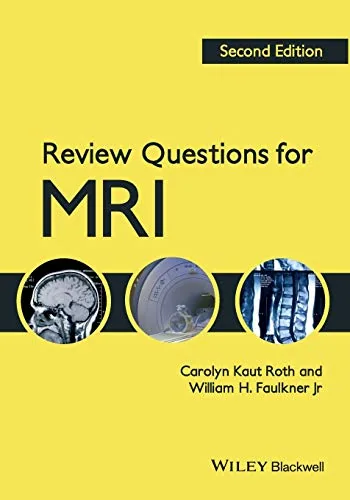
Review Questions for MRI, Second Edition, provides topic-organized practice for MRI technologists studying advanced imaging concepts and registry content. Carolyn Kaut Roth and William H. Faulkner Jr. cover patient care, safety, imaging procedures, data acquisition, physical principles, equipment, artifacts, contrast agents, and image quality in a question-based review format.
Inside this title
Question-based review of MRI care, procedures, acquisition, and physics
Current listed price $25.00Regular price $56.00Digital ebook
The question-based structure lets MRI students and technologists work through selected areas of the subject and notice where further study is needed. Major domains include patient care and safety, imaging procedures, data acquisition, and the physical principles behind MRI. Head, spine, musculoskeletal, and body examinations appear within the procedural scope.
Technical topics include relaxation, spin and gradient echo sequences, k-space, coils, shimming, and system operation. Questions also address artifacts, signal-to-noise ratio, spatial resolution, and contrast-related considerations. The second edition is suited to structured revision alongside MRI coursework and to technologists organizing preparation around the content domains of advanced-level registry study, without requiring readers to follow a continuous textbook narrative.
Study guide included
Inside Review Questions for MRI, 2nd Edition.
For MRI technologists, registry preparation is a matter of domains as much as hours. This question-based review organizes practice around patient care, safety, procedures, acquisition, physics, equipment, artifacts and image quality, letting readers test one area at a time and return to weak spots.
The book works by questions rather than by continuous exposition. Its sections follow the content areas that structure advanced imaging study: patient care and safety, imaging procedures, data acquisition, and the physical principles behind the modality. Procedural coverage includes head, spine, musculoskeletal and body examinations, while technical questions address relaxation, spin and gradient echo sequences, k-space, coils, shimming and system operation. Artifacts, signal-to-noise ratio, spatial resolution and contrast receive their own attention. Because each block stands alone, students can use the book alongside coursework or build a revision plan around the registry domains, returning to topics that resist recall rather than reading front to back.
Working with a question-based review
The format assumes the reader already has some instruction and now needs to test it. Questions are grouped by domain, so a session can concentrate on one area, reveal weak spots and send the reader back to notes or a textbook where needed.
Questions test rather than introduce
Domains can be practiced separately
Missed items identify study priorities
Topic 1
Patient care and safety
Safety questions cover the conditions that must be met before and during a scan. Patient screening, preparation and the management of hazards are treated as non-negotiable foundations, since technical skill cannot compensate for an unsafe environment.
Screening precedes every examination
Preparation affects image and safety
Hazard management is continuous
Topic 2
Procedures by body region
Head, spine, musculoskeletal and body examinations each raise their own positioning and protocol questions. Reviewing them by region helps readers connect anatomy with the choices a technologist makes during a study.
Region-specific protocols vary
Positioning affects diagnostic quality
Anatomy guides procedure choices
Topic 3
Data acquisition and physics
Acquisition questions address relaxation, spin and gradient echo sequences, k-space and the operation of the system. Physics is presented through the concepts a technologist applies when selecting and adjusting a sequence, not as abstract theory.
Relaxation underlies image contrast
Sequences differ in how data are collected
K-space organizes acquired data
Topic 4
Equipment, artifacts and image quality
Coils, shimming and system components belong with the artifacts and quality problems they can cause or correct. The review treats artifacts as diagnostic clues, since recognizing their source often points to the adjustment needed.
Coils and shimming affect signal
Artifacts often reveal their cause
Quality depends on system setup
Topic 5
Contrast, resolution and registry domains
Contrast-related considerations, signal-to-noise ratio and spatial resolution bring the technical strands together. Reviewing them alongside the registry content domains helps readers see how the areas connect and where their remaining gaps are.
Contrast choices shape the image
Resolution and noise trade off
Registry domains overlap in practice
Topics 6-7
Topic map
Using the Review QuestionsTopic 1
Patient Care and SafetyTopic 2
Imaging Procedures by Body RegionTopic 3
Data Acquisition and Physical PrinciplesTopic 4
Equipment, Artifacts, and Image QualityTopic 5
Contrast, Signal, and ResolutionTopic 6
Registry Domains and Revision PlanningTopic 7
Key takeaways
The question format is for testing established knowledge, so it works best after some coursework or clinical exposure.
Grouping by domain makes it practical to target weak areas instead of rereading everything.
Technical topics such as physics and artifacts are tied to the practical decisions a technologist makes during a scan.
MRI students and technologists preparing for advanced-level registry examinations, and practitioners who want a structured way to review imaging domains.
Topics covered
Review Questions for MRI 2nd Edition
Carolyn Kaut Roth
William H. Faulkner Jr.
MRI registry review
MRI safety and patient care
pulse sequences and k-space
MRI artifacts and image quality
MRI physics review
Questions about this ebook.
Edition, audience, and study-guide details at a glance.
What is Review Questions for MRI, 2nd Edition about?
Review Questions for MRI, Second Edition, provides topic-organized practice for MRI technologists studying advanced imaging concepts and registry content. Carolyn Kaut Roth and William H. Faulkner Jr. cover patient care, safety, imaging procedures, data acquisition, physical principles, equipment, artifacts, contrast agents, and image quality in a question-based review format.
Which edition of Review Questions for MRI, 2nd Edition is this?
This listing is for the 2nd edition. Check the title, ISBN, and book details above before ordering, especially if your course or reading list names a specific edition.
Who is Review Questions for MRI, 2nd Edition for?
MRI students and technologists preparing for advanced-level registry examinations, and practitioners who want a structured way to review imaging domains.
Does this page include a study guide?
Yes. This page includes an original study guide with six thematic sections, key takeaways, and a topic map for structured reading.