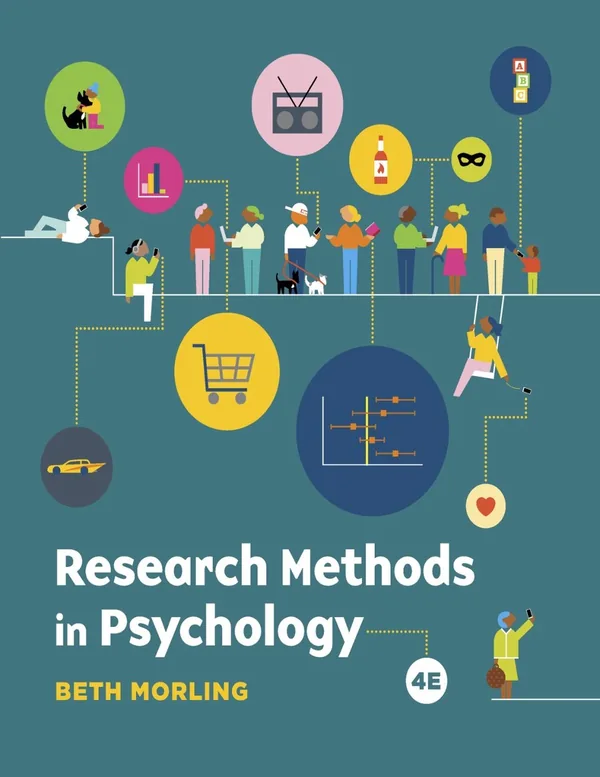
Research Methods in Psychology: Evaluating a World of Information, 4th Edition
By Beth Morling
About this ebook
Research Methods in Psychology: Evaluating a World of Information, fourth edition, teaches students to assess psychological evidence as readers and researchers. Beth Morling organizes inquiry around construct, internal, external, and statistical validity, connecting research design, ethics, measurement, published studies, and media claims with practical evaluation of scientific conclusions.
Inside this title
Four-validities framework for assessing the quality of research evidence
Current listed price $9.99Regular price $21.00Digital ebook
Morling approaches research methods by asking what a study can justify and how the quality of its evidence can be assessed. The four validities provide a recurring framework for evaluating measurement, causation, generalization, and statistical conclusions across different research questions.
Descriptive, correlational, and experimental designs establish the foundation for examining factorial studies, quasi-experiments, small-N research, and replication. Examples from published work connect design decisions with journal articles and public reporting, while ethics coverage addresses consent, review, and participant welfare. The fourth edition supports undergraduate psychology methods courses and readers in related fields who need to judge research claims or begin planning their own studies.
Study guide included
Inside Research Methods in Psychology: Evaluating a World of Information, 4th Edition.
Morling asks readers to label the claim in front of them—whether it concerns frequency, association, or cause—work out what evidence it demands, and weigh four validity questions. The same habits serve both a person planning research and a person judging a news headline, making the book as much about evaluation as about procedure.
The text moves from how science reasons, through ethics and measurement, into surveys, observation, correlation, and experiments, grouping the material by the claims studies make. Each design makes certain questions tractable while leaving others open. Later material covers multi-factor and quasi-experimental work, small-N studies, and the drive for replication and openness, offering a framework for evidence whose standing can shift as more work appears. Chapters pair each concept with media examples that students can evaluate directly, so the tools stay tied to real claims.
Name the claim, then the test
Frequency claims describe how common something is, association claims link measured variables, and causal claims assert that changing one thing would shift another. Any subject can yield all three, so the wording must be pinned down before evidence is judged. Morling then separates concerns about construct, statistical precision, generalization, and internal causal inference, noting that a design may satisfy one while leaving another unanswered, so each claim sets its own standard.
Pin down what the wording asserts
Match validity to the claim
Accept that one design has gaps
Part I, Chapters 1–3
Careful measurement, fair treatment
A construct becomes a self-report, an observation, or a physiological reading, and reliability means the same score recurs across occasions, item sets, or judges. Evidence for validity asks whether a number can bear the intended reading, including links to other measures. A repeatable score can capture a narrower idea than its label implies. Ethically, consent, harm limits, fair recruiting, and confidentiality shape the plan, and historical cases plus online data prompt questions about participant assumptions.
Ask what the score stands for
Check consistency and meaning
Put consent and harm in design
Part II, Chapters 4–5
Surveys and observation as estimates
Any questionnaire item should target one behavior or belief someone can interpret, with answer choices that make sense, since steering language, faulty recall, and concern about appearances can distort reports. Observation carries its own risks, and explicit coding rules, trained observers, and reliability checks keep records comparable. Generalization depends on naming the target population, on how the sample was drawn, and on who answered. Convenience samples can address questions but may skew who is included.
Inspect wording and response options
Train raters and check agreement
Ask who could and did respond
Part III, Chapters 6–7
Association is not explanation
Inspect both variables visually before summarizing, checking linearity, influential points, and restricted range, and remember that any estimated correlation carries uncertainty. Longitudinal data can show which variable moves first, and regression can weigh links while adjusting for alternatives that were measured. Neither step removes every plausible confounder, and mediation is a claim still awaiting support. Given a reading, ask which rivals were assessed and which results would separate them.
Look at the data before the number
Ask which variable changed first
Name the alternatives left open
Part IV, Chapters 8–9
Building and testing causal comparisons
A simple trial manipulates one variable and measures an outcome, while random assignment spreads differences across groups. Comparisons within the same person control some of that variation but can create order effects. Crossing two or more factors asks whether an effect changes with another condition, since averages can hide patterns across combinations. A null result may stem from a weak effect, clumsy measurement, or too few observations, so design and estimates matter before concluding absence.
Identify the active difference
Check for a second systematic gap
Read null results with care
Part V, Chapters 10–12
How far findings can travel
Where assignment cannot be random, quasi-experimental work leans on comparison and timing, so rivals such as outside events, normal development, or group formation need scrutiny. Small-N designs follow a handful of people repeatedly, altering conditions to see whether behavior shifts. Replication comes in close and conceptual forms, and preregistration with shared materials lets readers separate what was decided from what came later. Generalization rests on pooled evidence spanning participants, settings, and how constructs were defined.
Check rival explanations for change
Distinguish close from conceptual replication
Use transparency to separate plans
Part VI, Chapters 13–14
Chapter and section map
Three Claims, Four ValiditiesCh. 3
Identifying Good MeasurementCh. 5
SamplingCh. 7
Multivariate Correlational ResearchCh. 9
Experiments with More Than One Independent VariableCh. 12
Quasi-Experiments and Small-N DesignsCh. 13
Replication, Transparency, and Real-World ImportanceCh. 14
Key takeaways
Classify the claim first, then decide which validity questions deserve the closest look.
Ask what a number stands for, not just whether it repeats reliably.
Weigh a causal headline using its design, rival explanations, and uncertainty, not the result alone.
Undergraduate psychology students taking a methods course, and anyone who wants to read research reports or media stories about behavior with a sharper, more skeptical eye.
Topics covered
research methods
psychological research
construct validity
causal claims
study design
replication crisis
sampling methods
critical thinking
Questions about this ebook.
Edition, audience, and study-guide details at a glance.
What is Research Methods in Psychology: Evaluating a World of Information, 4th Edition about?
Research Methods in Psychology: Evaluating a World of Information, fourth edition, teaches students to assess psychological evidence as readers and researchers. Beth Morling organizes inquiry around construct, internal, external, and statistical validity, connecting research design, ethics, measurement, published studies, and media claims with practical evaluation of scientific conclusions.
Which edition of Research Methods in Psychology: Evaluating a World of Information, 4th Edition is this?
This listing is for the 4th edition. Check the title, ISBN, and book details above before ordering, especially if your course or reading list names a specific edition.
Who is Research Methods in Psychology: Evaluating a World of Information, 4th Edition for?
Undergraduate psychology students taking a methods course, and anyone who wants to read research reports or media stories about behavior with a sharper, more skeptical eye.
Does this page include a study guide?
Yes. This page includes an original study guide with six thematic sections, key takeaways, and a chapter and section map for structured reading.